

The Next AI Winners May Not Be ChatGPT: Inside the $500 Billion AI Infrastructure War
Artificial intelligence is entering its most important phase yet. While the world focuses on ChatGPT, Gemini, Claude, and other AI applications, a much bigger battle is happening behind the scenes.
The next generation of artificial intelligence will depend on something far less visible: AI infrastructure.
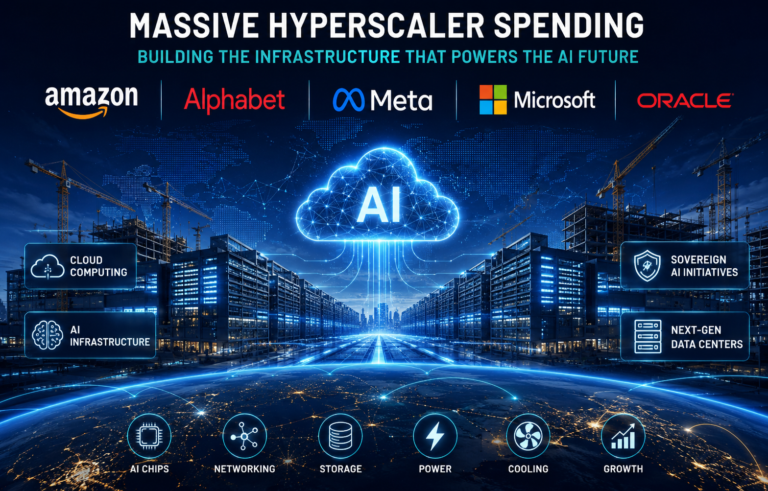
Amazon, Microsoft, Alphabet, Meta, and Oracle are investing hundreds of billions of dollars to build massive AI data centers, expand cloud computing capacity, secure advanced AI chips, and develop the energy systems needed to power increasingly complex models.
This massive AI infrastructure boom is creating opportunities across multiple industries. The biggest winners of the AI revolution may not only be the companies creating AI applications. They could also be the companies supplying the chips, networking equipment, power, cooling technology, and cloud infrastructure that make AI possible.
Why Big Tech Is Spending Billions on AI Infrastructure
Modern artificial intelligence requires enormous computing power. Training large language models and running AI applications at global scale requires thousands of advanced GPUs, high-speed networking systems, massive storage capacity, and reliable electricity.
As AI adoption accelerates across healthcare, finance, manufacturing, defense, and enterprise software, demand for computing power continues growing faster than existing infrastructure can handle.
Consequently, hyperscalers are moving beyond traditional cloud expansion. They are building specialized AI campuses designed specifically for AI training and inference workloads.
These investments support several major areas:
-
AI model development
-
Enterprise AI applications
-
Cloud computing expansion
-
Government AI projects
-
Sovereign AI infrastructure
-
Advanced data processing
The companies controlling this infrastructure could become some of the biggest beneficiaries of the AI economy.

Amazon AWS: Building the Foundation of Enterprise AI
Amazon remains one of the largest players in the AI infrastructure race through Amazon Web Services (AWS).
AWS continues expanding AI-ready data centers while developing custom silicon solutions designed to improve AI performance and reduce computing costs. The company’s AI infrastructure supports startups, enterprises, and governments that need scalable computing power.
Furthermore, Amazon’s advantage comes from its massive cloud ecosystem. Millions of businesses already rely on AWS for storage, databases, and computing services, making it easier for organizations to adopt AI tools.
As companies move more workloads into the cloud, AWS could benefit from long-term demand for AI computing capacity.
Microsoft Azure: The Enterprise AI Powerhouse
Microsoft has positioned Azure as a central platform for enterprise artificial intelligence.
Through its partnership with OpenAI and continued investment in cloud infrastructure, Microsoft is expanding its AI capabilities across businesses worldwide.
The company’s competitive advantage comes from its existing enterprise ecosystem. Organizations already using Microsoft products can integrate AI tools more easily, creating stronger demand for Azure services.
Additionally, Microsoft continues investing in AI data centers, networking infrastructure, and advanced computing systems to support future AI workloads.
Alphabet: Strengthening Google Cloud and AI Capabilities
Alphabet is another major force in the AI infrastructure boom.
Google has operated one of the world’s most advanced computing networks for years. However, the rapid growth of AI requires even more powerful infrastructure.
The company continues developing custom Tensor Processing Units (TPUs), expanding AI-focused data centers, and improving Google Cloud services.
Meanwhile, Google Cloud is attracting businesses that need AI solutions, cybersecurity, analytics, and machine learning capabilities.
As enterprise AI adoption grows, Google’s infrastructure investments could become increasingly valuable.
Meta’s Massive AI Infrastructure Expansion
Meta has transformed from a social media company into one of the largest AI infrastructure investors.
The company is purchasing advanced AI hardware, expanding data center capacity, and developing AI systems that support recommendations, advertising, and future AI assistants.
Meta’s focus on open AI models also requires significant computing resources. Building and operating these systems demands massive investments in GPUs, networking, and energy.
Therefore, Meta’s AI strategy depends heavily on expanding its infrastructure capabilities.
Oracle Becomes a Rising AI Infrastructure Player
Oracle is emerging as a major beneficiary of enterprise AI demand.
Historically known for database technology, Oracle is now expanding its cloud infrastructure to support AI workloads requiring high-performance computing.
The company’s cloud services are attracting organizations that need powerful AI training and inference capabilities.
As enterprises search for alternatives and additional computing capacity, Oracle could capture a larger role in the growing AI infrastructure market.
The Hidden AI Bottleneck: Electricity and Energy
Although AI discussions often focus on chips and software, the biggest challenge may become electricity.
AI data centers consume enormous amounts of power. As hyperscalers build larger facilities, they need reliable energy sources to keep operations running.
This creates opportunities beyond technology companies.
Energy producers, nuclear power companies, grid infrastructure providers, and cooling technology firms are becoming important parts of the AI ecosystem.
The future AI race may not only depend on who builds the smartest models. It may depend on who can secure enough electricity to run them.
AI Infrastructure Companies That Could Benefit
The AI infrastructure boom is creating opportunities across several industries.
NVIDIA remains a critical supplier of AI GPUs that power many hyperscaler data centers.
Broadcom benefits from demand for custom AI accelerators and advanced networking solutions.
Micron Technology could benefit from rising demand for memory chips required by AI systems.
Vertiv provides cooling and power management solutions needed for high-density AI data centers.
Eaton benefits from increased demand for electrical infrastructure supporting data center expansion.
Constellation Energy and other power providers could benefit as technology companies search for reliable energy sources.
These companies represent the broader ecosystem supporting artificial intelligence.
Sovereign AI Creates a New Global Competition
Another major driver behind hyperscaler spending is the rise of sovereign AI.
Governments around the world increasingly want domestic AI capabilities to protect sensitive data, strengthen national security, and reduce dependence on foreign technology.
As a result, countries are investing in local AI data centers, cloud infrastructure, and semiconductor supply chains.
This trend could accelerate demand for AI infrastructure across North America, Europe, Asia, and the Middle East.
Challenges Facing the AI Infrastructure Boom
Despite the enormous opportunity, the AI infrastructure race faces several challenges.
First, supply chain constraints could slow the deployment of advanced AI hardware. Second, rising energy demand may create pressure on electricity networks. Third, governments are introducing new regulations around AI security, privacy, and competition.
Investors are also watching whether massive AI spending will generate enough long-term revenue growth.
However, most industry leaders believe AI adoption will continue expanding throughout the decade.

Why Michael Burry Is Watching AI Spending
Meanwhile, investor attention is shifting toward the massive spending powering artificial intelligence. While many investors focus on AI software and popular applications, others are questioning whether today’s record infrastructure investments will generate lasting returns.
Famous investor Michael Burry has warned about excessive optimism during major technology cycles. His perspective raises an important question for the AI infrastructure boom: will these unprecedented investments create sustainable value, or are some companies expanding too quickly ahead of real demand?
Ultimately, execution will separate the winners from the losers. Companies building essential AI infrastructure — including chips, data centers, energy systems, and cloud platforms — could benefit significantly, while companies spending aggressively without strong returns may face investor pressure.
As a result, investors must look beyond the AI hype and identify the companies creating the foundation of the future AI economy.
Final Thoughts
The AI revolution is becoming more than a software race. It is becoming an industrial transformation built on chips, cloud computing, energy, and infrastructure.
The companies creating AI applications may receive the most attention, but the companies building the foundation underneath them could capture some of the greatest opportunities.
The AI infrastructure boom represents a once-in-a-generation investment cycle. As Amazon, Microsoft, Alphabet, Meta, and Oracle continue their massive infrastructure expansion, the future winners of artificial intelligence may be the companies powering the machines behind the intelligence.