

Stay Updated
Why Invest? The Biggest Investment Opportunities Shaping 2026 and Beyond
Investing is no longer simply about choosing between stocks, bonds, or funds. Some of the biggest investment opportunities are emerging from enormous changes in artificial intelligence, semiconductors, energy, space, robotics, biotechnology, cybersecurity and digital infrastructure.
The challenge is identifying where the money is going before a trend becomes obvious.
A technology breakthrough can create opportunities far beyond the company developing the technology. AI, for example, requires processors, high-bandwidth memory, storage, networking equipment, cloud computing, data centers and enormous amounts of electricity.
That means investors can potentially find opportunities throughout an entire economic ecosystem rather than focusing only on the company receiving the headlines.
This guide explores the major investment themes shaping 2026, the infrastructure behind them, the forces that move stocks and the emerging industries that could influence markets for years to come.
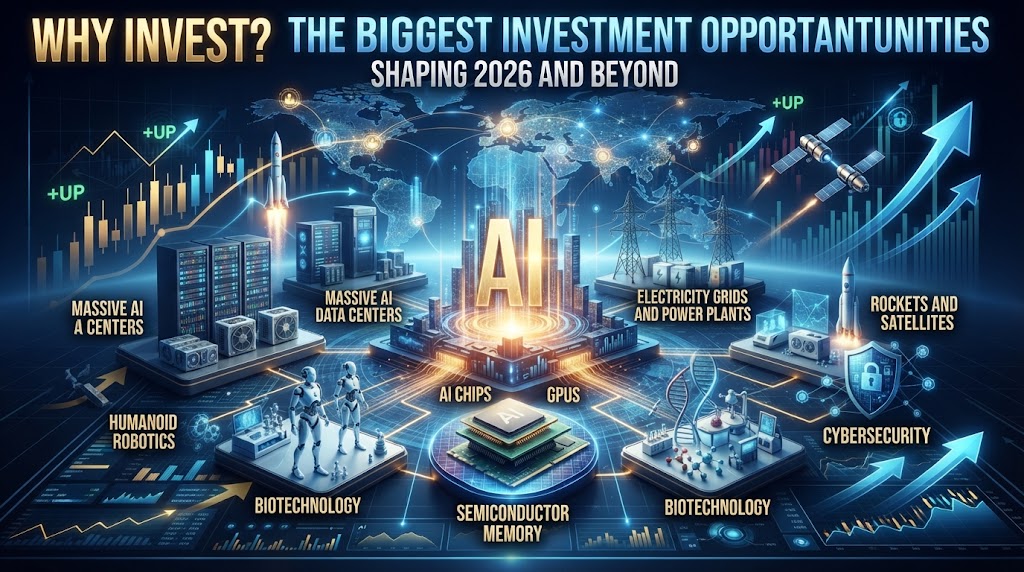
The Investment Themes Getting the Most Attention in 2026
🤖 Artificial Intelligence
Artificial intelligence remains one of the most important technology and investment themes of 2026.
The AI boom extends far beyond companies developing AI models. Building and operating increasingly sophisticated AI systems requires an enormous infrastructure ecosystem.
That ecosystem includes:
AI accelerators
GPUs and other processors
High-bandwidth memory
Advanced storage
Networking equipment
Data centers
Cloud computing
Cooling systems
Electricity generation
Power transmission
This creates multiple potential layers of investment exposure.
Companies such as NVIDIA and AMD represent the computing side of the ecosystem, while memory and storage companies can benefit from the enormous amount of data and processing required by AI infrastructure.
The bigger investment story is therefore not simply “AI stocks.”
It is the entire infrastructure required to make AI possible.
💾 Semiconductors, Memory & Storage
The AI revolution is also a semiconductor and memory revolution.
Advanced AI systems require enormous computing capacity, but processors cannot operate alone. They depend on increasingly sophisticated memory, storage and networking infrastructure.
High-bandwidth memory has become particularly important because AI accelerators need extremely fast access to data.
This creates investment interest across:
GPUs
AI accelerators
HBM
DRAM
NAND
Enterprise storage
Semiconductor manufacturing
Advanced packaging
Networking
Companies such as NVIDIA, AMD, Micron and SanDisk can therefore attract attention from investors looking for different ways to participate in the AI infrastructure cycle.
The important distinction is that AI growth can create demand for an entire supply chain, not just one company.
⚡ Powering the AI Boom
One of the most overlooked investment consequences of artificial intelligence is electricity demand.
AI data centers consume significant amounts of power, and the expansion of computing infrastructure is increasing pressure on electricity generation and transmission systems.
The investment chain can look like this:
AI models
↓
Computing infrastructure
↓
Data centers
↓
Electricity demand
↓
Power generation
↓
Transmission & grid infrastructure
This makes energy and power infrastructure an increasingly important part of the AI investment story.
Potential areas of interest include:
Nuclear energy
Utilities
Natural gas
Renewable generation
Battery storage
Transmission infrastructure
Grid modernization
Data-center power infrastructure
The AI boom therefore has implications far beyond technology stocks.
🚀 The Space Economy
Space is increasingly moving from a government-dominated industry toward a broader commercial ecosystem.
Satellite communications, launch services, Earth observation, defense technology and direct-to-device connectivity are creating new areas of investment interest.
Public companies such as Rocket Lab and AST SpaceMobile give investors exposure to different parts of the emerging commercial space ecosystem.
At the same time, private companies such as SpaceX have become major market stories despite not being publicly traded.
SpaceX is particularly important because its Starlink satellite business, launch capabilities and broader space ambitions can influence how investors think about the future of the commercial space industry.
The key point is simple:
You do not necessarily need to own the biggest private space company to benefit from the growth of the space economy.
Public suppliers, launch companies, satellite operators and communications businesses can also participate in the broader trend.
🦾 Robotics & Automation
Artificial intelligence is increasingly moving from software into the physical world.
Robotics and automation could transform:
Manufacturing
Warehousing
Logistics
Agriculture
Transportation
Healthcare
Defense
Construction
The combination of AI, sensors, machine vision and robotics could allow machines to perform increasingly complex tasks.
Investors therefore have several potential areas to watch, including industrial automation, robotics hardware, sensors, AI software and companies supplying automated infrastructure.
🧬 Biotechnology & Healthcare
Biotechnology remains another major long-term investment theme.
Advances in precision medicine, personalized therapies, diagnostics, genetic technologies and drug development could transform healthcare.
Potential areas include:
Personalized medicine
Cancer therapies
Gene-based technologies
mRNA platforms
Diagnostics
Digital health
AI-assisted drug discovery
Biotechnology can also behave very differently from technology stocks because clinical results, regulatory decisions and product approvals can create powerful catalysts.
🔐 Cybersecurity & Data Privacy
The more businesses depend on cloud computing, AI and connected systems, the more important cybersecurity becomes.
Companies increasingly need to protect:
Customer information
Financial data
Cloud infrastructure
Corporate networks
AI systems
Digital identities
Connected devices
This creates long-term demand for cybersecurity software, identity management, threat detection and secure cloud infrastructure.
Cybersecurity is therefore not simply a technology trend.
It is becoming an essential part of the digital economy.
💡 The Investment Chain Most Investors Miss
One of the biggest mistakes investors can make is focusing only on the company receiving the headlines.
Major technology trends often create entire ecosystems.
Consider artificial intelligence:
AI Models
↓
GPUs & AI Accelerators
↓
High-Bandwidth Memory
↓
Storage
↓
Networking
↓
Data Centers
↓
Cooling
↓
Electricity
↓
Power Generation
↓
Grid Infrastructure
The same concept can apply to other industries.
A space boom creates demand for satellites, launch services, communications equipment and ground infrastructure.
A robotics boom creates demand for sensors, chips, software, automation equipment and industrial systems.
A cybersecurity boom creates demand for cloud security, identity management and threat detection.
This is the investment-chain effect.
A major trend can create opportunities throughout the supply chain rather than only at its center.
📈 The Megatrends That Could Shape the Next Decade
Investors looking beyond individual stocks can also track broader structural themes.
Artificial Intelligence & Automation
AI adoption could affect enterprise software, robotics, data centers, semiconductors and business processes.
Energy & Power Infrastructure
Growing electricity demand, data centers, grid modernization and changing energy systems could support investment across multiple energy segments.
Healthcare & Biotechnology
Precision medicine, advanced therapies and biotechnology platforms could reshape healthcare.
Financial Technology
Digital payments, financial automation, blockchain infrastructure and AI-powered financial services continue to evolve.
Infrastructure & Smart Cities
Modern communications networks, data infrastructure, transportation systems and smart-city technologies could require substantial investment.
Cybersecurity
Increasing digital dependence creates continuing demand for security and identity solutions.
Space & Advanced Manufacturing
Satellite networks, commercial launch services, autonomous systems and advanced manufacturing could become increasingly important parts of the global economy.
AI Boom or AI Bubble?
The AI investment cycle has generated enormous enthusiasm, but enthusiasm also creates an important question:
How much future growth is already reflected in stock prices?
Investor concern about excessive AI valuations has become an important part of the market debate, including warnings from prominent investors such as Michael Burry.
The debate is not simply whether AI will succeed.
AI adoption can continue growing while individual AI stocks still decline.
Why?
Because stock prices reflect expectations about future earnings, not simply whether a technology is useful.
A company can report strong growth and still see its stock fall if investors expected even stronger results.
This is why investors need to separate:
Great technology
from
Great business
and from
Great stock at the current valuation.
Those three things are not always the same.
What Makes a Stock Suddenly Explode?
Stocks can move dramatically when several forces collide.
Earnings Surprise
Results significantly above or below expectations can rapidly change investor sentiment.
Major Contract
A large customer agreement can change expectations about future revenue.
New Technology
A major product or technological breakthrough can change how investors value a company.
Analyst Upgrades
Changes in analyst expectations can influence institutional and retail investors.
Short Squeeze
A sharp rise can force short sellers to close positions, adding buying pressure.
Institutional Buying
Large investors entering a stock can increase demand and change market positioning.
Retail Momentum
Social-media attention can bring thousands of additional investors into a stock.
The most powerful moves can happen when several of these catalysts occur at the same time.
📊 From Unknown to Viral Stock
A stock does not usually become a market sensation overnight.
Many stocks follow an attention cycle:
Unknown
↓
Early Discovery
↓
Growing Investor Interest
↓
Catalyst
↓
Social-Media Buzz
↓
Viral Attention
↓
Heavy Trading
↓
Mainstream Coverage
↓
Crowded Trade
↓
Correction or Consolidation
↓
Rediscovery
This cycle helps explain why some stocks suddenly dominate Stocktwits, Reddit, X and other investor communities.
But popularity does not guarantee investment success.
A stock can become viral because of genuine fundamental improvement, speculation, short interest, momentum or a combination of several factors.
💰 Follow the Money
Markets also move through periods of capital rotation.
Investors may shift money between sectors depending on economic conditions, valuations, interest rates, earnings expectations and new opportunities.
For example, a technology cycle can create demand for:
AI
↓
Semiconductors
↓
Memory
↓
Data Centers
↓
Energy
That does not mean every company in every sector will rise.
Instead, it demonstrates how a major investment theme can spread through an economic ecosystem.
Following these connections can reveal opportunities that are not immediately obvious from the day’s biggest headline.
🏦 How Major Asset Managers Approach Long-Term Trends
Large investment managers also provide an important window into broader market themes.
BlackRock: Industries & Strategies
BlackRock has developed significant exposure and expertise across areas including:
Private markets
Infrastructure
Private credit
Technology
Data
AI infrastructure
Energy transition
Global markets
Its broader strategy reflects the increasing importance of alternative assets, infrastructure and long-term structural trends.
However, investors should distinguish between an asset manager identifying a long-term theme and an individual stock representing a good investment opportunity.
Institutional strategies are not automatically applicable to individual portfolios.
Vanguard: Industries & Strategies
Vanguard is widely associated with low-cost investing, diversification and long-term portfolio construction.
Its broader investment approach includes:
Global diversification
Asset allocation
Equity and fixed-income exposure
Low-cost investment products
Active and passive strategies
Technology-enabled investment services
Vanguard’s approach highlights an important lesson:
Investing does not always mean chasing the fastest-growing stock.
Diversification, costs, time horizon and risk management can be just as important as identifying a high-growth opportunity.
🌎 Public Stocks vs. Private Giants
Some of the world’s most closely watched technology companies are not publicly traded.
🚀 SpaceX
SpaceX has become one of the world’s most closely followed private technology and space companies.
Its Starlink satellite network and launch business have helped make it an important company to watch even for investors who cannot directly purchase its shares through a public stock exchange.
🤖 OpenAI
OpenAI’s development of advanced AI systems has major implications for the broader AI ecosystem, including chips, cloud infrastructure and data centers.
🧠 Anthropic
Anthropic is another major private AI company whose technology partnerships and computing requirements contribute to the broader AI infrastructure economy.
🚀 xAI
xAI represents another major private AI company and contributes to the increasingly competitive race to develop and deploy advanced AI systems.
Private companies can therefore influence public markets even before they conduct an IPO.
⚠️ Why a Great Company Can Still Be a Bad Investment
One of the most important lessons in investing is that company quality and stock valuation are different things.
A company can have:
Excellent technology
Strong revenue growth
A huge market opportunity
Powerful products
Excellent management
and still be a poor investment if investors have already priced in unrealistic future growth.
Investors therefore need to consider both:
What could go right?
and
What is already reflected in the stock price?
🔎 What Investors Should Watch Before Buying a Stock
A useful framework is:
Growth
Is revenue and earnings growth accelerating, slowing or remaining stable?
Market Opportunity
How large could the company’s addressable market become?
Competitive Advantage
Does the company have technology, scale, patents, distribution or another advantage?
Financial Strength
Does the company generate cash? How much debt does it carry?
Valuation
How much future growth is already reflected in the current stock price?
Catalyst
What could cause investors to change their expectations?
Sentiment
Are investors becoming more optimistic or pessimistic?
Risk
What could cause the investment thesis to fail?
The Future Is Bigger Than the Next Hot Stock
The biggest investment opportunities are not always found by searching for the stock that is already trending.
Sometimes the opportunity lies one step earlier.
A new technology creates demand.
That demand creates infrastructure.
Infrastructure creates suppliers.
Suppliers create new markets.
And new markets create new investment opportunities.
That is why investors increasingly need to look beyond individual companies and understand the entire ecosystem behind a major trend.
Artificial intelligence is not just about AI companies.
It is about chips, memory, storage, networking, cloud computing, data centers and electricity.
The space economy is not just about rockets.
It is about satellites, communications, launch infrastructure, software and defense technology.
The robotics industry is not just about robots.
It is about sensors, chips, AI software, manufacturing and automation.
The most interesting investment opportunities can emerge where these industries intersect.
📌 Why Invest?
Investing provides a way to participate in the growth of businesses and industries that could shape the future.
But successful investing is not simply about finding the next stock that goes viral.
It is about understanding:
Where technology is going.
Where capital is moving.
Which industries are expanding.
Which companies are building the infrastructure.
Which catalysts can change expectations.
And how much optimism is already reflected in a stock’s price.
The goal is not to predict the future perfectly.
The goal is to understand the forces shaping it.
Follow the technology. Follow the infrastructure. Follow the capital. Then evaluate the companies competing for the opportunity.
This page is for educational and informational purposes only and is not investment advice. Stocks and other investments involve risk, including the potential loss of capital. Investors should conduct their own research and consider their individual financial circumstances before making investment decisions.