

Stay Updated
The 2026 Tech Meltdown: Why Apple is Raising Prices
The global technology sector is entering a decisive turning point driven by an ongoing chip shortage. Many analysts now describe this shift as the 2026 Tech Meltdown: Why Apple Is Raising Prices and 4 AI Stocks Could Surge, where rising costs, strained supply chains, and explosive AI demand are reshaping the entire industry. Pressure across semiconductor manufacturing continues to build, accelerating price increases and global supply constraints.
At the center of this transformation is a structural supply challenge that no longer resembles a temporary disruption. Semiconductor factories are operating near full capacity, while demand for AI infrastructure, cloud computing, and high-performance systems continues to outpace supply. As a result, pricing power is shifting away from consumer technology companies and moving toward semiconductor manufacturers and infrastructure providers.
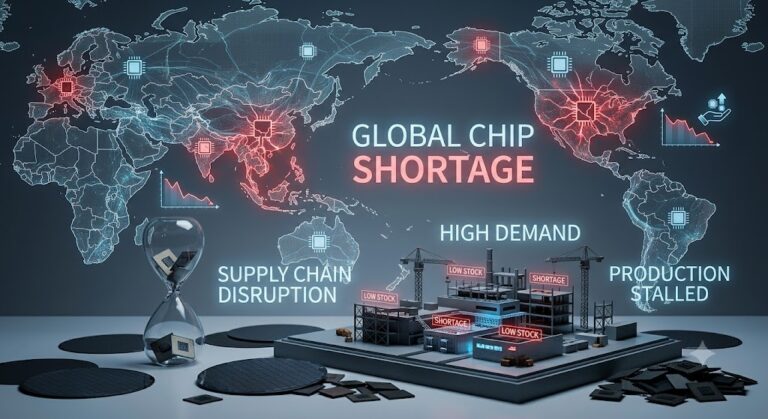
The New Reality of the Chip Shortage
The current chip shortage is fundamentally different from past cycles. In previous disruptions, production delays and logistics bottlenecks created temporary shortages. Today, the issue is demand-driven.
Artificial intelligence systems require massive amounts of computing power, advanced memory chips, and high-bandwidth components. This demand has absorbed a large portion of global semiconductor capacity, leaving limited supply for consumer electronics.
Instead of easing, the pressure is intensifying. Companies are now competing not just for chips, but for manufacturing slots at leading foundries and memory producers.
Why Apple Is Raising Prices
Apple has begun adjusting prices across select Mac and iPad models, citing rising component costs linked to the ongoing chip shortage. Entry-level devices have seen modest increases, while high-end configurations are experiencing more noticeable price adjustments.
Other major hardware manufacturers are also facing similar pressures. Dell has quietly increased pricing on performance laptops, while several EV manufacturers are warning of tighter margins due to semiconductor constraints.
As input costs rise, companies face a choice: absorb the losses or pass them on to consumers. Increasingly, the industry is choosing the latter.

How the 2026 Tech Meltdown Is Reshaping the Market
The situation many investors refer to as the 2026 Tech Meltdown: Why Apple Is Raising Prices and 4 AI Stocks Could Surge reflects a deeper shift in market structure.
Instead of rewarding consumer-facing brands, the market is increasingly favoring companies that control the upstream supply chain. These include memory producers, foundries, and semiconductor equipment manufacturers.
In this environment, pricing power has become the most important competitive advantage.

Micron Technology: The Memory Powerhouse
Micron Technology sits at the center of the memory chip market, particularly in high-bandwidth memory (HBM), which is essential for AI workloads.
As AI data centers expand rapidly, demand for advanced memory has surged. This has tightened supply across the industry and pushed pricing higher.
Micron benefits directly from this imbalance. Its production capacity for high-end memory is increasingly allocated to long-term contracts with large technology companies, giving it greater revenue visibility and stronger margins during the ongoing chip shortage.
TSMC: The Gatekeeper of Advanced Chips
Taiwan Semiconductor Manufacturing Company (TSMC) plays a critical role in the global semiconductor ecosystem.
It manufactures the most advanced chips used by companies like NVIDIA, AMD, and Apple. With cutting-edge fabrication facilities operating near full capacity, TSMC effectively controls access to next-generation chip production.
In a prolonged chip shortage, this position becomes even more valuable. Companies competing for limited manufacturing capacity must accept pricing structures set by TSMC, reinforcing its dominant role in the supply chain.
ASML: The Equipment Monopoly Behind AI Chips
ASML is the only company in the world that produces extreme ultraviolet (EUV) lithography machines, which are required to manufacture advanced semiconductors.
Every major chip expansion project depends on ASML’s equipment. As global governments and corporations invest heavily in new fabrication plants, demand for ASML systems continues to rise.
Because of long production cycles and high complexity, ASML operates with a significant order backlog. This positions the company as a long-term beneficiary of the structural chip shortage and the global push to expand semiconductor capacity.
NVIDIA: The AI Compute Leader
NVIDIA remains the dominant force in artificial intelligence hardware. Its GPUs power most large-scale AI models and data center infrastructure.
Despite rising costs across the semiconductor supply chain, NVIDIA maintains strong pricing power due to overwhelming demand for AI computing capacity.
Its CUDA software ecosystem further strengthens its position by locking developers and enterprises into its platform. This combination of hardware and software dominance allows NVIDIA to continue scaling even under tight supply conditions created by the ongoing chip shortage.
Why Upstream Companies Are Winning
The chip shortage has created a clear divide in the technology sector:
- Consumer hardware companies face rising costs and tighter margins
- Semiconductor manufacturers gain pricing power and stronger demand
- Equipment suppliers benefit from long-term infrastructure expansion
- AI infrastructure leaders capture premium enterprise spending
In this environment, capital is increasingly flowing toward companies that control bottlenecks rather than those exposed to end-consumer pricing pressure.
Investor Takeaway
The current phase of the chip shortage is not a short-term disruption. It represents a structural realignment of the global technology supply chain.
While consumer electronics companies adjust prices to protect margins, semiconductor leaders and AI infrastructure firms are strengthening their competitive positions.
Whether investors call it a supply shock or the 2026 Tech Meltdown: Why Apple Is Raising Prices and 4 AI Stocks Could Surge, the direction of capital is becoming clear: control of chips now equals control of growth.
As this cycle continues, the companies that manufacture, design, and enable advanced computing infrastructure are likely to remain at the center of market attention.