
SK hynix and SanDisk Just Changed AI Memory. What It Means for SNDK Stock
SanDisk AI memory is suddenly becoming one of the most intriguing stories in the AI infrastructure race. SanDisk and SK hynix have made a major move that could put a new spotlight on the memory industry, just as investors search for the next companies capable of benefiting from the massive spending behind artificial intelligence. With SanDisk stock already attracting attention, the latest development gives Wall Street another reason to scrutinize where the company could be heading next.
The bigger question is whether SanDisk can turn its growing role in AI memory into a lasting competitive advantage. The battle is heating up across the industry, with Micron stock price also closely watched as investors compare the major memory players competing for AI-driven demand. Meanwhile, SanDisk’s upcoming August 13 Investor Day could provide another major clue about management’s strategy, making the next few days particularly important for investors watching SNDK.
SanDisk AI Memory Targets a Growing AI Problem
AI systems need enormous amounts of data. However, moving that data quickly between storage and processors has become a major challenge.
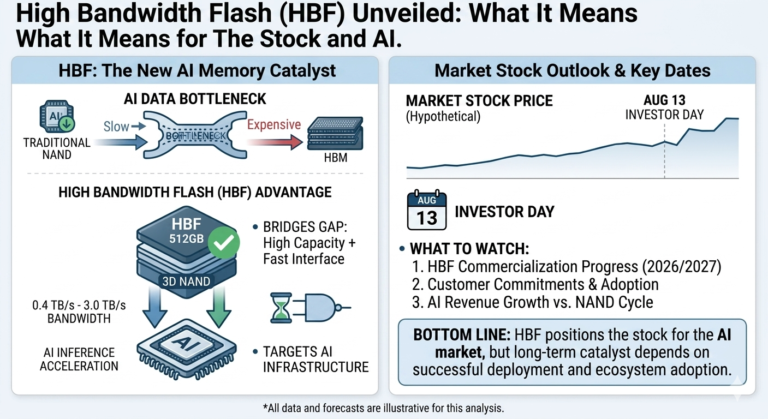
High Bandwidth Memory (HBM) currently plays a critical role in advanced AI systems because it delivers extremely high bandwidth. Yet HBM remains expensive and relatively limited in capacity. Traditional NAND flash offers much greater capacity at a lower cost, but it has historically delivered lower bandwidth.
SanDisk AI memory aims to bridge that gap.
SanDisk and SK hynix designed High Bandwidth Flash to combine high-capacity 3D NAND with a much faster interface. The initial HBF specification supports capacities of up to 512GB per stack and bandwidth ranging from roughly 0.4 TB/s to 3.0 TB/s.
Therefore, HBF could become particularly useful for AI inference. As companies deploy more AI applications, data centers need faster access to increasingly large datasets.
Why SK hynix Matters to SanDisk AI Memory
This is not a SanDisk-only technology story.
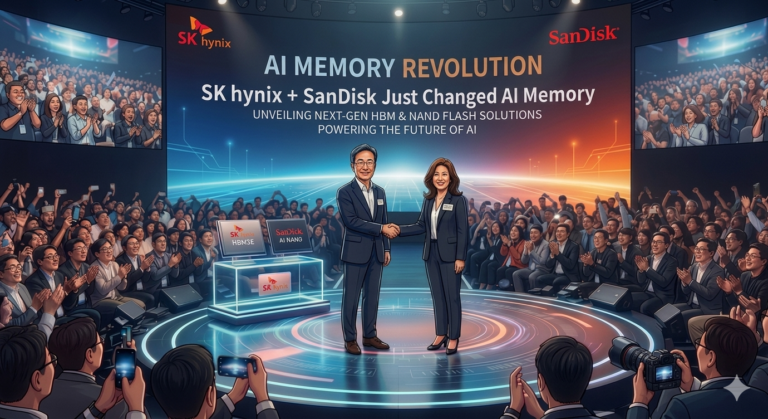
Instead, SK hynix and SanDisk are working together to establish HBF as a new memory category. The companies released the specification through the Open Compute Project, while other technology companies are participating in the broader ecosystem.
That matters because a new memory standard needs more than impressive specifications. It needs hardware compatibility, industry support and eventually major customers.
SK hynix also brings significant credibility to the SanDisk AI memory opportunity. The company already ranks among the world’s major suppliers of advanced memory used in AI infrastructure.
Meanwhile, the SK hynix US listing has increased the company’s visibility among U.S. investors and could make its AI-memory strategy easier for American markets to track.
The AI Infrastructure Race Is Getting Bigger
The timing of the HBF announcement is important.
AI infrastructure spending continues to expand as technology companies build larger and more powerful data centers. Nvidia GPUs remain central to that investment. However, GPUs represent only one part of the AI infrastructure equation.
Memory, storage, networking and power also determine how efficiently an AI data center operates.
That is where SanDisk AI memory could eventually become important.
HBF could provide AI systems with a larger and potentially more cost-effective memory tier. In turn, data centers could keep more information closer to AI processors while reducing pressure on existing memory architectures.
For SanDisk, that creates an opportunity to move deeper into the AI infrastructure market.
What Does SanDisk AI Memory Mean for SanDisk Stock?
The biggest question for investors is simple: Can SanDisk turn HBF into a meaningful business?
The SanDisk stock story now has another potential long-term catalyst. SanDisk already operates in the NAND and storage markets. Now, the company is attempting to position that technology for one of the fastest-growing areas of the semiconductor industry.
However, investors should not expect HBF to immediately boost earnings.
The technology remains in an early development stage. Industry reports indicate that sampling could begin later in 2026, while broader commercialization could take place in 2027 or beyond.
Therefore, investors will likely watch several milestones before assigning significant value to HBF. Those milestones include product sampling, new ecosystem participants, customer commitments and eventual deployment inside AI data centers.
SanDisk CEO Signals a More Strategic Market
The HBF announcement comes as SanDisk’s management describes a changing memory market.
According to Yahoo Finance coverage, SanDisk CEO David Goeckeler said the company’s largest customers are no longer focusing as heavily on pricing and are instead treating the business as “highly strategic.” That suggests major customers increasingly view reliable memory supply as an important part of their long-term infrastructure planning.
That shift could matter for SanDisk stock.
If AI data centers continue to demand enormous quantities of memory, large customers may place greater value on long-term supply relationships and technological capabilities.
The comments also provide context for the broader SNDK financial results and outlook. Investors are watching not only quarterly revenue and margins but also whether SanDisk can capture a larger share of AI-related memory demand.
August 13 Could Be the Next SanDisk Stock Catalyst
The August 13 catalyst could give investors another important look at where SanDisk is heading.
SanDisk has scheduled its 2026 Investor Day for August 13 at 9:00 a.m. ET. CEO David Goeckeler, CFO Luis Visoso and other members of the leadership team are expected to discuss the state of the business and the company’s outlook going forward.
The timing is especially interesting because SanDisk reported its fiscal 2026 fourth-quarter and full-year results on August 5. The Investor Day therefore gives management another opportunity to explain the company’s longer-term strategy after investors digest the latest financial results.
Investors will likely pay close attention to commentary around AI demand, NAND pricing, customer commitments, margins and long-term growth.
Most importantly, the event could provide additional context for the SNDK financial results and outlook and help investors understand how management sees the opportunity from next-generation memory technologies.
The event does not guarantee a move in SanDisk stock. Nevertheless, with HBF generating fresh attention, August 13 gives investors another potentially significant catalyst to watch.

Could SanDisk Become a Bigger AI Memory Stock?
This is where the story becomes particularly interesting.
Investors have traditionally viewed SanDisk primarily as a NAND flash and storage company. The AI boom, however, is changing how the market views memory manufacturers.
If SanDisk AI memory gains meaningful adoption, SanDisk could capture a new source of AI-related demand.
Importantly, HBF does not need to replace HBM to succeed. Instead, it could complement HBM by providing another high-capacity memory layer for demanding AI workloads.
That distinction could make the technology attractive to data-center operators looking for ways to balance performance, capacity and cost.
What About Micron Stock?
There is another important point for investors comparing AI memory companies.
Micron stock price remains closely watched because Micron is a major player in the broader AI memory market, particularly through HBM and other advanced memory technologies.
However, Micron is not currently part of the SK hynix-SanDisk HBF initiative. Its involvement in AI memory should therefore not be confused with participation in this specific HBF standard.
For investors researching SanDisk stock, the distinction is important. SanDisk and SK hynix are attempting to establish an early position in a new memory category, while Micron remains a major competitor in other parts of the AI memory market.
David Goeckeler SanDisk 2026 Forecast: What Investors Should Watch
Search interest around David Goeckeler SanDisk 2026 forecast reflects the market’s growing focus on SanDisk’s future AI opportunity.
However, investors should distinguish management commentary from an actual stock-price forecast.
Goeckeler’s comments about strategic customers provide insight into SanDisk’s business environment, but they do not guarantee where SNDK shares will trade in 2026.
Instead, investors should watch the company’s financial performance, NAND pricing, AI-related demand and progress toward HBF commercialization.
The August 13 Investor Day could also give investors additional information about management’s longer-term expectations. If executives provide stronger visibility into AI-driven demand or next-generation memory opportunities, the event could become an important piece of the SanDisk stock story.
The Risks for SNDK Stock
Despite the excitement around SanDisk AI memory, investors should consider several risks.
First, HBF must move from a technical specification to commercially available products. Second, major AI hardware and cloud companies must adopt the technology. Finally, competing memory architectures could limit HBF’s eventual market share.
SanDisk also remains exposed to the normal cycles of the NAND industry. Memory prices can rise and fall sharply as supply and demand change.
Therefore, investors should view HBF as a potential long-term catalyst rather than a guaranteed source of near-term revenue.
The Bottom Line for SNDK Stock
The SanDisk AI memory story goes beyond one technology announcement.
SK hynix and SanDisk are attempting to establish a new memory category that could help AI systems handle increasingly demanding workloads. If HBF gains widespread adoption, SanDisk could gain a much larger role in AI infrastructure.
For SanDisk stock, that creates an intriguing long-term opportunity.
At the same time, investors need to watch the company’s financial performance and the broader memory cycle. HBF will take time to commercialize, and competition across AI memory remains intense.
The August 13 Investor Day now gives the market another key date to watch. Management’s commentary could provide more clarity on SanDisk’s long-term strategy, AI demand and growth opportunities.
Ultimately, SanDisk AI memory gives investors another reason to watch SNDK as the AI infrastructure race expands. The technology is still early, but the potential market is large—and SanDisk is positioning itself to compete for a piece of it.