

SpaceX Rocket Crashes on the Moon as Elon Musk Faces New Investor Questions
The SpaceX rocket crashes on the Moon story has added a surprising new chapter to the company’s increasingly ambitious space operations. A spent Falcon 9 upper stage that had been traveling through space since its original mission eventually collided with the lunar surface, attracting attention to SpaceX, lunar exploration and the growing amount of hardware moving beyond Earth.
The incident comes as SpaceX continues expanding its Falcon 9 launch operations, Starlink satellite network and long-term plans for the Moon and Mars. At the same time, investors continue watching Elon Musk’s companies closely, particularly as private-market interest in SpaceX grows.
The lunar collision was not a failed Starship launch or a malfunction involving an active SpaceX mission. Instead, it involved an older Falcon 9 upper stage that had completed its original mission before continuing along a trajectory that eventually brought it into contact with the Moon.
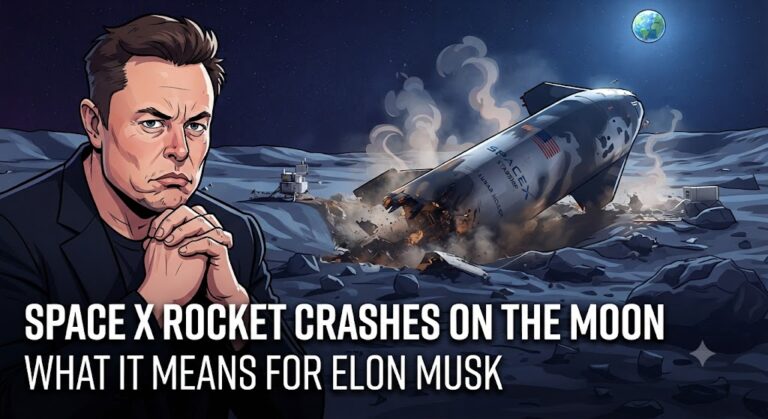
SpaceX rocket crashes on the Moon: A Falcon 9 Rocket Stage Hits the Moon
The SpaceX rocket crashes on the Moon event involved the upper stage of a Falcon 9 launched in January 2025. The rocket carried spacecraft toward the Moon before completing its primary mission.
The upper stage was not recovered and remained on a trajectory through the Earth-Moon system. Astronomers subsequently tracked the object’s movement and determined that it would eventually collide with the lunar surface.
The impact occurred on August 5, 2026.
Although the event sounds dramatic, it did not pose a danger to Earth. The Moon has no atmosphere capable of slowing an incoming object, and impacts from asteroids and other debris occur naturally across its surface.
Scientists were interested in the event because an artificial object of this size hitting the Moon provides an opportunity to study lunar material and the physical effects of a high-speed impact.
The resulting crater could provide researchers with another example of how objects behave when they strike the lunar surface.
SpaceX rocket crashes on the Moon: Why the SpaceX Crash Is Different From a Launch Failure
The distinction between a lunar impact and a launch failure is important.
Falcon 9 has become one of the world’s most frequently used orbital launch vehicles, and the rocket stage involved in the lunar collision had already completed its primary mission.
That means the event does not represent a conventional SpaceX launch failure.
Instead, it raises a different question: what should happen to rocket hardware after it finishes its mission?
That question will become increasingly important as commercial companies send more spacecraft toward the Moon.
The amount of human-made hardware operating in cislunar space is expected to increase significantly as lunar exploration expands. Future missions could involve communications satellites, cargo spacecraft, landers and eventually infrastructure supporting permanent human activity.
SpaceX rocket crashes on the Moon: Elon Musk and the SpaceX Investment Story
The incident also arrives at a time when interest in Elon Musk’s space company remains exceptionally high.
You may have heard talk about an Elon Musk SpaceX stock warning following major developments involving the company. However, investors should be careful about interpreting such claims because SpaceX is privately held and does not currently have publicly traded shares.
That means investors cannot buy SpaceX stock on Nasdaq or the New York Stock Exchange in the same way they can purchase shares of Tesla or Nvidia.
Instead, SpaceX’s value is assessed through private transactions, funding activity and private-market valuations.
The company’s financial story is also much larger than one Falcon 9 upper stage. Starlink, launch services, government contracts and future spacecraft development are among the factors that influence how investors and private-market participants view SpaceX.
For that reason, the lunar impact should not automatically be interpreted as a warning about the company’s overall business.
SpaceX rocket crashes on the Moon: Starlink Keeps SpaceX in the Spotlight
While the old Falcon 9 stage was heading toward the Moon, SpaceX continued building its much larger satellite business.
A SpaceX Starlink launch California operation is part of the company’s regular launch activity, with Falcon 9 missions departing from California’s Vandenberg Space Force Base.
These launches are particularly important for Starlink because the constellation requires a steady stream of satellites to expand coverage and replace older spacecraft.
California has become an important launch location for SpaceX because Vandenberg provides trajectories suitable for a range of satellite missions.
The continued pace of Starlink launches demonstrates how different parts of SpaceX’s business operate simultaneously.
One mission can involve lunar exploration, another can deploy Starlink satellites and another can support government or commercial customers.
That scale is one of the defining characteristics of SpaceX.

What About a SpaceX Share Price?
You may also be hearing about a SpaceX share price jump following major developments involving Elon Musk’s space company.
There is an important distinction, however. SpaceX does not currently trade publicly, so there is no official SpaceX stock ticker or publicly reported daily share price that moves during regular market hours.
Private SpaceX shares can nevertheless change in value through private-market transactions. When investors place a higher valuation on the company, headlines may describe an increase in the implied value of SpaceX shares.
That is very different from a public company’s stock jumping 10% during a normal trading session.
The distinction matters because SpaceX is frequently discussed alongside Tesla due to Musk’s leadership of both companies. Tesla is publicly traded, while SpaceX remains private.
As a result, a major SpaceX announcement does not automatically produce a directly observable move in a publicly traded SpaceX stock.

Could the Moon Impact Affect SpaceX’s Valuation?
The direct financial impact of the lunar collision is likely to be limited.
SpaceX’s broader business is built around a combination of launch services, Starlink, government contracts and future space transportation technologies.
Starlink is particularly important because it gives SpaceX a business that extends beyond rocket launches.
The company has effectively combined a launch provider with a large satellite communications operation, allowing it to manufacture satellites, launch them using its own rockets and operate the resulting network.
That vertically integrated model is one of the reasons SpaceX has attracted enormous private-market interest.
A spent rocket stage eventually hitting the Moon does not fundamentally change that business model.
The Bigger Problem Is Lunar Space Traffic
The more important lesson from the incident concerns the future of lunar exploration.
As governments and private companies send more spacecraft toward the Moon, the region around Earth’s natural satellite will become increasingly crowded.
Tracking those objects will become essential.
Space agencies and commercial operators will need to know where spacecraft are located, how their trajectories are changing and where they will ultimately go after their missions end.
The Falcon 9 upper-stage collision illustrates how an object can remain relevant long after its original mission has finished.
That could lead to greater attention on spacecraft disposal plans and international coordination around lunar missions.

What Investors Should Watch
For anyone following SpaceX, the lunar collision is only one part of a much bigger story.
The company’s Starlink expansion, Falcon 9 launch cadence, future Starship development and private-market valuation are likely to remain more important to its long-term outlook.
The continued SpaceX Starlink launch California activity demonstrates that the company is still focused heavily on expanding its satellite network, while its lunar ambitions point toward an increasingly important role in future Moon missions.
Meanwhile, investors should be cautious when interpreting headlines about an Elon Musk SpaceX stock warning or a SpaceX share price jump. SpaceX’s private status means that its valuation works differently from the public stock market.
The Moon collision is therefore better understood as a fascinating spaceflight event and a warning about the future management of lunar hardware—not as evidence that SpaceX’s broader business is failing.
As humanity moves toward a more commercially active Moon, the question will no longer be simply how to get spacecraft there.
It will also be how to manage them after they arrive—and what happens when their missions are over.