

Stay Updated
Rare Earth Stocks Set to Surge as Defense Spending Rises
The global technology and defense landscape faces a singular, urgent reality in 2026: the “rare earth cliff.” As of July 2026, the international supply chain for these critical minerals—the invisible backbone of everything from guided missiles to AI servers—reaches its most precarious moment in decades. Geopolitical tensions intensify, and a strict U.S. federal mandate looms, shifting the rare earth conversation from basic commodity trading to a matter of national survival.

China’s Strategic Grip
For years, the world relied on a fragile consensus: China dominated the rare earth sector, controlling approximately 90% of global processing and magnet manufacturing. This dominance functioned as more than a simple market position; it served as a calculated strategic lever.
The volatility of this dependence peaked in late 2025 when Beijing enacted “Notice 61,” a policy that imposed strict export controls on critical minerals. Although a brief suspension provided temporary relief, that window is closing rapidly. As of July 2026, China maintains an aggressive enforcement posture, blacklisting key U.S. companies and establishing whistleblower hotlines to police the reach of its export laws. For industries relying on high-tech hardware, this represent a persistent and existential supply chain risk.
The Pentagon’s Mandate
The U.S. Department of Defense (DoD) drew a hard line in the sand to combat this vulnerability. Beginning January 1, 2027, the U.S. military will officially prohibit the use of Chinese-origin rare earth magnets in all new defense platforms. This mandate forces major defense contractors to overhaul their global supply chains, requiring strict traceability down to the mining level.
Compliance demands more than merely identifying new sources of ore. The “metallization” process—the complex metallurgical step of converting rare earth oxides into pure, magnet-grade metals—has historically remained concentrated in China. Replicating this capability in the West constitutes a massive industrial undertaking, yet the race is now underway.
North America’s Industrial Counter-Offensive
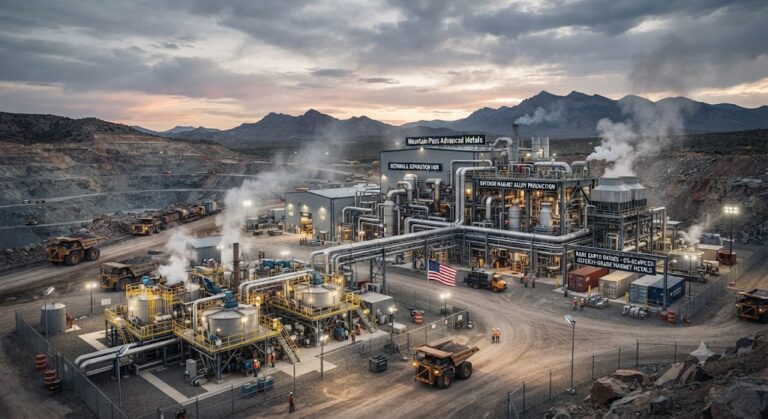
In response, a “mine-to-magnet” ecosystem emerges across North America in real-time. The U.S. and Canada successfully leverage sovereign funding and private innovation to bypass Chinese processing bottlenecks.
-
MP Materials (NYSE: MP): As the operator of the Mountain Pass mine in California, MP Materials remains the flagship of the U.S. rare earth effort. Backed by DoD supply agreements, the company expands from raw concentrate into downstream magnet manufacturing, effectively bridging the gap between raw mining and defense-ready components.
-
REalloys (ALOY): This company currently leads the defense-first effort. REalloys recently secured a contract to build a heavy rare earth processing facility at the Tooele Army Depot in Utah. This marks a significant milestone in the Pentagon’s commitment to domestication, as it is the first such facility permitted on U.S. military property.
-
Energy Fuels (NYSE: UUUU): Originally a uranium producer, Energy Fuels successfully pivoted its White Mesa Mill in Utah into a primary mid-stream processor. By achieving high-purity terbium and dysprosium production in early 2026, the company now serves as a linchpin for the U.S. domestic supply chain.
-
Canada’s Collaborative Edge: Canada plays a vital role in this renaissance. Canadian innovation, supported by groups like DIGITAL, accelerates extraction through AI-driven “surgical mining.” Additionally, firms like Ucore Rare Metals (TSXV: UCU) commercialize advanced separation technology in Louisiana, while the Nechalacho project in the Northwest Territories continues to prove that North American jurisdiction provides a critical competitive advantage for secure, stable supply.
Why the Industry Will Flourish
Beyond the immediate defense mandates, the broader rare earth industry enters a decade of sustained, multi-sector expansion. The global transition toward electrification acts as a permanent floor for demand; every electric vehicle motor and high-efficiency wind turbine relies heavily on neodymium-based permanent magnets. Simultaneously, the rapid expansion of AI data center infrastructure requires high-performance cooling systems and precision robotics—both of which depend on rare earth components. Analysts project that global demand for these minerals will more than double by 2030, outstripping current supply growth even as new mines come online. This structural supply-demand mismatch, combined with government incentives and the essential role these materials play in the “Sovereign AI” movement, ensures that rare earth producers will remain vital, high-growth pillars of the global economy well beyond the 2027 defense deadline.
Technological Breakthroughs as a Growth Catalyst
Innovation currently rewrites the economics of extraction. In 2026, companies move beyond traditional “acid bake” methods toward more efficient, environmentally friendly alternatives. Techniques like bioleaching—using specialized bacteria to solubilize rare earths—and advanced membrane separation significantly reduce the capital expenditure and environmental footprint required for processing. Furthermore, recent breakthroughs in plasma processing allow for the recovery of rare earths from complex, polymetallic ores that were previously considered waste. These technological advancements enable miners to unlock previously untapped deposits, effectively increasing the global resource base while lowering operational costs. By de-risking the “midstream” bottleneck, these innovations make North American projects commercially competitive against legacy Chinese production, further accelerating the industry’s long-term profitability.
The Investment Landscape
Investors now re-rate these companies not merely as miners, but as critical infrastructure providers. The market shows intense interest, fueled by a 2026 price surge across the rare earth complex, with elements like dysprosium and terbium seeing significant double-digit gains.
However, the sector remains volatile. Institutional capital increasingly favors “vertically integrated” players—companies that own the entire supply chain, from the earth to the magnet. The risk associated with exploration-only junior miners now weighs heavily on the market, pushing investors toward firms with active government contracts and proven processing facilities.
As the January 1, 2027, deadline approaches, the pressure on the defense industrial base will only intensify. The companies that successfully prove their “mine-to-magnet” capabilities before the end of this year will likely form the foundation of a new, secure, and sovereign supply chain. For the modern investor, the story of 2026 is no longer about finding the next “lucky” strike; it is about identifying the companies that have built the industrial plumbing necessary to keep the Western defense machine operational in a fragmented global economy.