

Stay Updated
Palantir Technologies: A Leader in Sovereign AI and Defense Infrastructure (July 2026)
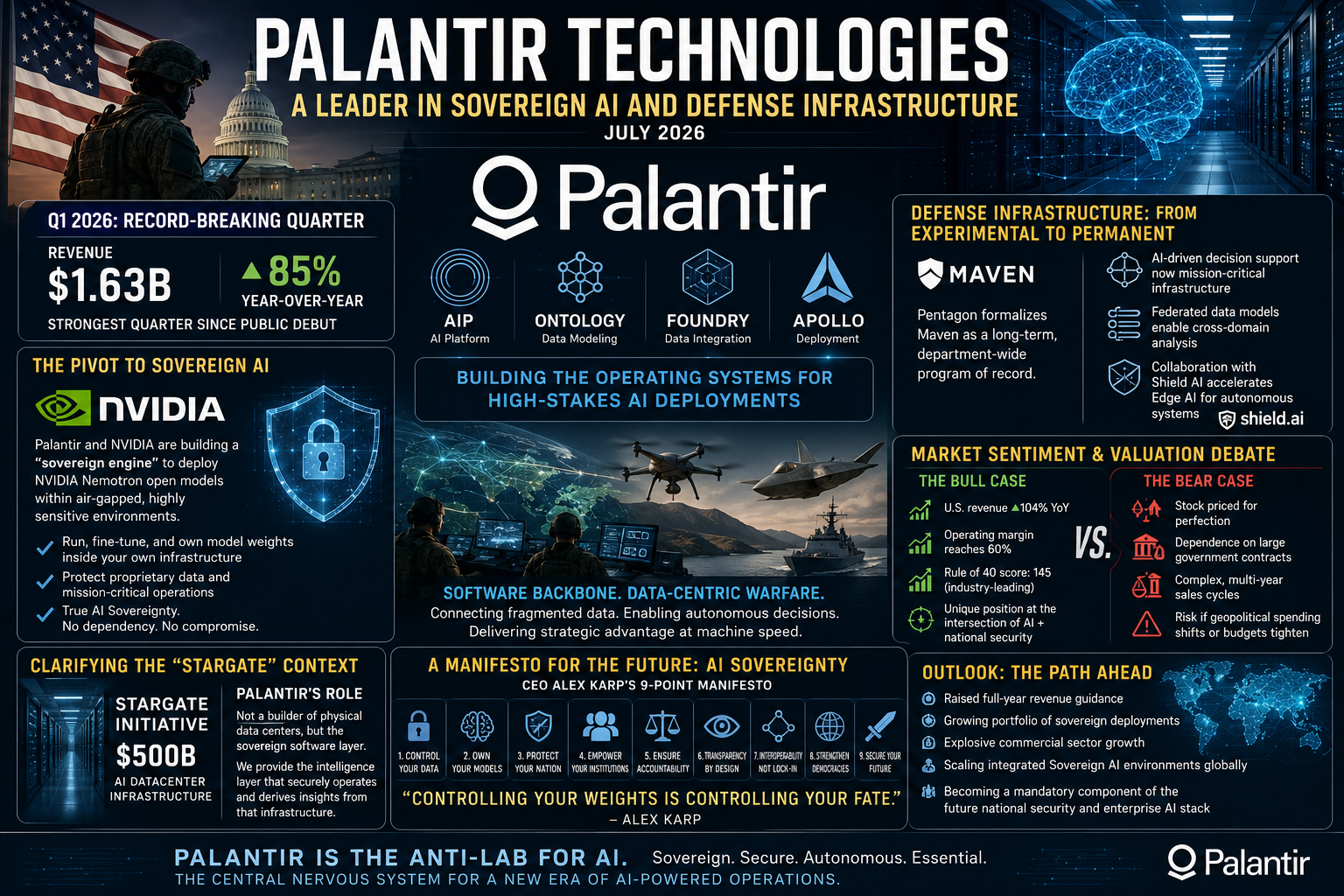
Palantir Technologies has fundamentally transformed its role in the first half of 2026, evolving from a sophisticated data analytics provider into the foundational architect of global “Sovereign AI.” With Q1 2026 revenue surging 85% year-over-year to $1.63 billion—marking its strongest quarter since its public debut—the company is proving that its core platforms (AIP, Ontology, Foundry, and Apollo) are rapidly becoming the de facto “operating systems” for high-stakes government and commercial AI deployments.
The Pivot to Sovereign AI and the NVIDIA Partnership
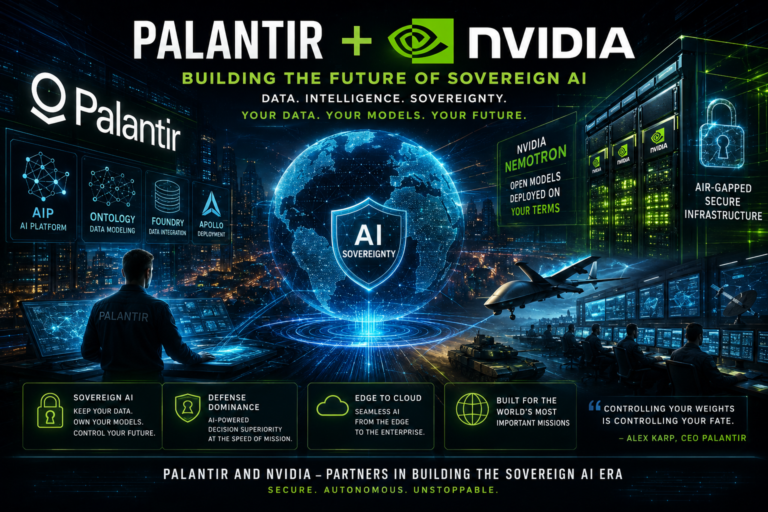
A defining milestone of mid-2026 is Palantir’s deep strategic integration with NVIDIA. Announced in late June, this partnership focuses on a new “sovereign engine” designed to deploy NVIDIA’s Nemotron open models within air-gapped, highly sensitive government and critical infrastructure environments.
This move addresses a growing enterprise anxiety: “tokenmaxxing.” As organizations grapple with the spiraling costs and data-security risks of outsourcing their intelligence to closed-source, cloud-dependent AI labs, Palantir has positioned itself as the protector of “AI Sovereignty.” By providing the infrastructure to run, fine-tune, and own the model weights of frontier-quality AI within an organization’s own walls, Palantir is effectively shifting the AI power dynamic. For U.S. government agencies, this means they can leverage state-of-the-art AI without relinquishing control of proprietary data or sensitive operational knowledge to third-party tech giants.
Defense Infrastructure: From Experimental to Permanent
Palantir’s entrenchment in the defense sector has matured significantly in 2026. The Pentagon’s recent decision to formalize the “Maven” system as a long-term, department-wide program of record signals a definitive transition. AI-driven decision support is no longer viewed as an experimental toolset; it is now permanent, mission-critical infrastructure.
Palantir acts as the “software backbone” for this shift, connecting fragmented data across the Joint Force. Its platforms allow for federated data models that sit above existing military applications, enabling cross-domain analysis without the need for risky, large-scale system replacements. Furthermore, the company’s ongoing collaboration with Shield AI—integrating autonomous drones and aircraft software—is accelerating the delivery of “Edge AI” in contested environments. By blending AI-driven analytics with autonomous hardware orchestration, Palantir is moving toward the realization of data-centric warfare, where information-processing speed is the primary strategic advantage.
Market Sentiment and the Valuation Debate
As of July 2026, Palantir’s stock remains a flashpoint for investor debate. Following its Q1 earnings beat, the company’s “Rule of 40” score reached an astounding 145, a metric that has silenced many of the earlier skeptics regarding its profitability. However, its lofty price-to-earnings multiple remains a point of contention.
The Bull Case: Long-term investors point to the company’s U.S. revenue growth (up 104% year-over-year) and its widening operating margins, which have climbed to 60%. They view Palantir as the only company capable of successfully navigating the intersection of national security and enterprise-grade AI, effectively insulating it from the “AI bubble” volatility that has hit hardware-reliant firms.
The Bear Case: Skeptics argue that the stock is “priced for perfection.” While the company’s growth is undeniable, its dependence on massive government contracts and complex, multi-year sales cycles presents a risk if geopolitical spending patterns shift or if federal procurement budgets face future tightening.
Clarifying the “Stargate” Context
In the broader AI narrative of 2026, Palantir is frequently mentioned alongside the high-profile, $500 billion “Stargate” datacenter initiative. It is essential to distinguish Palantir’s role: the company is not a primary builder of massive physical data centers. Instead, Palantir provides the sovereign software layer. As the physical infrastructure of the AI era encounters delays and skepticism, Palantir’s value proposition has actually gained clarity—it provides the intelligence layer that allows governments to securely operate and derive actionable insights from that infrastructure.
A Manifesto for the Future
In a nine-point “AI Sovereignty” manifesto published in July 2026, CEO Alex Karp laid out a combative vision for the industry. The core message is stark: “Controlling your weights is controlling your fate.” By urging institutions to retain their data and own their models, Palantir is framing its service not merely as a software purchase, but as a strategic necessity for national and organizational survival.
Outlook: The Path Ahead
Palantir enters the second half of 2026 with a clear competitive advantage: it has successfully branded itself as the “Anti-Lab” for AI. By prioritizing data integrity, security, and institutional control, the company has managed to attract the most conservative and critical customers—governments and defense departments—while simultaneously seeing explosive growth in the private commercial sector.
With raised full-year revenue guidance and a growing portfolio of “sovereign” deployments, Palantir is increasingly viewed not as a service provider, but as a mandatory component of the future national security and enterprise AI stack. For the remainder of 2026, the focus will shift to how effectively the company can scale these integrated “Sovereign AI” environments globally, further cementing its role as the central nervous system for a new era of autonomous, secure, and data-driven operations. Whether the market eventually aligns its valuation with this massive institutional footprint remains the central question for shareholders, but the strategic relevance of Palantir in the current geopolitical and technological climate has never been more pronounced.