
Stay Updated
The $26.5B SK Hynix Nasdaq Debut: The New “AI Supply Chain” King
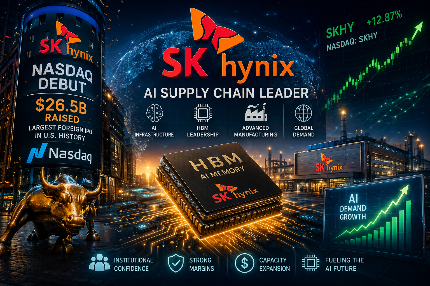
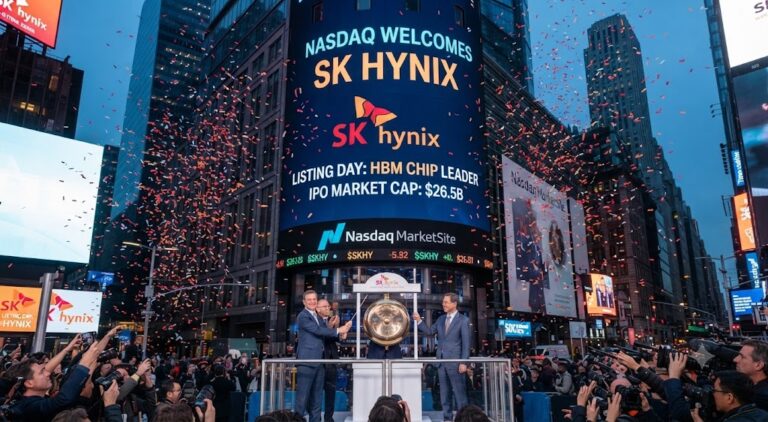
On July 10, 2026, South Korean semiconductor giant SK Hynix (SKHY) officially began trading on the U.S. stock market (Nasdaq). This landmark event raised $26.5 billion, marking the largest foreign initial public offering (IPO) in U.S. history and surpassing the record held by Alibaba since 2014. Shares surged approximately 13% on their first day of trading, signaling overwhelming investor confidence in the company’s central role within the global artificial intelligence boom.
Why This Listing Signals a Market Shift
SK Hynix’s entry into U.S. capital markets clarifies exactly how the global “AI Infrastructure” buildout is evolving. The company currently dominates the market for high-bandwidth memory (HBM), holding a massive market share of approximately 56% to 60%. These ultra-fast memory chips serve as the essential “linchpin” components thatfeed data into the high-performance processors used by AI powerhouses like Nvidia.
This listing allows SK Hynix to tap into the world’s deepest pool of capital, providing the necessary “fresh firepower” to accelerate the construction of advanced packaging plants and next-generation manufacturing facilities. Because the industry currently faces acute hardware bottlenecks, management has earmarked the capital raised in this offering specifically for expanding wafer production capacity to meet projected demand through 2030.
A High-Stakes Race Against North American Giants
This move intensifies the pressure on North American competitors, most notably Micron Technology (MU). For years, Micron has positioned itself as the “go-to” domestic supplier for the U.S. tech industry. However, with SK Hynix now directly accessible to U.S. institutional investors, the “accessibility gap” that previously protected Micron’s valuation is disappearing.
Micron is responding by aggressively expanding its fabrication plants in Idaho and Virginia and focusing on its own HBM4 development. While Nvidia currently relies on SK Hynix for the majority of its memory stacks, the chipmaker actively works to diversify its suppliers. This competition creates a high-stakes sprint between SK Hynix and Micron to capture the next generation of AI-driven memory contracts.
The Pivot to “AI Infrastructure”
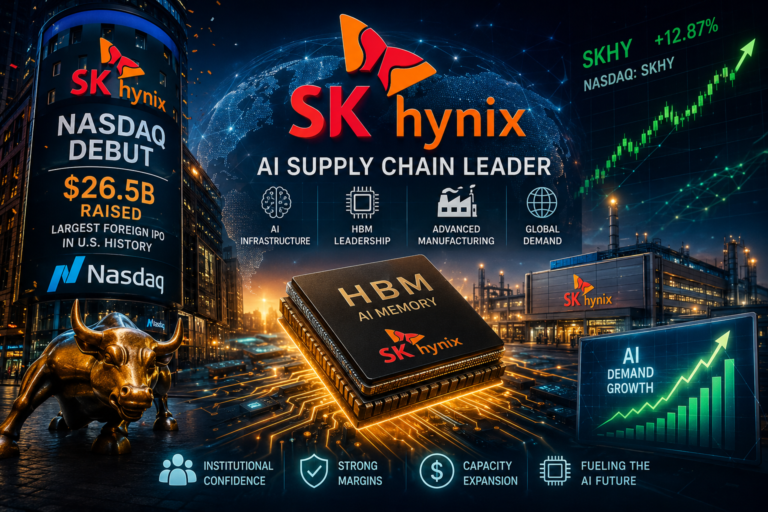
The market is currently transitioning from an early phase of AI software hype into a capital-heavy phase focused on physical hardware and capacity. Several key trends define this shift:
-
Focus on the Compute Layer: Institutional capital now concentrates on firms that build the physical “compute layer”—the chips, memory, and specialized hardware required to run AI models.
-
Sovereign AI: Nations increasingly treat domestic computing power as a matter of national security. Governments are aggressively investing in sovereign infrastructure to ensure they have the compute capacity to compete globally, which drives massive, long-term capital expenditures (CapEx).
-
Addressing Bottlenecks: Demand for advanced AI components, particularly HBM, remains tight. Recent reports indicate that the top five hyperscalers—Amazon, Microsoft, Google, Meta, and Oracle—project spending over $700 billion on infrastructure in 2026, with a substantial portion dedicated specifically to AI hardware and data centers.
The “Two-Tier” Market Illusion
The excitement surrounding the SK Hynix debut underscores why the market currently feels like a “two-tier” system. Although headline indices like the Nasdaq have reached all-time highs, much of this growth stems from a small, elite group of companies—the “AI Hardware” providers. Because these firms hold such significant weight in the indices, their success often masks the struggles of the broader tech sector, which does not see the same level of institutional inflows. The SK Hynix listing confirms that the current market rally focuses laser-like on the hardware, chips, and energy infrastructure that make the AI era possible.
The Macroeconomic Impact: Why Investors are Moving
Global investors are flocking toward companies that possess “pricing power” and a “moat” around their technology. Because the HBM sector is effectively sold out for the remainder of 2026, companies like SK Hynix retain significant control over their pricing and margins. This stands in stark contrast to the software sector, where competition remains fierce and costs are often unpredictable.
Institutional investors view these businesses as “suppliers to the gold rush.” Just as shovels and picks provided the most reliable way to make money during the 1849 Gold Rush, memory chips serve as the “picks and shovels” of the AI age. By moving their listing to the Nasdaq, SK Hynix has made it easier for the world’s largest pension funds and hedge funds to buy into this supply chain, further cementing its position as a central pillar of the digital economy.
Looking Ahead: The 2030 Roadmap
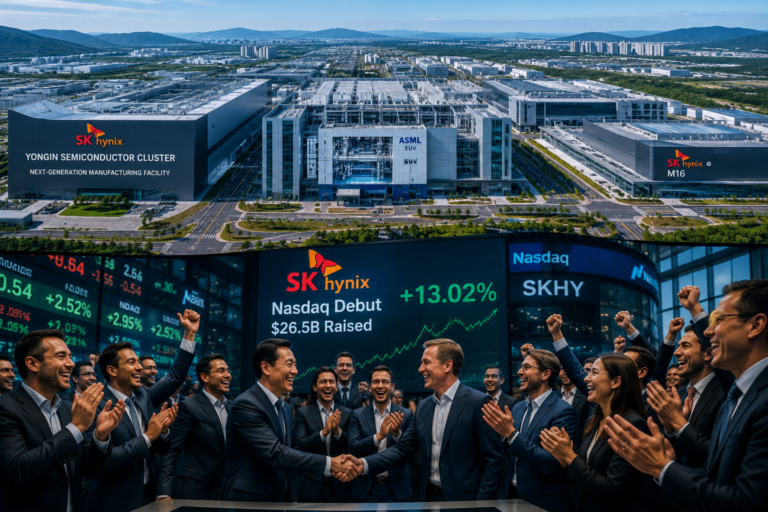
The proceeds from this $26.5 billion listing are not intended for temporary fixes. SK Hynix has explicitly stated that the funds will support the Yongin semiconductor cluster, a massive project designed to scale production to meet the AI needs of the next decade.
This long-term planning is exactly what institutional investors look for in 2026. As energy demand for data centers approaches 1,000 TWh globally, the hardware manufacturers that provide the most efficient, high-performance chips will define the market winners of the next five years. The SK Hynix IPO is not just a one-day celebration; it marks the opening of a new chapter where physical hardware dictates the winners and losers of the artificial intelligence race.
A Wake-Up Call for the Tech Sector
The current bull market tells a tale of two realities. Headline indices tell a story of universal growth, but underlying data shows a market that has hollowed out to support only the most critical hardware players. The record-breaking SK Hynix listing serves as a wake-up call: the era of “broad gains” is definitively over. To thrive in this environment, institutional investors are pivoting away from the index and toward the elite few who control the hardware of the future. By aligning their capital with the concentration of hardware-focused firms, they position themselves to survive the upcoming transition toward a hardware-first economy.