
Stay Updated
The Future Transformation of Indian Startups
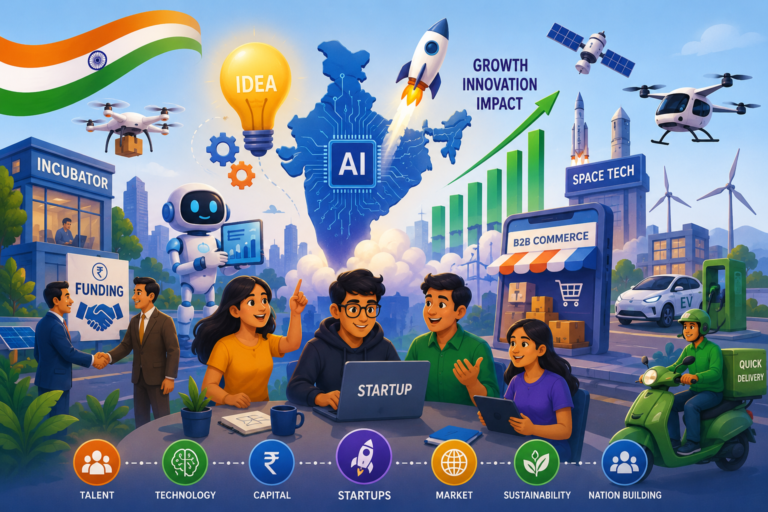
The Structural Transformation of Indian Startups is becoming clearly visible across the Indian startup ecosystem. Founders are increasingly moving beyond the traditional growth-at-all-costs model and focusing on building sustainable businesses driven by profitability, technological innovation, operational efficiency, and long-term value creation.
At the same time, investors have become more selective. Venture capital firms now prioritize strong business fundamentals, scalable revenue models, and clear paths to profitability. This shift is reshaping how startups build products, attract capital, and compete in both domestic and global markets.
Emerging Startup Sectors Driving Growth
Artificial Intelligence and Semiconductor Innovation
Artificial intelligence has become one of the most active areas of startup investment in India. Rather than simply adopting global AI technologies, several Indian startups are developing solutions specifically designed for local languages, regional markets, and domestic infrastructure requirements.
Sarvam AI
Sarvam AI is focused on developing AI models optimized for Indian languages and dialects. By leveraging localized datasets and specialized tokenization techniques, the company aims to improve AI performance while reducing computational costs for enterprises serving diverse linguistic markets.
As demand for AI-powered services continues to grow across India, language-focused AI infrastructure is becoming an increasingly important component of the country’s digital ecosystem.
HrdWyr
HrdWyr is building domestic AI chip and system-on-chip (SoC) technologies designed to support next-generation artificial intelligence applications.
The company’s focus on edge computing enables AI processing to occur directly on devices rather than relying entirely on cloud infrastructure. This approach can improve efficiency, reduce latency, and strengthen India’s long-term semiconductor capabilities.
Together, companies like Sarvam AI and HrdWyr represent a broader movement toward developing foundational AI and hardware technologies within India.
DeepTech and Aerospace Innovation
Skyroot Aerospace
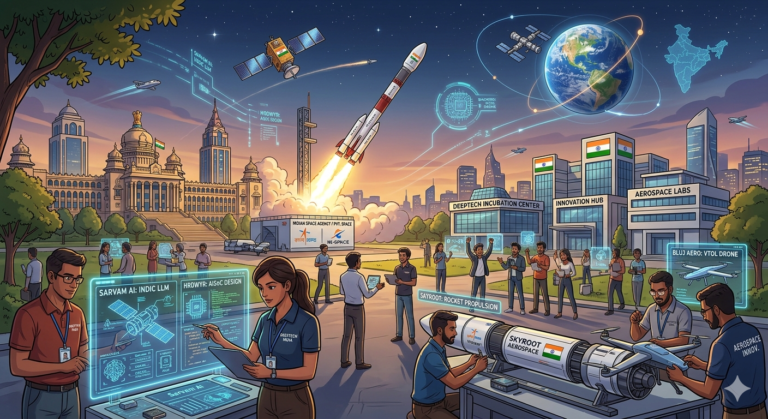
Skyroot Aerospace has emerged as one of India’s leading private space technology companies. The startup is developing launch vehicle technologies and advanced propulsion systems to support the growing global demand for satellite launches.
Its engineering approach includes advanced manufacturing techniques such as carbon-composite structures and 3D-printed rocket components, helping improve efficiency while reducing production timelines.
As commercial space activities continue to expand worldwide, Indian aerospace startups are increasingly positioning themselves as competitive participants in the global market.
BLUJ Aero
BLUJ Aero is developing autonomous aviation solutions and electric vertical take-off and landing (eVTOL) aircraft for cargo transportation.
The company focuses on addressing logistics challenges by creating aircraft capable of efficient middle-mile delivery operations. Through advancements in autonomous flight systems, battery technologies, and future hydrogen-electric propulsion platforms, BLUJ Aero is contributing to the evolution of next-generation transportation infrastructure.
Mobility and Logistics Transformation
Rapido
Rapido has expanded significantly by focusing on two-wheeler and auto-rickshaw mobility services across urban and emerging markets.
Its technology platform uses real-time data and route optimization algorithms to efficiently match riders and drivers while improving vehicle utilization. This approach has enabled the company to establish a strong position within India’s rapidly evolving mobility sector.
Ola Electric
Ola Electric continues to play a major role in India’s electric vehicle transition.
The company is pursuing vertical integration by developing key components such as battery technologies, electric drivetrains, and software systems internally. Investments in large-scale manufacturing infrastructure aim to strengthen domestic EV production capabilities and support long-term industry growth.
The Rise of B2B Commerce Platforms
Fairdeal.market
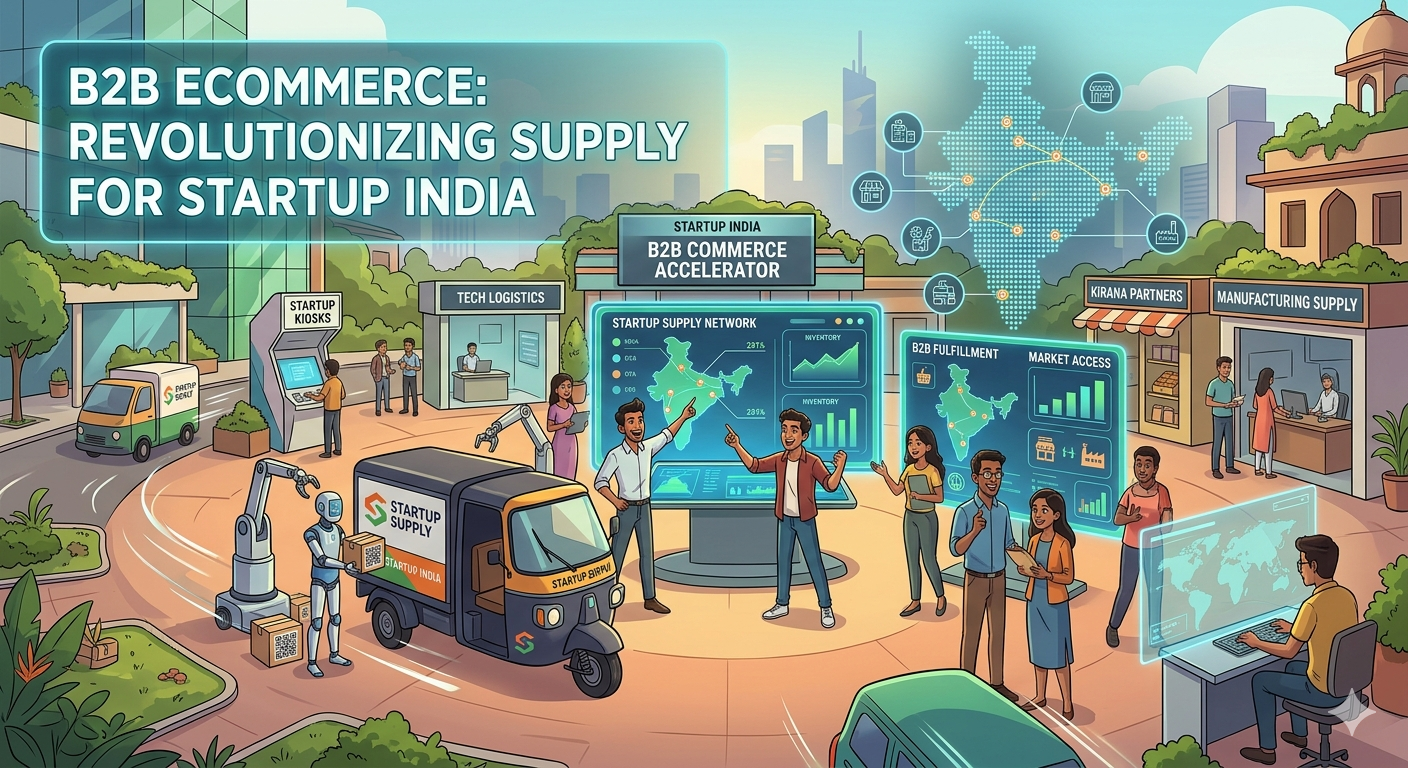
While consumer-focused quick-commerce platforms have attracted significant attention, business-to-business commerce is emerging as an equally important opportunity.
Fairdeal.market focuses on providing wholesale inventory solutions for neighborhood retailers and small businesses. By combining technology-enabled logistics with inventory optimization, the platform helps retailers replenish stock more efficiently and reduce working capital requirements.
This model demonstrates how startups are increasingly targeting operational challenges within traditional supply chains rather than focusing solely on consumer convenience.
Business Model Comparison
Key Business Comparison
- Average Order Value:
Consumer Quick Commerce → Lower
B2B Wholesale Commerce → Higher - Logistics Structure:
Consumer Quick Commerce → Point-to-Point Delivery
B2B Wholesale Commerce → Hub-and-Spoke Distribution - Inventory Management:
Consumer Quick Commerce → Higher Risk of Wastage and Stock Imbalance
B2B Wholesale Commerce → More Predictable Demand and Stable Inventory Flow - Customer Base:
Consumer Quick Commerce → Individual Consumers
B2B Wholesale Commerce → Retailers and Small Businesses
Changing Venture Capital Priorities
The venture capital landscape has evolved considerably over the past few years.
Investors are placing greater emphasis on financial discipline, operational efficiency, and sustainable growth rather than purely focusing on user acquisition and market share expansion.
Previous Growth Model
- Growth at all costs
- Customer acquisition through heavy subsidies
- Emphasis on valuation growth
- Reliance on continuous fundraising
Emerging Investment Focus
- Sustainable unit economics
- Clear profitability pathways
- Strong corporate governance
- Efficient capital allocation
- Long-term value creation
As a result, startups are increasingly expected to demonstrate resilience and financial sustainability at earlier stages of development.
The Growing Importance of Domestic Capital
India’s startup ecosystem is becoming less dependent on international venture funding alone.
Domestic institutional investors, family offices, mutual funds, and strategic corporate investors are playing a larger role in supporting innovation and growth. This expanding pool of local capital provides startups with additional funding options while strengthening the overall ecosystem.
The increased participation of domestic investors also reflects growing confidence in India’s long-term technology and innovation potential.
IPO Readiness Becomes the New Benchmark
Public market readiness is emerging as a key milestone for mature startups.
Rather than focusing exclusively on private market valuations, companies are increasingly preparing for the governance, transparency, and operational standards required by public markets.
This trend is encouraging startups to strengthen financial reporting, improve compliance frameworks, and prioritize sustainable business performance long before pursuing public listings.
The Indian startup ecosystem is entering a new phase defined by technological innovation, financial discipline, and long-term value creation.
From artificial intelligence and semiconductor development to aerospace, mobility, and B2B commerce, startups are increasingly building foundational technologies and scalable business models capable of competing on a global stage.
As investor expectations continue to evolve and domestic capital markets mature, the next generation of Indian startups is likely to be shaped not only by rapid growth but also by sustainability, profitability, and innovation-driven leadership.