

Stay Updated
Human Archive: Building the Data Layer for Humanoid Robots
As the race to build intelligent humanoid robots accelerates, most headlines focus on companies developing robotic hardware. However, behind every capable robot lies an equally important resource: data.
Human Archive, a Silicon Valley startup, is tackling one of the biggest challenges in robotics today—collecting the real-world training data needed to teach robots how humans work. Instead of building robots, the company is building the data infrastructure that could help power the next generation of humanoid and embodied AI systems.

What Is Human Archive?
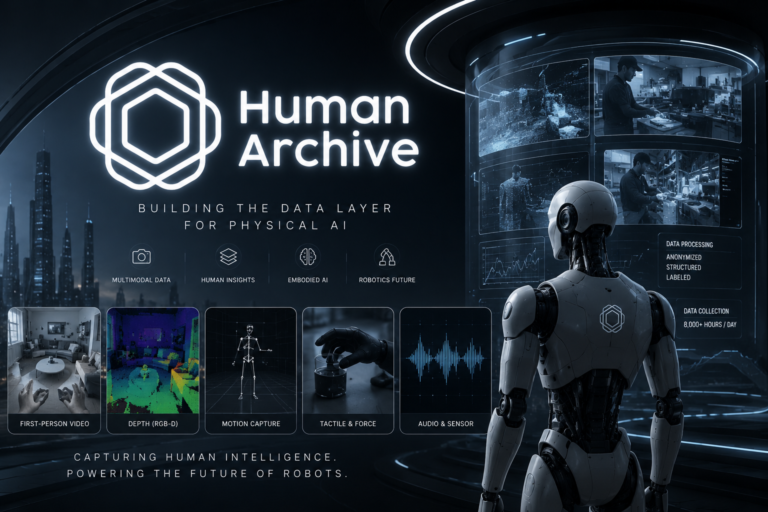
Human Archive specializes in collecting and organizing large-scale multimodal datasets that capture how humans interact with the physical world.
The company gathers several types of information, including:
- First-person video
- Depth (RGB-D) data
- Motion capture data
- Tactile and force information
- Audio recordings
- Sensor data
Using this information, Human Archive creates structured datasets that robotics companies can use to train AI systems. The goal is simple: help robots learn from human behavior in the same way language models learned from internet text.
Why Robotics Needs Better Data
Over the past few years, artificial intelligence has advanced rapidly because developers gained access to massive datasets. Large language models learned from billions of documents, websites, books, and conversations.
Humanoid robots face a similar challenge.
A robot cannot learn how to clean a hotel room, prepare food, organize inventory, or assist customers simply by reading instructions. Instead, it must observe how humans perform these tasks and learn from those examples.
Recognizing this need, Human Archive focuses on collecting real-world demonstrations of everyday work. The founders refer to this concept as human embodied intelligence—the knowledge humans use to navigate and interact with the physical world.
As a result, the company aims to create the data foundation that future robots may rely on.
How Human Archive Collects Data
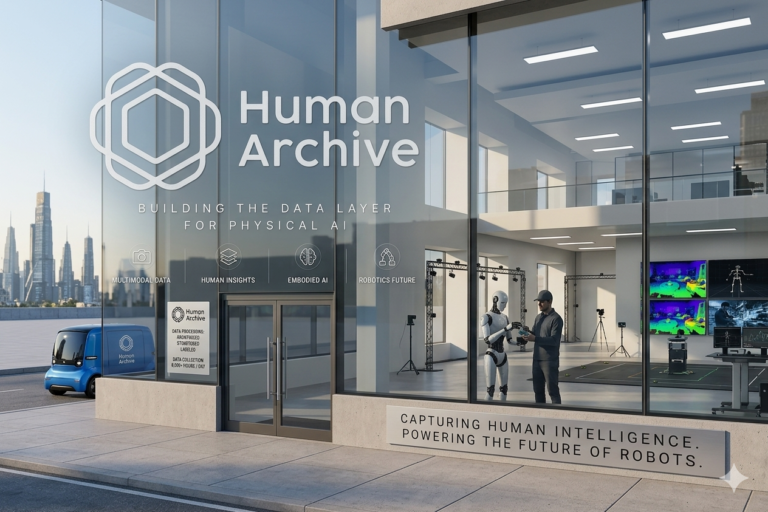
To build these datasets, Human Archive works with service-sector businesses and workers who perform everyday tasks while wearing specialized recording equipment.
The company captures information about:
- Human movement
- Object interactions
- Environmental conditions
- Task execution
- Physical workflows
By combining multiple data streams, Human Archive creates a detailed picture of how people perform real-world tasks.
Today, the company reportedly operates more than 1,000 active recording headsets and continues to expand its data collection network. According to its Y Combinator profile, Human Archive can collect up to 8,000 hours of data daily through its growing contributor base.
Building the Future of Physical AI
Human Archive believes the future of robotics depends on access to high-quality training data.
Consequently, the company’s datasets may support organizations developing:
- Humanoid robots
- Physical AI systems
- Warehouse automation platforms
- Service robots
- Hospitality robots
- Industrial automation systems
- General-purpose robotics models
Rather than competing with robot manufacturers, Human Archive positions itself as a supplier to the broader robotics ecosystem.
In many ways, the startup hopes to become for robotics what large-scale datasets became for generative AI.
Funding and Investor Interest
Investor enthusiasm for Human Archive increased significantly in May 2026 when the startup announced an $8.2 million seed funding round.
The round was led by Wing Venture Capital and NVP Capital, with participation from Y Combinator and investors connected to OpenAI, Nvidia, Google, and Meta.
Seed funding represents one of the earliest major investment stages for a startup. Companies typically use this capital to build products, hire employees, expand operations, and validate their business model.
For Human Archive, the funding will help expand data collection infrastructure, grow engineering teams, and accelerate the development of large-scale robotics datasets.
More importantly, the investment signals growing confidence that robotics data infrastructure could become a valuable market in its own right.
Meet the Founders
Human Archive was founded by:
- Raj Patel
- Rushil Agarwal
- Samay Maini
- Shloke Patel
The founders come from backgrounds connected to leading technology and research institutions, including the University of California, Berkeley and Stanford.
After observing rapid progress in robotics hardware and AI models, they identified a major bottleneck: the lack of large-scale real-world training data. Rather than building another robotics company, they chose to address that problem directly.
Today, Human Archive is part of the Y Combinator Winter 2026 startup batch and continues to grow within Silicon Valley’s technology ecosystem.
Is Human Archive Still Active?
Yes. Human Archive remains an active and rapidly growing startup.
Since emerging from Y Combinator, the company has expanded its data collection operations and attracted significant venture capital support. It currently maintains partnerships across multiple industries and continues to increase the size of its contributor network.
The company describes its long-term vision as creating a “Common Crawl for human sensorimotor intelligence”—a massive repository of human actions that can helptrain future generations of robots.
Furthermore, Human Archive is actively hiring for engineering, hardware, operations, and product-related positions, indicating ongoing expansion.
The Opportunity Ahead
Many investors see a strong parallel between Human Archive and the early days of generative AI.
During the rise of large language models, companies required enormous text datasets to train increasingly capable systems. Similarly, humanoid robots may require enormous datasets showing how humans interact with the physical world.
If that vision becomes reality, companies that control high-quality robotics training data could become critical infrastructure providers.
For this reason, Human Archive has attracted attention from investors who believe the humanoid robotics industry could eventually reach trillions of dollars in value.
Challenges and Criticism
Despite its momentum, Human Archive has also faced scrutiny.
Because much of its data collection occurs through service workers in India, critics have raised questions about privacy, consent, compensation, and the ethics of using human labor to generate training data for automation systems.
Some observers worry that workers contributing data today may ultimately help train systems that automate similar jobs in the future.
In response, Human Archive states that it anonymizes collected information and removes identifying details during processing.
As physical AI continues to develop, discussions around privacy, transparency, and responsible data collection will likely become increasingly important throughout the industry.
Why Startup Investors Are Watching Human Archive
Human Archive sits at the intersection of three powerful technology trends that many investors believe could shape the future of artificial intelligence and robotics.
Humanoid Robotics: Companies around the world are investing billions of dollars to develop robots capable of performing human-like tasks in factories, warehouses, retail environments, healthcare facilities, and homes.
Physical AI and Embodied Intelligence: AI is rapidly evolving beyond chatbots and software applications. The next wave of innovation focuses on machines that can perceive, move, interact with objects, and operate in the physical world.
AI Data Infrastructure: Just as cloud computing became critical infrastructure for software companies, large-scale training datasets may become essential infrastructure for robotics developers. Robots cannot learn physical tasks without vast amounts of real-world data showing how humans perform them.
Because Human Archive operates where these three trends converge, many venture capital firms view the company as a potentially important player in the emerging robotics ecosystem. Rather than competing directly with robot manufacturers, Human Archive is building the data foundation that could help power the next generation of humanoid robots and embodied AI systems.
Final Thoughts
The future of robotics may depend on more than advanced hardware and powerful AI models. It may also depend on access to massive amounts of real-world training data.
That is precisely the problem Human Archive aims to solve.
In simple terms, Human Archive is not trying to build the robot. Instead, it is building the dataset that teaches future robots how humans move, work, interact with objects, and navigate the physical world.
If humanoid robotics expands as rapidly as many experts predict, companies providing the underlying data infrastructure could become some of the most important players in the industry. Human Archive is betting that the next robotics revolution begins with understanding human behavior—and transforming that knowledge into the data that powers intelligent machines.