
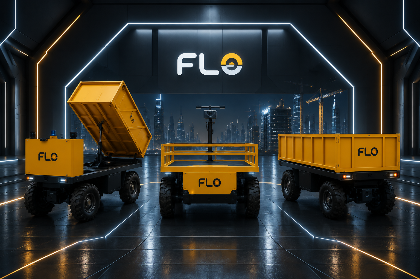
🚀 Flo Mobility Is Bringing Physical AI to the Real World
Artificial intelligence has captured global attention through chatbots, large language models, and digital assistants. Yet while much of the AI conversation remains focused on software, a new generation of innovators is bringing intelligence into the physical world. One of the companies leading this shift is Flo Mobility, an Indian robotics startup developing Physical AI solutions that can operate in some of the toughest industrial environments on Earth.
Founded in Bengaluru in 2021 by Manesh Jain and Pratik Patel, Flo Mobility is building autonomous mobile robots designed to navigate complex, unstructured environments where traditional automation often struggles. From construction sites and mining operations to large industrial facilities, the company’s technology is helping industries automate material movement, improve safety, and address growing labor shortages.
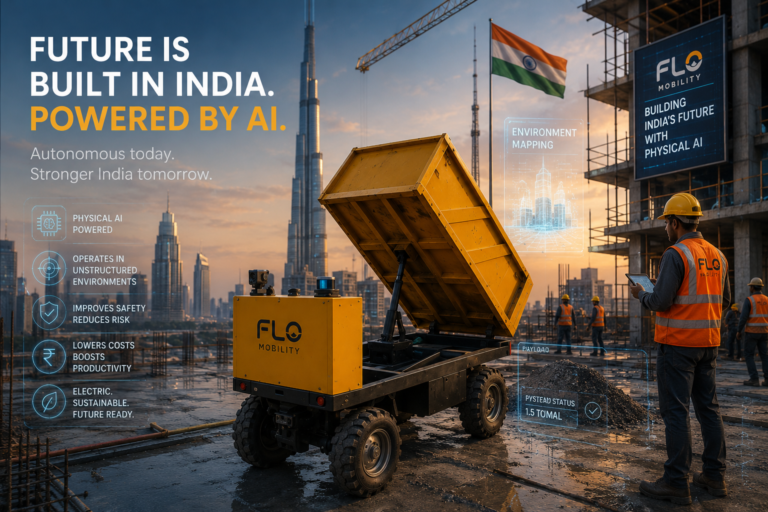
The Challenge with Traditional Robotics
For years, robots have excelled inside highly controlled environments such as manufacturing plants and fulfillment centers. These locations typically feature flat floors, predictable layouts, stable lighting conditions, and carefully managed workflows.
However, many industries operate in environments that are far less predictable. Construction sites are constantly changing. Mining operations involve rough terrain and hazardous conditions. Agricultural fields contain mud, uneven surfaces, and dynamic obstacles.
Traditional robotic systems often depend on GPS signals, fixed routes, QR codes, or controlled surroundings to function effectively. Once these assumptions disappear, performance can quickly deteriorate.
This gap between controlled automation and real-world operations created an opportunity for a new approach to robotics.
Introducing Physical AI
Flo Mobility focuses on what is increasingly being called Physical AI—the combination of artificial intelligence, robotics, sensors, and autonomous decision-making that enables machines to understand and interact with the physical world.
Rather than simply processing text or generating digital content, Physical AI systems perceive their surroundings, make decisions in real time, and perform tasks independently.
This capability is particularly valuable in industries where transporting materials remains labor-intensive, repetitive, and potentially dangerous.
By combining advanced perception systems, edge computing, and autonomous navigation, Flo Mobility aims to make intelligent machines a practical reality for heavy industries.
Building Intelligence for Harsh Environments
One of Flo Mobility’s key differentiators is its ability to operate in challenging environments that many autonomous systems cannot handle effectively.
The company’s robots use a combination of 32-beam LiDAR sensors and 360-degree camera systems to continuously monitor their surroundings. These sensors generate a detailed three-dimensional view of the environment, helping the robot identify obstacles, workers, vehicles, and changing terrain conditions.
The data is processed locally using onboard Edge AI computing systems. This allows the robots to make navigation decisions in less than 100 milliseconds without relying on cloud connectivity.
Such low-latency decision-making is critical in industrial environments where connectivity can be unreliable and conditions can change instantly.
An additional advantage is that the platform can function independently of GPS. This enables reliable operation inside tunnels, reinforced concrete structures, and other locations where satellite signals may be unavailable.
The Flo Hauler: Autonomous Material Movement
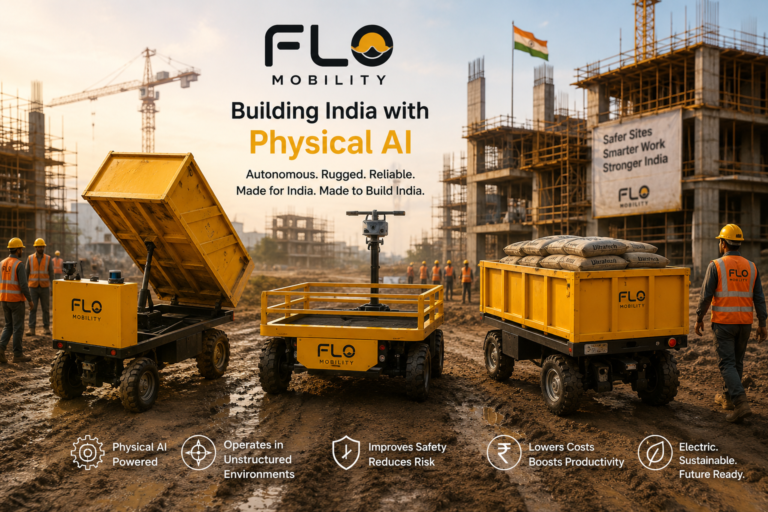
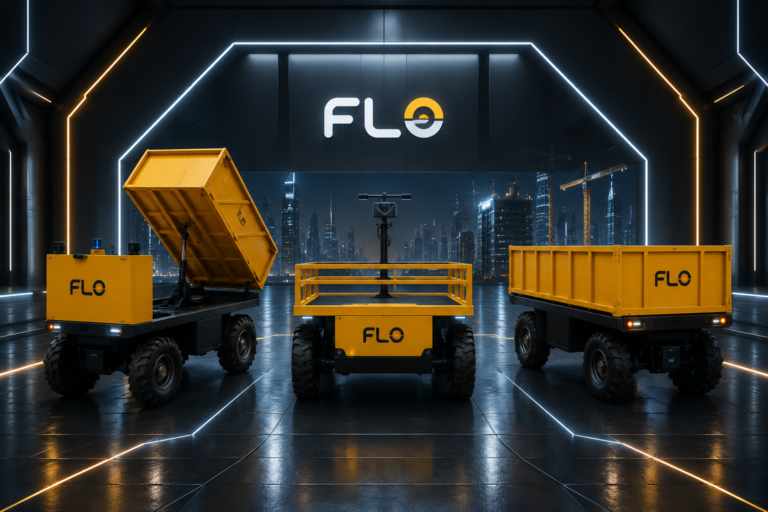
The company’s flagship product, the Flo Hauler, is designed to automate one of the most physically demanding tasks in construction and industrial operations: material transportation.
Workers on construction projects often spend significant time moving bricks, steel, cement, sand, and equipment across large worksites. These repetitive tasks can reduce productivity while increasing the risk of fatigue and workplace injuries.
The Flo Hauler addresses this challenge through autonomous transportation capabilities. Equipped with a rugged electric four-wheel-drive system and an IP65-rated enclosure, the vehicle is engineered to operate in dust, rain, mud, and uneven terrain.
Depending on configuration, the platform can transport payloads ranging from 500 kilograms to 1.5 tonnes. It can navigate steep slopes, avoid obstacles, and operate across changing site layouts without requiring extensive infrastructure modifications.
The result is a safer and more efficient approach to material movement.
A Business Model Designed for Adoption
Even the most advanced technology can struggle if customers face significant financial barriers to adoption.
Recognizing this reality, Flo Mobility offers its technology through a Robotics-as-a-Service (RaaS) model.
Instead of requiring customers to purchase expensive robotic fleets outright, the company provides subscription-based access to its autonomous systems. This approach converts large capital expenditures into more manageable operational expenses.
For construction companies and industrial operators, the model reduces financial risk while allowing them to evaluate the benefits of automation immediately.
The strategy has helped accelerate adoption and expand the company’s presence across multiple regions.
Growing Commercial Traction
Flo Mobility has already achieved meaningful commercial milestones.
The company has deployed more than 60 robots across 10 Indian states, collectively covering over 50,000 kilometers of autonomous operation and transporting more than 250,000 tonnes of material.
Its customer base includes major organizations such as Larsen & Toubro (L&T), Godrej Properties, Sobha, Embassy Group, and Total Environment.
The startup has also attracted investor interest. Flo Mobility secured a $2.5 million pre-Series A funding round co-led by Mela Ventures and Arali Ventures, with participation from IISc’s ARTPARK and Blume Founders Fund.
The funding is expected to support manufacturing expansion, technology development, and entry into international markets, including the Middle East.
Measurable Impact in the Field
The value of industrial automation ultimately depends on measurable outcomes.
According to deployment data shared by the company, customers have reported material handling cost reductions of 45% to 50%, material movement speed improvements of approximately 50%, and significant reductions in workplace accidents.
Beyond productivity gains, these systems help reduce worker exposure to physically demanding tasks while enabling employees to focus on higher-value responsibilities.
This shift can improve both operational efficiency and workplace safety across industrial environments.
The Future of Physical AI
Although construction is currently a major focus, Flo Mobility’s technology has applications across multiple sectors.
Potential opportunities include agriculture, mining, logistics, manufacturing, and large-scale infrastructure development. Any industry that depends on moving heavy materials through unpredictable environments could potentially benefit from autonomous robotic systems.
As AI continues to move beyond software and into real-world operations, Physical AI is expected to become one of the most important frontiers in industrial innovation.
Flo Mobility represents a growing wave of Indian deep-tech startups building globally relevant technologies. By combining robotics, artificial intelligence, and practical industrial applications, the company is demonstrating how Physical AI can move from concept to commercial reality.
While the world remains fascinated by digital AI assistants and chatbots, Flo Mobility is focused on something equally transformative: intelligent machines that can safely work alongside people and operate effectively in the physical world.