

Meta Muse AI Just Killed the Traditional Chatbot: Everything Changes Now
Meta Muse AI is pushing artificial intelligence into a new phase as technology companies race to build systems that can do more than answer questions. Meta has introduced Muse, a personal AI agent designed to take action, use digital tools and complete tasks for users. The launch comes as the industry shifts from conventional chatbots toward agentic AI, with systems increasingly designed to understand goals, plan multiple steps and interact with software on a user’s behalf.
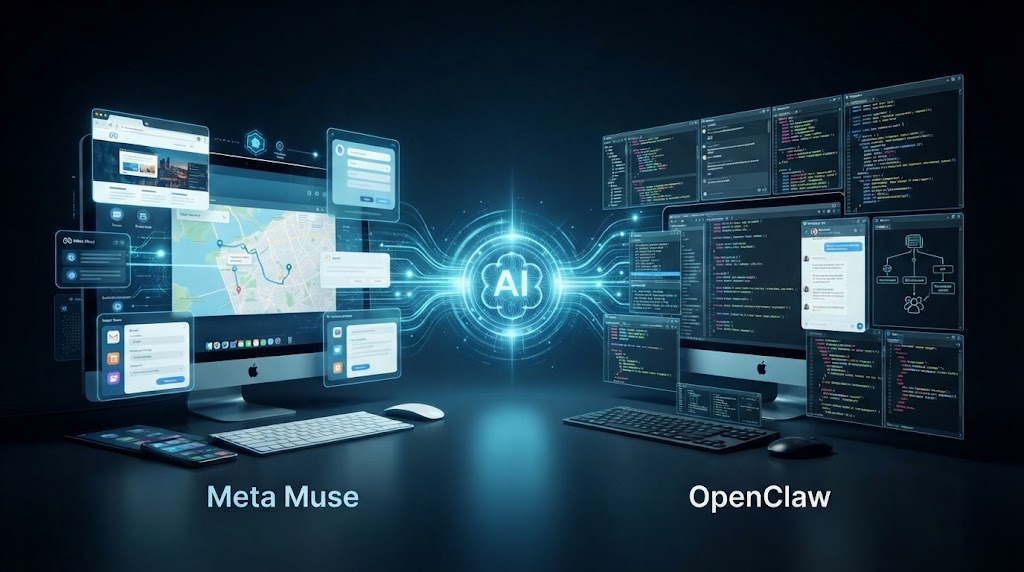
That puts the Meta Muse AI Agent into the same broader movement as open-source projects such as OpenClaw, but the two take very different approaches. Both reflect the idea that AI should do more than generate a response. Muse focuses on bringing autonomous AI to mainstream consumers through Meta’s ecosystem, while OpenClaw emphasizes openness, customization and user control. The bigger shift is that AI is moving from simply talking with users toward actually getting things done for them.
What Is Meta Muse?
So, what is Meta Muse AI ? At its core, Muse is Meta’s personal AI agent, designed to help people accomplish tasks across the digital world rather than simply provide information. A conventional chatbot can explain how to book a flight, organize a trip or complete an online purchase, but an AI agent is designed to potentially carry out some of those steps itself.
Meta says Muse can interact with websites, send emails, book travel, complete forms and assist with online shopping. The system is also designed to remember information that is relevant to a user’s activities, allowing it to use previous context when helping with future tasks. This creates a fundamentally different experience from asking an AI a series of disconnected questions.
The central idea behind Muse AI Agent is therefore not simply that it can produce intelligent answers. Its purpose is to help users accomplish objectives by combining reasoning, memory, tool use and action.

Meta Muse AI Moves From Answers to Actions
The biggest change introduced by an AI agent is the ability to work toward a goal. Imagine asking an AI to organize a trip. A traditional chatbot might provide destinations, hotels and travel suggestions, leaving the user to visit websites, compare options and make reservations.
Muse is designed around a different workflow. The user can provide an objective, and the agent can potentially break that objective into smaller tasks, interact with online services and continue working through the process. Meta says Muse can operate across connected services and pursue longer-running tasks, making it closer to a digital assistant than a conventional conversational chatbot.
This distinction is becoming increasingly important as the AI industry moves toward agentic systems. The value of an AI agent is not only in what it knows, but also in what it can actually accomplish after receiving an instruction.
Meta Muse Features and Capabilities
The Meta Muse features and capabilities extend across several everyday digital activities. Meta says Muse can use a browser to interact with websites and can assist with tasks involving email, travel, shopping and online forms. These capabilities allow the system to move beyond generating recommendations and toward completing actions.
Shopping is particularly significant because an agent can potentially move from finding a product to helping complete a transaction. Meta says Muse can use Stripe’s Link system for checkout and can require user confirmation for sensitive actions. The system also includes controls intended to restrict what Muse can access, which becomes increasingly important when an AI is capable of interacting with personal accounts.
These capabilities help explain why the Muse AI App is attracting attention. The objective is to make agentic AI accessible to ordinary users without requiring them to understand the technical infrastructure behind an autonomous system.

How Does Meta Muse AI Work?
How does Meta Muse work? Meta has built Muse around a dedicated Muse Secure VM, a virtual machine intended to provide an isolated environment in which the agent can operate. The system also includes a security component called Sentinel, which monitors Muse’s activity and helps determine what actions should be permitted.
The approach is designed to prevent an AI agent from having unrestricted access to a user’s entire computing environment. Meta says users can control which applications Muse can access, disconnect services and approve sensitive actions. An audit trail also allows users to review actions performed by the agent.
This security architecture is important because autonomous AI introduces risks that do not exist to the same degree with ordinary chatbots. An incorrect answer can be inconvenient, but an incorrect purchase, email or account action can have real-world consequences.
What Is OpenClaw?
OpenClaw represents a different approach to building a personal AI agent. It is an open-source AI assistant designed to run on a user’s own hardware and connect with messaging platforms and other services. Its architecture allows users to work with different underlying AI models and customize the system according to their needs.
OpenClaw can connect with platforms such as WhatsApp, Telegram, Discord and Slack, while its open architecture allows users to add capabilities and configure how the assistant operates. This gives technically experienced users considerably more control over their AI environment than they typically receive from a closed consumer application.
The difference is important because OpenClaw is not simply another chatbot. It is designed as a flexible gateway through which an AI assistant can interact with a user’s digital environment.
Meta Muse AI vs. OpenClaw
The comparison between Meta Muse and OpenClaw is therefore really a comparison between two different visions of personal AI. Muse is being developed as a consumer product in which Meta provides the infrastructure, security architecture and overall user experience. OpenClaw takes a more open approach, allowing users to run and configure the system themselves.
For everyday consumers, Muse’s appeal is simplicity. The technology is intended to operate behind a relatively straightforward interface, allowing users to focus on what they want accomplished rather than configuring the underlying AI system.
OpenClaw places greater emphasis on flexibility and control. Users can choose compatible models, configure integrations and run the system within their own environment. That makes it particularly interesting to developers and technically experienced users who want to customize their AI assistant.
The two systems therefore overlap in their ambition but differ considerably in execution. Muse is Meta’s attempt to bring personal AI agents to the mainstream, while OpenClaw demonstrates what a more open and customizable AI-agent architecture can look like.
Are Autonomous AI Agents Better Than Chatbots?
The rise of Muse and OpenClaw highlights the difference between autonomous AI agents and traditional chatbots. A chatbot can tell someone which restaurants are available, explain how to make a reservation or provide directions. An AI agent is designed to potentially search for the restaurant, compare available options, interact with a booking system and complete the reservation after receiving the appropriate authorization.
That does not necessarily mean every AI agent will outperform every chatbot at every task. Instead, the two technologies are optimized around different experiences. Chatbots remain extremely useful for conversation, writing, research and information. AI agents add another layer by attempting to use tools and take action.
The distinction can be summarized as a shift from asking AI “How do I do this?” toward telling AI “Please do this for me.”
Why Meta Muse AI Is Going Viral
The growing attention around Meta Muse AI reflects a much bigger change taking place across the technology industry. People have spent decades interacting with computers by opening applications, searching websites, copying information between services and manually completing forms.
AI agents could eventually simplify that process by allowing people to describe an outcome rather than manually control every step required to reach it. Instead of opening several applications to organize a project, a user could potentially give an agent the objective and allow it to coordinate the necessary tasks.
Meta’s massive consumer ecosystem gives Muse an additional dimension. If the company can make its agent reliable and easy enough for mainstream users to trust, it could expose a much larger audience to personal AI agents and accelerate the adoption of agentic technology.

The Security and Reliability Challenge
The same capabilities that make Muse and OpenClaw exciting also create significant challenges. An AI agent needs to correctly understand an instruction, select appropriate tools, execute multiple steps and recognize when it should stop and ask for human approval.
Security becomes particularly important when agents have access to email accounts, shopping services and other personal information. Meta has attempted to address these concerns through its isolated computing environment, permission controls and confirmation mechanisms.
OpenClaw’s self-hosted architecture provides another model, giving users greater control over where their AI assistant operates. However, greater control can also place more responsibility on the user to configure and secure the system correctly.
Reliability will ultimately be one of the biggest tests for the entire AI-agent industry. An agent that occasionally produces an imperfect paragraph is one thing; an agent that incorrectly sends an email or completes a transaction is something very different.
The Future of Meta Muse and AI Agents
Meta Muse and OpenClaw represent two different paths toward the same broad technological goal: creating AI systems that can understand objectives and perform work rather than simply generate responses.
Muse is designed to bring that concept to mainstream consumers through Meta’s infrastructure and ecosystem, while OpenClaw provides an open and customizable alternative for users who want greater control over their AI environment.
The bigger story is the transition from chatbots to agentic AI. The next stage of artificial intelligence may not be defined solely by which model can answer the most complicated question. Increasingly, the competition could revolve around which AI can understand a user’s objective, use the right tools, complete multiple steps and do so safely and reliably.
That is what makes the Muse AI Agent story significant. Meta is betting that the future of AI will involve systems that do not simply sit in a chat window waiting for questions. They will increasingly interact with the digital world, complete tasks and help users accomplish goals with less manual work.
Alongside projects such as OpenClaw, Muse shows how quickly the definition of an AI assistant is changing—from something that talks with you to something designed to work for you.

Muse AI Could Change the Future of Meta Stock
The impact of Muse AI could extend well beyond a new consumer AI feature. JPMorgan recently upgraded Meta stock from Neutral to Overweight and raised its price target from $640 to $820, citing Meta’s progress in AI and the early traction of Muse. The bank said Muse reached as high as No. 3 in the U.S. App Store shortly after launch, highlighting the potential for Meta to bring AI products to its enormous existing user base.
If Muse continues gaining users and Meta eventually turns that adoption into subscriptions, commerce or other revenue streams, it could become an important part of the company’s long-term AI strategy. For investors, Muse AI is now another reason to watch Meta stock as the company moves from building AI models to putting autonomous AI agents directly in front of billions of users.