
Stay Updated
Lyzr: Building the Future of Enterprise AI Agents
Artificial intelligence is rapidly transforming how businesses operate, and startups developing enterprise AI solutions are attracting growing attention from investors and organizations worldwide. One such company is Lyzr, an enterprise AI startup founded in 2023 by Siva Surendira, Anirudh Narayan, and Jithin George. Headquartered in Jersey City, New Jersey, United States, with a significant engineering presence in Bengaluru, India, Lyzr focuses on helping enterprises build, deploy, and manage intelligent AI agents securely and at scale.
Unlike many AI startups that concentrate on consumer chatbots, Lyzr has positioned itself as an enterprise AI infrastructure company. Its platform enables organizations to create AI agents capable of automating business processes, analyzing company data, interacting with enterprise software, and supporting employees across multiple departments. As businesses increasingly adopt generative AI to improve efficiency and productivity, Lyzr aims to provide the secure, governed foundation that allows these AI systems to operate reliably in real-world enterprise environments.
Although the company is relatively young, it has experienced rapid growth by addressing one of the biggest challenges facing enterprise AI adoption: deploying powerful AI solutions while maintaining security, compliance, and organizational control. Consequently, Lyzr has emerged as one of the promising startups competing in the fast-growing enterprise AI and agentic AI market.
What Is Lyzr?
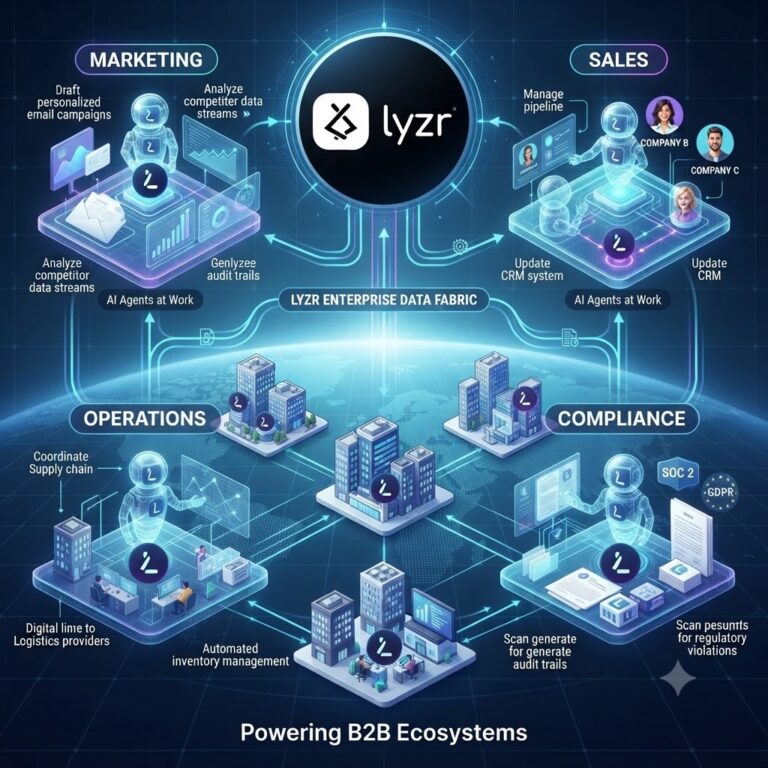
Lyzr is an enterprise AI platform designed to simplify the development and deployment of AI agents. These agents go beyond answering questions. They can perform multi-step tasks, retrieve information from internal databases, interact with enterprise software, generate reports, and automate repetitive business processes.
Unlike consumer-focused AI assistants, Lyzr focuses on organizations that require strong security, governance, and regulatory compliance. Businesses can build AI agents that understand company-specific knowledge while maintaining control over sensitive information.
The platform supports multiple large language models rather than locking customers into a single provider. Organizations can choose models from OpenAI, Anthropic, Google, Meta, Mistral, or other supported providers depending on their requirements for performance, cost, and privacy.
Enterprise AI Rather Than Consumer AI
Many AI startups focus on creating chatbots for consumers. Lyzr has taken a different approach by targeting enterprises that need reliable AI systems for daily operations.
For example, an AI agent built on Lyzr can automatically review financial documents, summarize contracts, answer employee questions, retrieve customer information, and prepare reports. Instead of simply generating text, these agents complete business workflows while interacting with multiple software applications.
This enterprise-first strategy allows organizations to improve productivity without replacing their existing technology stack. Businesses can integrate AI into customer support, finance, human resources, legal operations, sales, and supply chain management while maintaining oversight over every process.
Key Features of the Platform
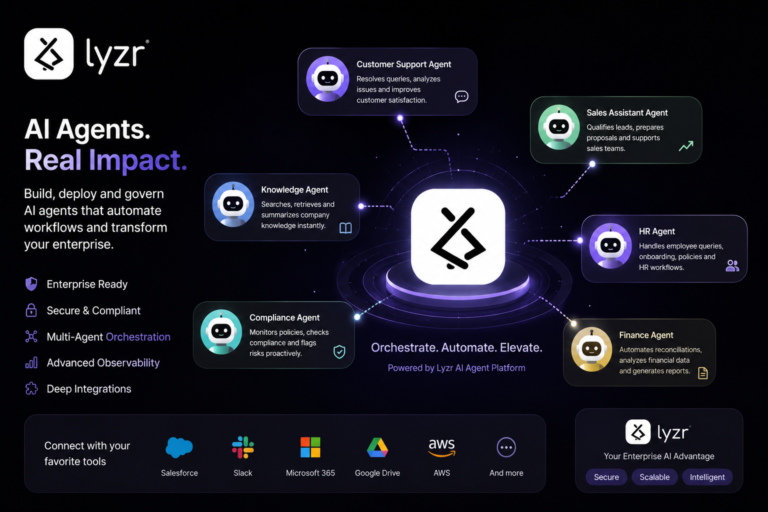
One of Lyzr’s strengths is its emphasis on enterprise-grade capabilities rather than basic chatbot functionality.
The platform includes visual tools that allow organizations to design AI workflows without extensive programming. Developers can also build more advanced applications using APIs and integrations.
Another major advantage is AI governance. Companies often hesitate to deploy AI because of concerns about privacy, compliance, and inaccurate responses. Lyzr addresses these concerns through features such as role-based access controls, audit trails, approval workflows, and security policies that help organizations monitor AI activity.
The platform also supports Retrieval-Augmented Generation (RAG), enabling AI agents to retrieve information from company documents before generating responses. This approach helps reduce hallucinations while ensuring answers rely on current business knowledge instead of only the language model’s training data.

Multi-Agent Automation
One of the fastest-growing trends in artificial intelligence is the use of multiple AI agents working together.
Rather than assigning every task to one assistant, organizations can create specialized agents responsible for different functions. One agent may collect customer information, another may analyze financial data, while a third prepares reports for management.
Lyzr supports this multi-agent architecture by coordinating communication between different AI agents and business systems. Consequently, companies can automate increasingly sophisticated workflows without requiring constant human intervention.
As businesses seek greater efficiency, this approach has become one of the platform’s strongest competitive advantages.
Security and Compliance
Security remains one of the biggest barriers to enterprise AI adoption. Organizations cannot risk exposing confidential customer information or intellectual property.
Lyzr places security at the center of its platform. Companies can deploy AI in public cloud environments, private cloud infrastructure, or on-premises depending on their regulatory requirements.
In addition, organizations maintain control over data access through permission management, encryption, logging, and governance policies. Human approval workflows can also require employees to review important AI-generated actions before execution.
These capabilities make the platform attractive to highly regulated industries such as banking, healthcare, insurance, and government organizations.
Industry Applications
Lyzr’s technology supports a wide range of enterprise use cases.
Customer service teams can deploy AI agents that resolve common support requests while accessing internal knowledge bases. Sales organizations can automate lead qualification and proposal generation. Human resources departments can answer employee questions, assist with onboarding, and simplify policy management.
Meanwhile, finance teams can automate invoice processing, expense analysis, and financial reporting. Legal departments can summarize contracts and identify compliance risks. Manufacturing companies can improve operational efficiency by analyzing production data and maintenance records.
Because the platform integrates with existing enterprise software, organizations can introduce AI without rebuilding their entire technology infrastructure.
Growth and Market Position
Although Lyzr is still a relatively young startup, it has expanded rapidly since its launch. The company has attracted investment, grown its engineering team, and established operations in both the United States and India.
Its customer base includes enterprises across industries seeking practical AI solutions rather than experimental projects. As demand for enterprise AI continues rising, Lyzr competes with larger technology companies as well as AI infrastructure startups by emphasizing flexibility, security, and rapid deployment.
Instead of competing directly with language model developers, Lyzr positions itself as the enterprise layer that enables businesses to deploy whichever AI models best fit their needs.
Challenges Ahead
Despite its strong momentum, Lyzr operates in one of the most competitive areas of artificial intelligence.
Major technology companies such as Microsoft, Google, Salesforce, Amazon, and IBM continue expanding their enterprise AI platforms. At the same time, open-source frameworks and emerging startups are lowering the barriers to building AI applications.
To maintain its competitive position, Lyzr must continue innovating in areas such as AI governance, workflow automation, model orchestration, and enterprise integrations. Delivering measurable business value while maintaining security will remain critical as organizations move AI projects from pilot programs into full production.
Final Take
Lyzr represents a new generation of enterprise AI startups focused on practical business automation rather than standalone chatbots. By combining AI agent development, workflow orchestration, governance, security, and multi-model support, the company enables organizations to deploy artificial intelligence confidently across core business operations.
As enterprises increasingly adopt agentic AI, platforms that simplify deployment while ensuring compliance and reliability are likely to play an essential role. If Lyzr continues expanding its enterprise capabilities and customer base, it has the potential to become an important player in the rapidly evolving AI infrastructure market.