

Stay Updated
How Penny Stocks Explode: Short Squeezes, Short Sellers and the Hidden Power of Low Float
Why do some penny stocks suddenly explode, gaining 20%, 50% or even 100% in just a few trading sessions? What causes an almost forgotten small-cap stock to attract thousands of buyers and experience an explosive stock price surge?
Sometimes, the answer is a short squeeze. However, many powerful penny stock breakouts have little to do with short sellers. Instead, a combination of low public float, unusual trading volume, retail investor buying pressure and market momentum can send share prices dramatically higher.
Understanding how penny stocks explode requires looking beyond the share price. Investors need to understand how short sellers operate, why limited share supply matters and how sudden demand can trigger a powerful stock market rally.

What Are Short Sellers and How Do They Make Money?
Short sellers attempt to profit when a stock price falls. Instead of buying shares and waiting for them to increase in value, they borrow shares from a broker and immediately sell them in the market. Later, they hope to buy those shares back at a lower price and return them to the lender.
For example, imagine a trader borrows 10,000 shares at $1 each and sells them for $10,000. If the stock falls to $0.60, the trader can buy back the same 10,000 shares for $6,000. That creates a $4,000 profit before borrowing fees, commissions and other costs.
However, short selling becomes dangerous when the stock moves higher instead of lower. If the same shares rise to $2, buying them back would cost $20,000. The trader would face a $10,000 loss before costs.
Unlike traditional stock purchases, where an investor’s loss is generally limited to the amount invested, short selling carries theoretically unlimited losses because a stock price can continue rising.
This is where a potential short squeeze begins.
How Does a Short Squeeze Make Penny Stocks Explode?
A short squeeze happens when a heavily shorted stock starts rising and puts pressure on traders who bet against it. As the share price climbs, short sellers face increasing losses. Consequently, some decide to close their positions by buying back the shares they originally borrowed.
That buying activity can create additional demand and push the stock price even higher.
Consider a hypothetical penny stock trading at $0.50. A major company announcement sends the price to $0.70. As the rally gains momentum, short sellers begin buying shares to reduce their losses. Their buying adds further pressure, potentially pushing the stock toward $0.90.
This creates a powerful feedback loop:
-
The stock price starts climbing.
-
Short sellers face growing losses.
-
Some short sellers buy shares to close their positions.
-
Their purchases create additional demand.
-
More buying pressure can accelerate the rally.
As a result, short squeeze stocks can experience explosive price movements, particularly when relatively few shares remain available for trading.
However, high short interest alone does not guarantee a short squeeze. Traders should also examine liquidity, borrowing conditions, short interest data and actual buying activity before assuming that short covering is driving a rally.

Why Low-Float Penny Stocks Can Explode Without a Short Squeeze
A penny stock does not need heavily shorted shares to double in price. Sometimes, the explanation is much simpler: supply and demand.
Imagine a small mining company with 100 million shares outstanding. A major shareholder owns 80 million shares and rarely sells. That leaves approximately 20 million shares outside that shareholder’s ownership, although the company’s actual freely tradable public float may be different.
Now imagine that the company attracts sudden attention from retail investors. More buyers enter the market, but existing shareholders do not sell enough shares to satisfy the demand.
Consequently, buyers begin competing for the available shares. The stock could move from $0.10 to $0.12, then $0.15 and eventually $0.20.
In this example, the share price doubles without requiring short sellers to cover their positions.
Traders often describe this type of movement as a low-float momentum rally. When limited share supply meets rapidly increasing demand, even relatively small amounts of buying activity can produce significant price movements.
This is one reason low-float stocks can attract speculative trading interest.
Adex Mining: How Retail Investor Buying Pressure Can Drive a Penny Stock Rally
The November 2026 rally in Adex Mining illustrates how retail investor interest and limited share supply can contribute to a dramatic penny stock move.
The Canadian mining company attracted attention after receiving a US$1 million loan from its largest shareholder and announcing a strategic review of its Mount Pleasant mineral property in New Brunswick.
These developments encouraged speculation about a possible strategic transaction, partnership or asset sale. Meanwhile, increased investor attention helped bring more trading activity into the stock.
Trading volume reportedly exceeded one million shares on some days, while the share price moved from approximately $0.09 toward $0.20.
However, this price movement does not establish that Adex Mining experienced a confirmed short squeeze. Without reliable short-interest and short-covering data, attributing the rally to short sellers would be premature.
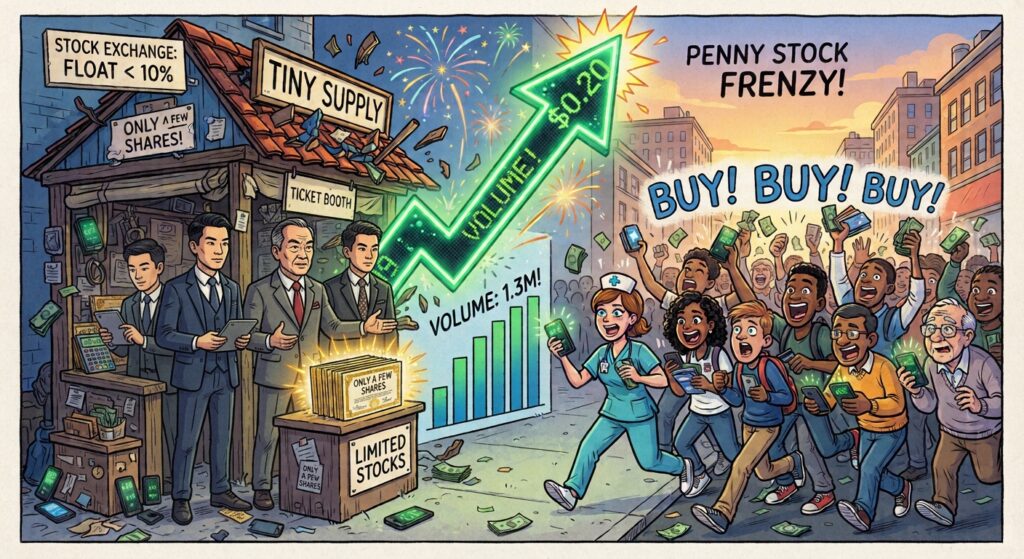
Instead, several factors may help explain the movement:
-
Company developments: The shareholder loan and strategic review attracted attention.
-
Ownership concentration: A significant shareholder position can affect the number of shares actively available for trading.
-
Increased trading volume: More market participants began trading the stock.
-
Speculative demand: Investors considered potential outcomes involving the company’s mineral property.
The important lesson is that a retail investor-driven rally can produce explosive penny stock movements even without a confirmed short squeeze.
Unusual Trading Volume: A Key Signal Behind Penny Stock Breakouts
One of the most important indicators traders watch when searching for explosive penny stocks is unusual trading volume.
Volume measures how many shares change hands during a specific period. When a stock suddenly trades significantly more shares than usual, it can indicate growing investor interest or changing market sentiment.
For example, imagine a stock that normally trades 15,000 shares per day. Suddenly, its trading volume reaches 750,000 shares. That represents a substantial increase in market activity.
Traders also monitor Relative Volume (RVOL) to compare current trading activity against historical averages. An RVOL reading of 5 means the stock is trading at approximately five times its comparison average, based on the indicator’s calculation.
However, high volume alone does not confirm a breakout. Investors should examine how the share price behaves alongside trading activity.
Rising prices with increasing volume can indicate stronger buying demand. In contrast, falling prices with increasing volume may signal aggressive selling. Meanwhile, unusually high volume with little price movement can indicate a battle between buyers and sellers.
Therefore, traders should combine unusual trading volume, price trends, available float and company developments rather than relying on one indicator.

Six Signals Traders Watch Before a Penny Stock Explodes
Finding a potential penny stock breakout requires more than looking for a low share price. Traders often examine several factors to understand whether a stock could attract sudden buying pressure.
Public Float: A smaller freely tradable share supply can make a stock more sensitive to sudden increases in demand.
Insider Ownership: Large insider or strategic shareholder positions can influence how many shares remain available to other investors. However, outstanding shares and public float are not interchangeable.
Unusual Trading Volume: A sudden increase in trading activity can reveal growing market interest, especially when the share price also moves higher.
Company Catalysts: Contracts, acquisitions, government funding, strategic reviews, mineral discoveries and new partnerships can attract attention and bring fresh buyers into the market.
Short Interest: A heavily shorted stock may become vulnerable to a squeeze if its price begins rising. Nevertheless, traders should not assume that high short interest guarantees a rally.
Dilution Risks: Private placements, warrants, convertible securities and new share offerings can increase the supply of shares. Consequently, investors should examine potential dilution before chasing a rapidly rising penny stock.
Together, these signals help traders evaluate whether a stock’s momentum comes from genuine company developments, limited share supply, short covering or speculative demand.
Can Retail Investors Trigger an Explosive Penny Stock Rally?
Yes. Retail investors can contribute to powerful penny stock rallies, particularly in smaller companies with limited trading liquidity.
Unlike large-cap stocks, which typically have substantial trading activity, some small-cap companies have relatively few shares changing hands. As a result, a sudden increase in buying interest can have a noticeable impact on the share price.
Social media platforms and online investing communities can accelerate this process. Discussions on Reddit, Stocktwits, Facebook and other platforms can introduce an unfamiliar company to thousands of potential investors.
As more traders discover the stock, viral stock market posts and growing online attention can increase trading activity. If enough buyers enter the market while existing shareholders hold their positions, the resulting demand may push prices sharply higher.
However, social media attention does not guarantee sustainable demand. Early buyers may take profits, promotional interest can fade and additional share supply can weaken momentum.
More importantly, investors should distinguish genuine company developments from online speculation before making trading decisions.
Understanding How Penny Stocks Explode
Understanding how penny stocks explode means recognizing the difference between a short squeeze and a low-float breakout.
A short squeeze occurs when rising share prices pressure short sellers into buying back borrowed shares. Meanwhile, a low-float rally develops when sudden buying demand overwhelms the available share supply.
Both situations can produce dramatic stock market movements. However, they do not require the same market conditions.
Before chasing explosive penny stocks, investors should examine public float, unusual trading volume, ownership concentration, company catalysts, short interest and dilution risks.
Ultimately, some of the biggest penny stock rallies do not happen because short sellers are trapped. Instead, they happen because there are not enough available shares to satisfy a sudden rush of buyers.
Understanding that difference can help investors recognize the forces behind a penny stock breakout and make more informed trading decisions.