

Stay Updated
Buy, Borrow, Die Strategy vs. Trading Stocks With a Loan: How Wealthy Investors Use Debt Differently
What if borrowing money could help you preserve millions in wealth, while the same financial tool could put another investor deep into debt? That is the difference between the Buy, Borrow, Die strategy and trading stocks with a bank loan.
Both approaches involve borrowing money, but their financial goals are completely different. Wealthy investors often borrow against appreciating stock portfolios to access cash without selling their investments. Meanwhile, retail traders may use a TD, BMO or RBC line of credit to purchase stocks and generate investment returns.
Understanding how these strategies work can reveal why borrowing can be a powerful wealth-management tool for some investors but a dangerous financial gamble for others.

What Is the Buy, Borrow, Die Strategy?
The Buy, Borrow, Die strategy is a wealth-preservation approach commonly associated with ultra-wealthy investors. It involves purchasing appreciating assets, borrowing against those assets instead of selling them, and potentially passing them to heirs.
Consider an investor who purchased $10 million worth of stocks years ago. Over time, the portfolio grows to $30 million.
Instead of selling shares and potentially triggering capital gains taxes, the investor approaches a private bank and borrows against the investment portfolio.
For example, the investor might secure a $5 million loan using eligible stocks as collateral, depending on the lender’s requirements.
This provides access to millions in cash without selling the underlying investments.
Why does this matter? Selling appreciated stocks can trigger capital gains taxes. However, loan proceeds generally do not count as taxable investment income.
Consequently, the investor retains ownership of the shares while potentially benefiting from further market appreciation.
The borrowed money could finance luxury properties, business investments or personal expenses.
However, this strategy carries risks. If the portfolio loses substantial value, the lender may demand additional collateral or repayment. Interest also continues accumulating.

How Trading Stocks With a Line of Credit Works
Unlike wealthy investors using the Buy, Borrow, Die strategy, retail traders may borrow money specifically to purchase stocks.
For example, imagine an investor obtains a $50,000 personal line of credit from TD, BMO or RBC at an annual interest rate of 8%.
The investor uses the entire amount to purchase shares, hoping to sell them at a higher price.
The objective is simple: generate enough investment profit to cover interest expenses and repay the original loan.
However, the stock market does not guarantee returns.
If the investment increases by 20%, the portfolio grows to $60,000. After paying $4,000 in annual interest, the investor has $6,000 in potential profit before taxes and other expenses.
But what happens if the stock falls?
The portfolio could decline to $40,000, while the original $50,000 debt remains outstanding.
In other words, the investor loses money on the investment but still owes the bank the full loan amount plus interest.

Buy, Borrow, Die vs. Trading With Borrowed Money: The Financial Difference
The biggest difference between these strategies is the investor’s starting position.
With the Buy, Borrow, Die strategy, the investor already owns substantial appreciating assets. Borrowing simply provides liquidity without requiring an immediate sale.
By comparison, someone trading stocks with a line of credit uses borrowed capital to create market exposure.
Moreover, wealthy investors may have access to private banking services, negotiated interest rates and diversified portfolios.
Retail investors usually have fewer financial resources to absorb unexpected market losses.
Therefore, the same borrowing strategy can produce dramatically different financial consequences.
What Happens When the Stock Market Crashes?
Both strategies face market risk, but the consequences can be particularly severe for investors using loans to purchase volatile stocks.
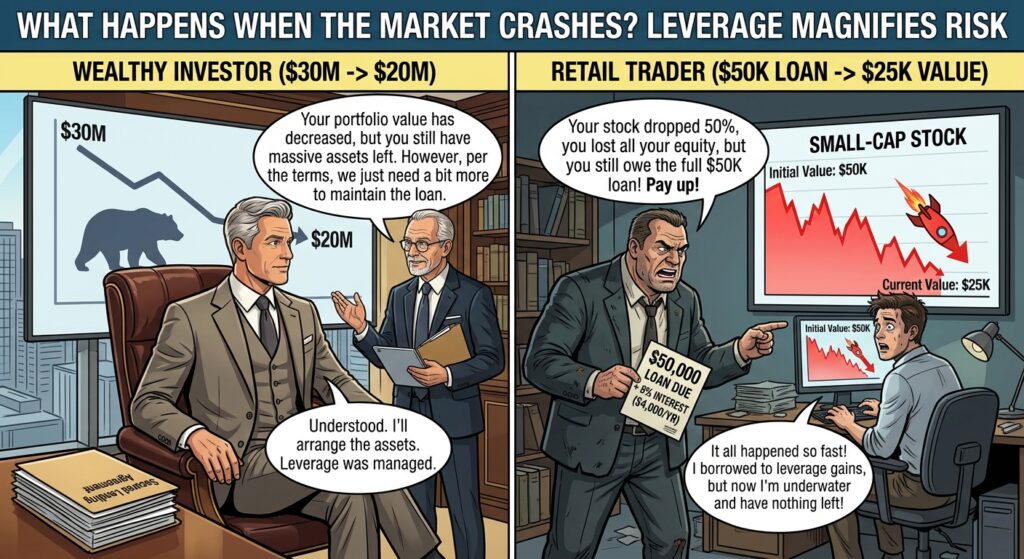
Imagine a wealthy investor holding a $30 million portfolio that falls to $20 million. Although the portfolio has lost substantial value, the investor still owns significant assets.
However, the lender may reduce borrowing limits or demand additional collateral.
Now consider a retail trader who borrows $50,000 and invests everything in a small-cap stock.
If the stock loses 50% of its value, the investment is worth only $25,000. Nevertheless, the bank still expects repayment of the original $50,000, plus interest.
This is why leveraged stock trading can become dangerous during market downturns.
Borrowing does not eliminate investment risk. Instead, it magnifies the financial consequences of a losing investment.
Can Borrowing Money to Buy Stocks Be Profitable?
Yes, borrowing money to invest can generate profits when investment returns exceed borrowing costs. However, investors must consider interest rates, trading expenses, taxes and potential losses.
For example, borrowing $50,000 at 8% creates approximately $4,000 in annual interest expenses if the balance remains outstanding for a full year.
The investment must generate more than that amount simply to cover the borrowing cost.
Furthermore, investors should consider what happens if the market declines 20%, 30% or even 50%.
Unlike cash investments, borrowed money creates a repayment obligation regardless of market performance.
Consequently, investors should never assume that a rising stock price will automatically produce a profitable leveraged investment.

The Bottom Line: Wealthy Investors Borrow Differently
The Buy, Borrow, Die strategy and trading stocks with a loan demonstrate two very different approaches to using debt.
Wealthy investors borrow against accumulated assets to access liquidity while potentially preserving long-term investments. Retail traders, on the other hand, may borrow money to purchase stocks and generate returns.
The fundamental difference is that one approach uses existing wealth as collateral, while the other uses debt to pursue future investment gains.
Ultimately, wealthy investors often borrow because they already have wealth, while retail traders sometimes borrow because they hope to build it.
Before using a bank loan to invest in the stock market, understand the interest costs, calculate potential losses and make sure you can repay the debt even if your investments decline.