
Stay Updated
Democrats’ AI Data Center Crackdown: Is America’s $1 Trillion AI Boom in Danger?
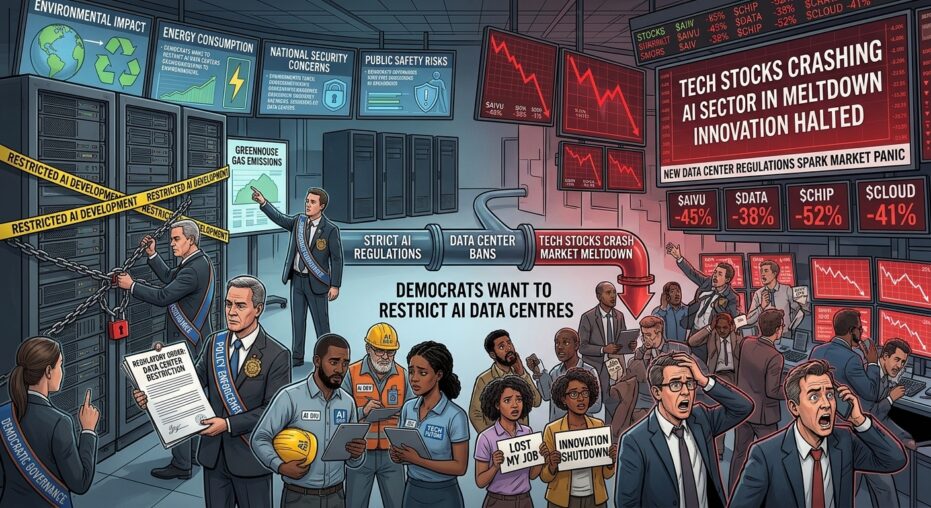
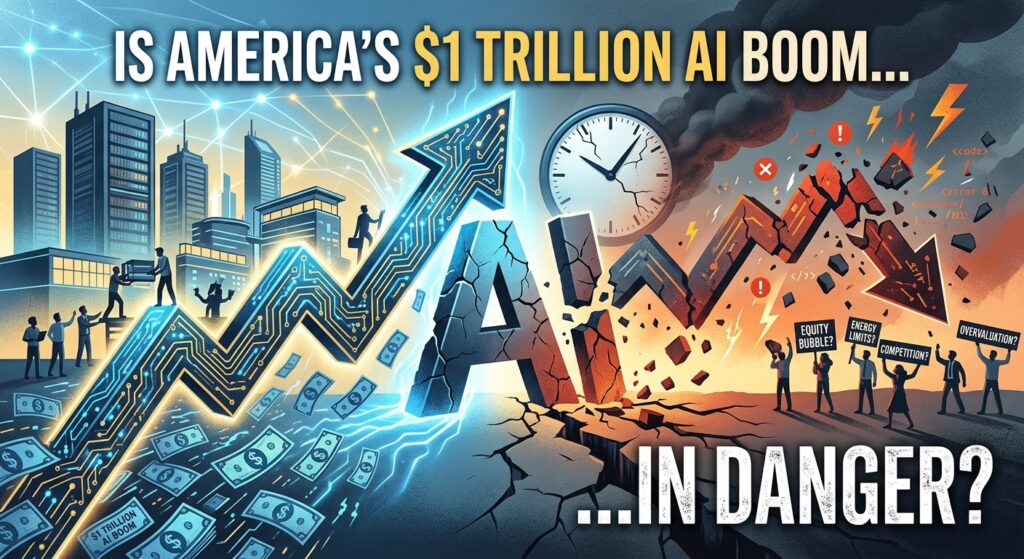
America’s artificial intelligence industry faces a new political challenge as public opposition to massive AI data centres begins influencing national politics. Following the November 2026 midterm elections, Democrats gained control of both chambers of Congress, while voters across several states pushed back against the rapid expansion of AI data centres. The election results have raised serious questions about the future of America’s AI infrastructure boom, particularly as technology giants race to build facilities capable of supporting increasingly powerful AI models. Companies such as Nvidia, Microsoft, Amazon, Google and Meta depend on enormous computing capacity to develop and deliver their next generation of artificial intelligence services. However, communities are increasingly questioning whether these projects bring enough local benefits to justify their demands for electricity, water and public infrastructure. As a result, the political debate is shifting from technological innovation toward energy costs, environmental pressure, corporate responsibility and national competitiveness. Although technology companies continue investing billions in computing capacity, growing public opposition could make their expansion more expensive, complicated and politically controversial. The emerging conflict also presents Washington with a difficult choice: protect consumers and local communities without slowing America’s race to lead the global AI industry.
AI Data Center Crackdown: Democrats Gain Political Momentum Against AI Data Centre Expansion
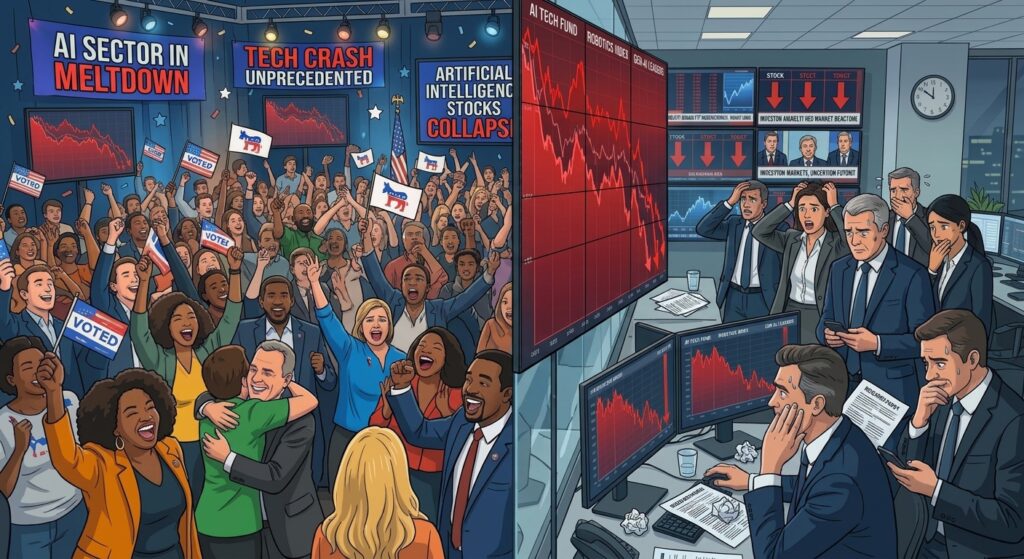
The Democrats’ AI data center crackdown has gained momentum as communities increasingly question the impact of large facilities on electricity prices, water supplies and local infrastructure. According to reporting on the November 3 elections, voters favoured restrictions on data-centre development in 40 of 41 local ballot-measure contests tracked by Ballotpedia. These measures did not all impose outright bans. Instead, they included zoning restrictions, temporary moratoriums and other limits on new projects.
The political shift also reached state leadership. Data Center Watch figures reported by the Associated Press indicated that 32 of 34 winning gubernatorial candidates supported stronger regulation or restrictions on data-centre development. Some candidates also backed bans or temporary pauses. Consequently, technology companies now face a more challenging political environment as they seek approval for new facilities across the country.
AI Data Center Crackdown: Why Democrats Want to Restrict AI Data Centres
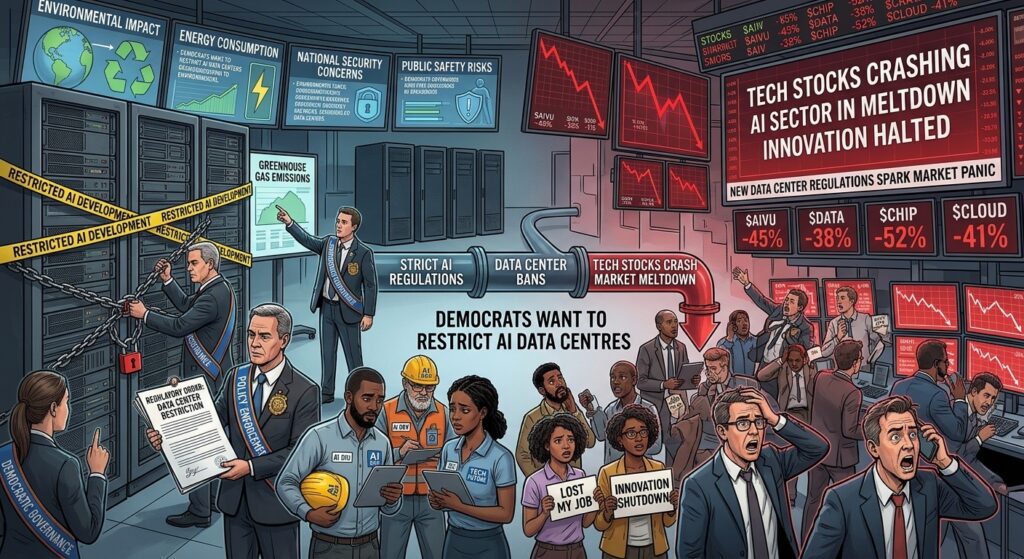
The growing opposition reflects concerns that AI data centres consume enormous amounts of electricity and water. These facilities require powerful servers, cooling systems and reliable energy supplies to operate continuously. As technology companies build larger campuses, nearby communities worry that additional electricity demand could increase household bills and put pressure on existing power networks.
Democratic lawmakers have increasingly focused on making technology companies pay for the infrastructure required to support their projects. The debate also gained momentum after the House passed legislation aimed at preventing AI data centres from shifting electricity costs onto ordinary consumers. However, the proposal does not automatically establish a nationwide restriction. Instead, it highlights growing political pressure for Big Tech companies to cover more of the costs associated with their energy demand.
AI Data Center Crackdown: Nvidia, Microsoft and Amazon Face New AI Investment Risks
The political backlash creates uncertainty for companies investing heavily in AI infrastructure. Nvidia supplies the advanced processors that power many AI systems, while Microsoft and Amazon continue expanding their cloud-computing and data-centre operations. Google and Meta are also investing heavily in computing capacity to support their artificial intelligence ambitions.
However, tighter regulations could increase project costs, delay construction approvals and complicate access to electricity. Companies may need to negotiate additional requirements with state governments, local authorities and utility providers. For investors, the central concern is whether rising infrastructure costs and regulatory uncertainty could affect the speed and profitability of AI expansion.
AI Data Center Crackdown: Wall Street Reacts as AI Infrastructure Stocks Face Uncertainty
Investors have started paying closer attention to the political risks surrounding the AI infrastructure boom. Reuters reported that data-centre-related shares came under pressure following the midterm results, while renewable-energy companies attracted attention as investors assessed the possibility of stronger regulation and changes in energy policy.
Nevertheless, political opposition does not automatically mean that America’s AI investment cycle will collapse. Demand for advanced chips, cloud computing and AI services remains an important driver of technology spending. The bigger question is whether companies can continue expanding at the same pace while managing higher electricity costs, stricter permitting requirements and growing community resistance.
AI Data Center Crackdown: Could Washington Stop America’s AI Infrastructure Boom?
Despite the election results, Democrats cannot immediately impose a nationwide ban on AI data centres. The incoming Congress must still pass legislation, and any major federal restrictions would face political and legal challenges. President Donald Trump also remains in office and could oppose measures that threaten his administration’s technology and investment priorities.
As a result, state and local governments may have a more immediate influence over where companies build new facilities. Local zoning decisions, environmental reviews, electricity agreements and construction permits could determine whether individual projects move forward. This creates a complicated landscape for technology companies because regulations may differ significantly between states and communities.
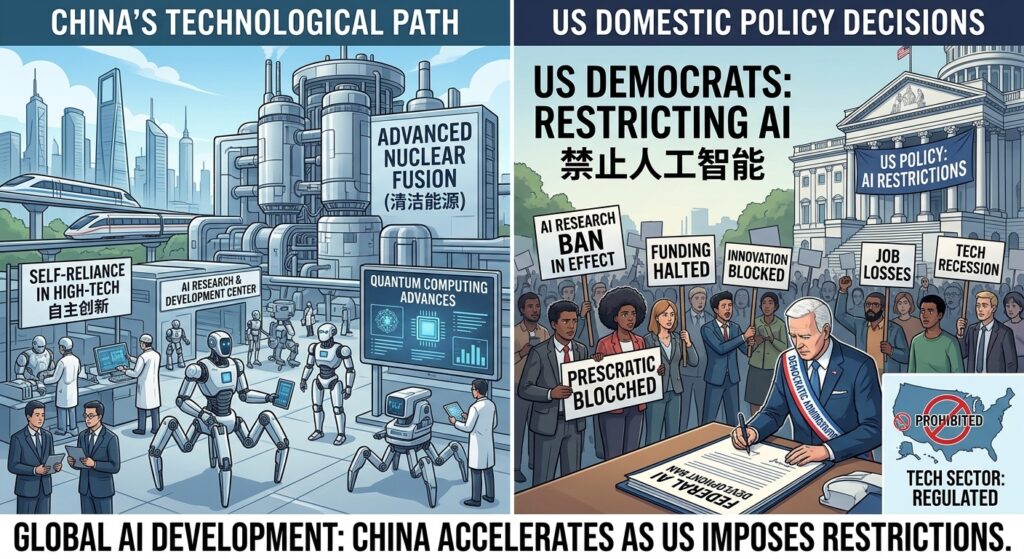
AI Data Center Crackdown: National Security May Ultimately Decide America’s Superintelligence Race
However, the political battle over AI data centres could become much bigger than electricity bills, water consumption or local planning restrictions. America’s intelligence and national security agencies may have a powerful influence on how Washington approaches AI expansion, particularly as the race toward superintelligence intensifies. US officials increasingly view advanced AI as a strategic technology, while China and Russia continue developing capabilities that could challenge America’s technological advantage. North Korea also presents a growing threat through sophisticated cyber operations and cryptocurrency thefts.
The reported North Korean cryptocurrency attack involving Binance adds another dimension to these concerns. The FBI has attributed major cryptocurrency theft activity to North Korean state-linked hackers, highlighting how hostile groups can exploit financial and digital infrastructure. Such incidents demonstrate that cybersecurity, artificial intelligence and national security are increasingly connected. For Washington, the strategic question is no longer simply whether AI data centres consume too much power, but whether slowing their expansion could weaken America’s technological and security position.
Consequently, intelligence assessments, defence priorities and competition with rival powers could carry significant weight alongside political pressure from voters. Even lawmakers demanding tougher restrictions may face a difficult choice: protect communities from the costs of rapid data-centre expansion without giving China, Russia or North Korea an advantage in advanced technology. Ultimately, national security could become one of the strongest arguments for keeping America’s AI infrastructure expansion on track, even as the political backlash against data centres grows.