
Stay Updated
Former Infosys CEO Vishal Sikka Launches AI Startup Hang Ten Systems, Raises $32 Million to Transform Enterprise Software
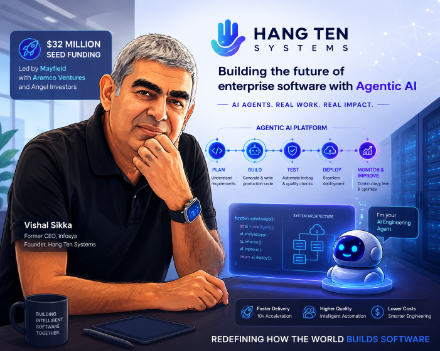
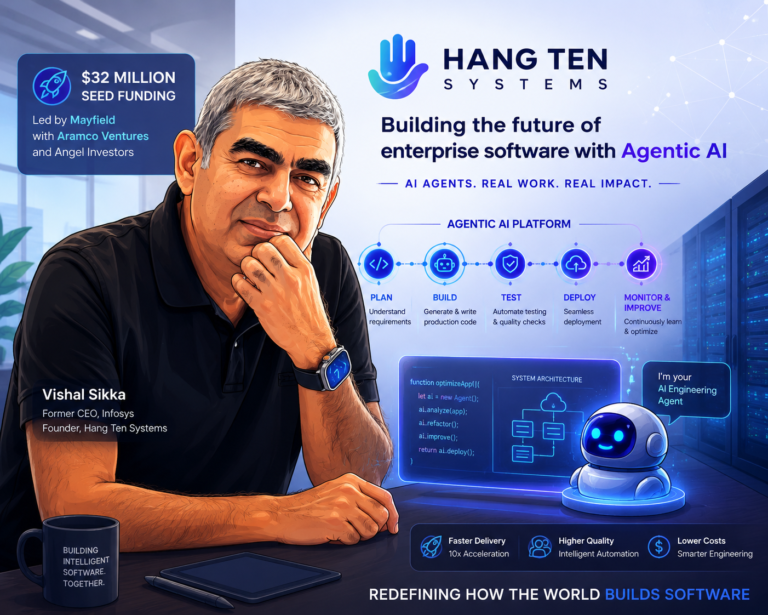
The enterprise technology industry is entering a new phase as former Infosys CEO Vishal Sikka launches his latest artificial intelligence venture, Hang Ten Systems. The startup has emerged from stealth with $32 million in seed funding, demonstrating strong investor confidence in its mission to reinvent enterprise software engineering through AI-powered automation. Mayfield led the funding round, while Aramco Ventures and several angel investors also backed the company.
Unlike many AI startups that focus on chatbots or productivity assistants, Hang Ten Systems is building an AI-native enterprise engineering platform. The company wants intelligent AI agents to work alongside software engineers throughout the entire software lifecycle. Its long-term goal is to help enterprises build, modernize, test, maintain, and optimize applications faster while reducing development costs and improving software quality.
A New Approach to Enterprise Software Development
For decades, enterprises have relied on large engineering teams to design, build, and maintain software. As businesses expanded, they hired more developers to meet growing technology demands. This model helped create today’s global IT services industry, but it also increased costs and extended software delivery timelines.
Hang Ten Systems believes artificial intelligence can fundamentally improve this process.
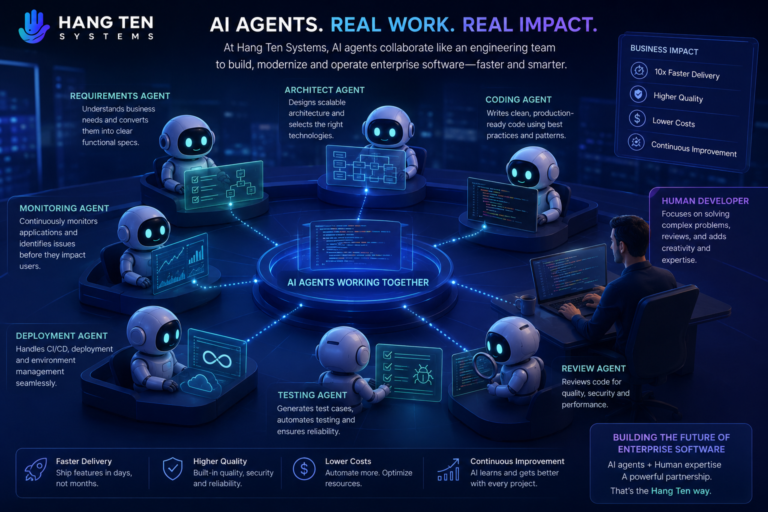
Instead of treating AI as a simple coding assistant, the company is developing intelligent software agents that actively collaborate with engineers across every stage of application development. These AI agents can automate repetitive engineering tasks, assist with software architecture, modernize legacy applications, improve testing, and continuously optimize enterprise systems.
As a result, organizations could deliver software more quickly while allowing engineers to focus on solving complex business challenges.
Why Vishal Sikka’s Leadership Matters
Vishal Sikka brings decades of experience in enterprise technology and artificial intelligence.
Before joining Infosys, he served as Chief Technology Officer at SAP, where he helped develop innovative enterprise software platforms. In 2014, he became the first non-founder CEO of Infosys and accelerated the company’s investments in automation, cloud computing, and AI-driven digital transformation.
Following his departure from Infosys, Sikka founded VianAI, an enterprise AI company focused on helping organizations use artificial intelligence for business intelligence and decision-making.
Now, Hang Ten Systems represents his most ambitious venture yet. Rather than using AI only to generate insights, the startup aims to build AI systems capable of performing meaningful software engineering work. Moreover, Sikka’s proven track record gives investors confidence that the company understands the complex requirements of enterprise customers.
Building AI That Works Like an Engineering Team
Most AI coding assistants generate code snippets or help developers complete individual programming tasks. Hang Ten Systems is pursuing a much broader vision.
The company wants AI agents to understand complete enterprise software systems instead of isolated files or functions. These intelligent agents can potentially generate production-ready software, modernize legacy applications, detect bugs, improve performance, automate testing, recommend architectural improvements, and assist developers throughout long-term maintenance.
Furthermore, the AI platform continuously learns from previous engineering projects, enabling it to improve over time as it supports more enterprise workloads.
This collaborative approach positions AI as an engineering partner rather than a replacement for human expertise.
Challenging the Traditional IT Services Industry
Hang Ten Systems enters a market long dominated by traditional IT services companies such as Infosys, TCS, Wipro, and Accenture.
Historically, these firms expanded by hiring more software engineers as customer demand increased. While this outsourcing model fueled decades of growth, generative AI is beginning to reshape how enterprise software gets built.
Today, advanced AI models can write code, automate testing, identify vulnerabilities, generate documentation, and assist with debugging. Hang Ten Systems combines these capabilities into a unified enterprise platform that reduces repetitive engineering work while improving productivity.
Instead of scaling primarily through workforce expansion, the company believes future IT services will increasingly scale through intelligent AI agents working alongside highly skilled engineering teams.
If successful, this model could significantly change how enterprises purchase software development and modernization services.
Strong Investor Confidence
Launching with $32 million in seed funding gives Hang Ten Systems substantial momentum at an early stage.
Mayfield led the investment, while Aramco Ventures joined the round alongside several experienced angel investors. Their backing reflects growing confidence in enterprise AI infrastructure and AI-powered software engineering.
Furthermore, the funding allows Hang Ten Systems to accelerate product development, expand its engineering organization, recruit top AI researchers, and strengthen its enterprise platform before entering broader markets.
Strong financial support also positions the startup to compete for talent in one of today’s fastest-moving technology sectors.
An Experienced Leadership Team
One of Hang Ten Systems’ greatest strengths is its experienced leadership team.
Sikka has assembled executives and engineers with backgrounds spanning SAP, Infosys, and VianAI. Their combined expertise covers enterprise software architecture, artificial intelligence, cloud infrastructure, and large-scale business transformation.
This experience enables the company to build enterprise-grade AI solutions that meet demanding requirements for security, scalability, reliability, compliance, and seamless integration with existing business systems.
Why Enterprise AI Continues to Grow
Meanwhile, enterprises around the world are rapidly moving artificial intelligence from experimentation into everyday business operations.
Organizations want AI to improve productivity, reduce operating costs, accelerate digital transformation, and modernize aging software infrastructure. At the same time, many companies continue to rely on legacy applications that require significant maintenance and upgrades.
Hang Ten Systems addresses these challenges by using intelligent AI agents to simplify software engineering while helping organizations modernize critical business systems more efficiently.
As AI capabilities continue advancing, enterprise software engineering has become one of the largest opportunities for intelligent automation.
Looking Ahead
Hang Ten Systems enters the market as enterprises increasingly seek AI-first software development solutions. Although competition continues to grow, the company distinguishes itself by focusing on intelligent AI agents that participate throughout the complete software development lifecycle rather than simply generating code.
The timing also reflects a broader transformation taking place across the global technology industry. While Hang Ten Systems is headquartered in the United States, Vishal Sikka’s leadership highlights the growing influence of Indian technology pioneers in shaping enterprise AI worldwide. At the same time, the Indian startup ecosystem is thriving, with a new generation of AI agentic startups attracting investor attention across healthcare, finance, enterprise software, manufacturing, and automation. India is also expanding its AI infrastructure and next-generation data centers, creating the computing capacity needed to train and deploy increasingly sophisticated AI models. As investment, talent, and infrastructure continue to grow together, India is positioning itself as one of the world’s leading hubs for enterprise AI, intelligent automation, and the next wave of AI-powered innovation.