
Stay Updated
The AI Memory Squeeze: Why Micron Is Beating Big Tech in 2026
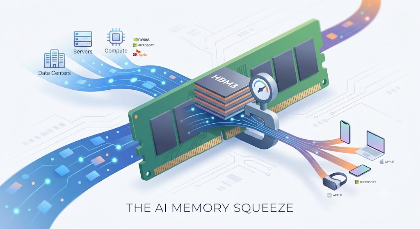
The global technology industry is undergoing a major structural shift in 2026, now called the AI Memory Squeeze. Artificial intelligence remains the primary growth engine, but the way value is distributed across the sector is changing quickly. Instead of lifting all technology companies equally, the AI boom is concentrating profits in a much narrower part of the supply chain.
The AI Memory Squeeze highlights a simple but important reality: AI growth is no longer limited by software innovation. It is increasingly constrained by memory chips, bandwidth, and physical infrastructure.
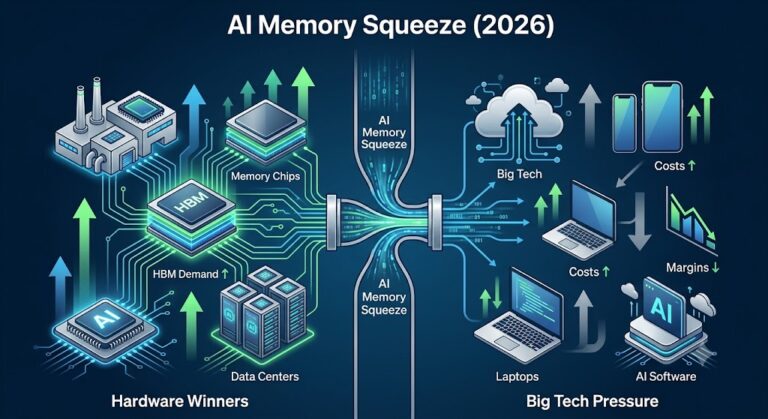
As a result, the tech market is splitting into two clear groups—hardware companies that supply AI infrastructure and big tech companies that build products and services on top of it.
A Tech Market Splitting in Two
The AI economy in 2026 is forming two distinct layers.
The first layer includes semiconductor and memory manufacturers. These companies design and produce the chips and components that power AI data centers, cloud systems, and advanced computing workloads.
The second layer includes big tech and software platforms. These firms build AI models, cloud services, consumer devices, and enterprise software that depend on that hardware.
For years, software companies captured most of the value in technology cycles. However, AI has changed the structure of demand. As models become larger and more complex, the real bottleneck has shifted from software capability to physical computing infrastructure.
This change is not temporary. It reflects a deeper shift in how AI systems are built and scaled.
Why Memory Has Become the Core of AI
Modern AI systems are extremely data-intensive. They do not simply process information—they constantly move, store, and retrieve massive datasets in real time.
Every AI workload involves continuous memory activity, including loading neural networks, storing intermediate results, and handling large-scale training data. This makes memory bandwidth one of the most critical components in AI performance.
A key technology enabling this is High-Bandwidth Memory (HBM). HBM allows AI chips to access and process data at extremely high speeds, which is essential for training large AI models and running real-time applications.
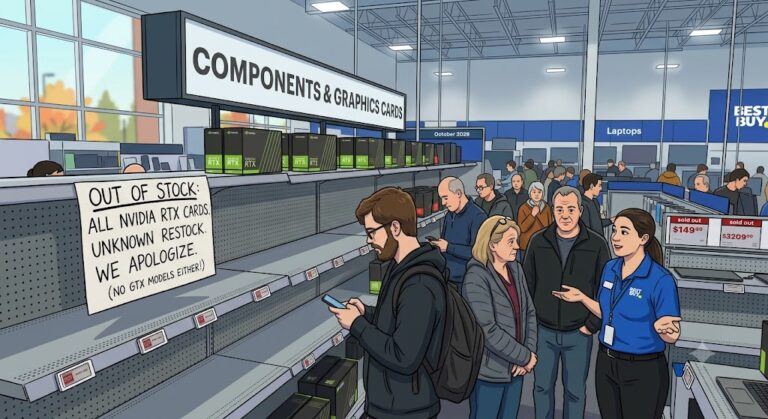
However, demand for HBM and other advanced memory technologies has surged far faster than supply. AI data centers are expanding rapidly, but memory production capacity takes years to scale.
This imbalance between demand and supply is at the core of the AI Memory Squeeze.
Micron’s Strategic Position in the AI Boom
One of the biggest beneficiaries of this shift is Micron Technology.
Micron produces DRAM and NAND memory chips, which are essential components in everything from consumer electronics to AI data centers. In the AI era, these chips have become even more important because they directly support large-scale computing workloads.
As demand has increased, Micron has gained stronger pricing power. In a supply-constrained market, customers have limited alternatives, allowing memory producers to raise prices and secure stronger margins.
Recent earnings strength and investor interest reflect this reality. Markets are increasingly recognizing that AI expansion depends heavily on memory availability.
Without sufficient memory supply, AI systems cannot scale efficiently. This gives companies like Micron a critical role in the AI ecosystem.
In simple terms, Micron is not just benefiting from AI growth—it is enabling it.
Big Tech Faces Rising Cost Pressure
While semiconductor companies benefit from rising prices, big tech companies are facing increasing cost pressure.
Memory chips are used across almost every modern technology product, including smartphones, laptops, gaming consoles, cloud infrastructure, and AI training systems.
As memory prices rise, these costs flow upward through the entire technology stack. This makes AI infrastructure significantly more expensive to operate.
Big tech companies are now forced to respond in different ways. Some are increasing subscription prices, others are raising cloud service fees, and many are adjusting device pricing strategies to absorb higher input costs.
This marks a major shift in the industry: the cost of AI is no longer hidden. It is increasingly being passed on to consumers and enterprise customers.
The Risk: Will Demand Stay Strong?
A key concern for investors is whether the market can absorb rising prices.
Technology demand is historically sensitive to price increases. Even moderate price hikes can affect consumer behavior, especially in hardware markets.
If memory shortages continue, companies will face a difficult decision. They can either absorb higher costs and reduce profit margins, or pass those costs on to customers and risk slower demand.
For example, a 10–15% increase in device prices could delay upgrade cycles. Consumers may hold onto devices longer or shift to cheaper alternatives, which can impact overall sales growth.
This creates uncertainty for big tech earnings, even in a strong AI demand environment.
Why Investors Are Moving Toward Chipmakers
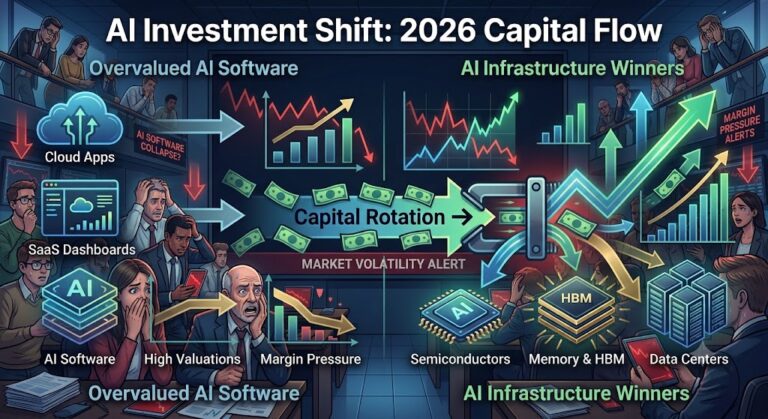
As pressure builds on software companies, capital is shifting toward semiconductor and memory manufacturers.
The logic is increasingly clear:
- AI demand is long-term and structural
- Memory is a constrained and essential resource
- Supply cannot scale quickly
- Pricing power sits upstream in the value chain
This creates a favorable environment for chipmakers.
Companies like Micron Technology, Samsung Electronics, and SK Hynix are benefiting directly from this imbalance. They control a critical bottleneck in the AI infrastructure stack.
Meanwhile, software companies must manage rising costs while competing in already crowded markets.
Cyclical or Structural Shift?
There are two major views on the AI Memory Squeeze.
The Cyclical View
Some analysts argue this is a normal semiconductor cycle. They believe:
- Supply shortages are temporary
- Manufacturers will expand capacity over time
- Prices will eventually stabilize
- Profit margins will normalize
In this view, today’s strong pricing power may fade as supply catches up with demand.
The Structural View
Others believe this is a long-term structural shift driven by AI itself.
They argue that AI demand is fundamentally different because:
- Model sizes continue to grow rapidly
- Training and inference require constant memory access
- Data movement is becoming more important than computation
- Global AI infrastructure is expanding continuously
Under this scenario, memory is not a cyclical commodity. It becomes a permanent foundation of the AI economy.
The New Rule of Tech Investing
The AI era is changing how investors evaluate technology companies.
Instead of focusing only on user growth or platform scale, the key question has shifted to:
Who has pricing power in the AI stack?
Companies that can raise prices without losing demand, control supply constraints, and protect margins are emerging as long-term winners.
Right now, that advantage is concentrated in semiconductor and memory companies.
A Divided AI Economy
The AI revolution is not benefiting all technology companies equally. Instead, it is creating a divided market structure.
On one side are hardware companies benefiting from strong demand, limited supply, and rising prices. On the other side are big tech firms facing higher costs and margin pressure.
This divide is likely to continue throughout 2026 as AI infrastructure expands globally.
The biggest winners of this cycle will not necessarily be the companies building AI applications. Instead, they will be the companies powering the foundation beneath them.
That is the essence of the AI Memory Squeeze.
And at the center of this transformation stands Micron Technology, which is becoming one of the most strategically important companies in the entire AI-driven economy.