
Stay Updated
AI Integration Agencies in Action: Real-World Examples and Their Growing Impact
As artificial intelligence becomes a core part of modern business, AI integration agencies are playing a critical role in turning AI from a promising technology into a practical business tool. These agencies help organizations adopt, customize, and embed AI systems into real-world workflows so that they improve efficiency, decision-making, and overall performance.
Unlike companies that only build AI models, AI integration agencies focus on making AI usable inside existing business systems. This includes connecting AI to enterprise software, ensuring data readiness, automating workflows, and maintaining ethical and secure deployment. Their role has become increasingly important as more organizations realize that simply having access to AI tools is not enough—successful implementation is what truly creates value.
Below are real-world examples showing how AI integration is already reshaping industries.

Accenture and Enterprise AI Transformation
A major global example of AI integration in action is Accenture, which has been actively helping large enterprises adopt generative AI across business functions.
Accenture works with organizations to integrate AI systems into customer service platforms, internal workflows, and enterprise analytics tools. Instead of building standalone AI applications, they focus on embedding AI directly into daily business operations.
They are developing AI copilots for enterprise employees, integrating generative AI into customer support systems, automating reporting and documentation, and enhancing decision-making through predictive models.
In retail and service-based industries, AI systems built through Accenture’s integration frameworks help reduce customer support workload by automating responses to common queries. Human agents are then able to focus on more complex cases, improving efficiency and customer satisfaction.
This reflects the core role of AI integration agencies: embedding intelligence into existing systems without disrupting operations.
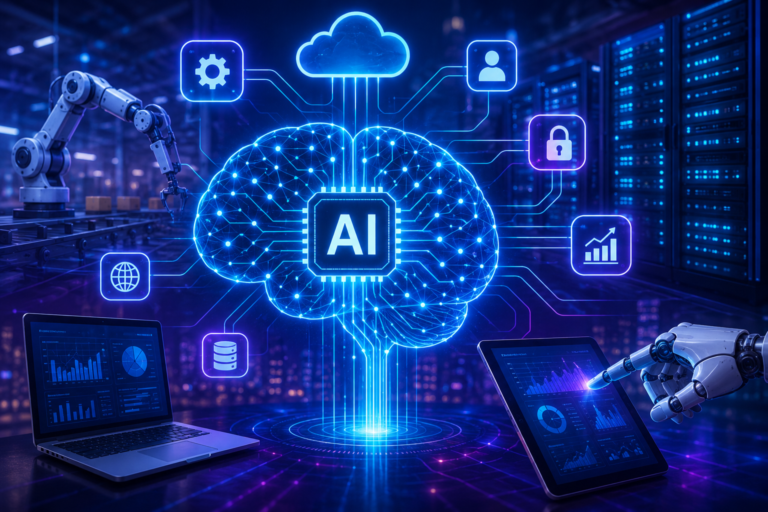
AI Integration in Biorefinery Operations Drives Major Efficiency Gains
Artificial intelligence is reshaping biorefinery operations as companies actively deploy advanced digital systems to improve efficiency, cut costs, and accelerate carbon neutrality goals. Increasingly, operators use AI-powered predictive maintenance tools to identify equipment issues before failures occur, and as a result, they reduce downtime and avoid costly disruptions. In addition, firms implement process optimization algorithms that continuously adjust production parameters, which helps maximize feedstock conversion and improve overall output quality.
Moreover, digital twin technology plays a key role by allowing engineers to simulate real-time operations and test performance scenarios without interrupting physical production. This approach enables faster decision-making and more precise control over energy consumption. Consequently, biorefineries achieve higher operational efficiency while simultaneously lowering emissions. According to industry reporting, large-scale AI adoption in this sector has already generated up to hundreds of millions of dollars in annual savings, particularly through improved resource utilization and reduced maintenance costs.
Meanwhile, companies continue to scale these solutions as global demand for low-carbon fuels and sustainable chemicals rises. Ultimately, AI strengthens the sector’s ability to balance profitability with environmental responsibility, and it positions biorefineries to meet stricter climate targets while maintaining competitive industrial performance.
Microsoft and the AI Copilot Ecosystem
Another major example of large-scale AI integration is Microsoft, which has embedded generative AI into its productivity ecosystem.
Microsoft has integrated AI copilots into widely used tools such as Word, Excel, Outlook, and Teams. This is not just an added feature—it is a full-scale integration of AI into workplace infrastructure.
AI is embedded directly into productivity software, connected securely with enterprise data, and designed to support employees in generating content, summaries, and analysis instantly while automating repetitive office tasks across departments.
Organizations in finance, consulting, and technology are now using AI copilots to summarize meetings, draft professional emails and reports, analyze large datasets in spreadsheets, and generate insights from internal documents.
This is a strong example of AI integration at scale, where AI becomes part of everyday workflows rather than a separate tool.
Morgan Stanley and Financial AI Integration
A highly important example from the financial sector is Morgan Stanley, which has integrated GPT-based AI systems into its wealth management division.
Morgan Stanley has built internal AI assistants for financial advisors and connected these systems to thousands of research reports and market documents. This enables instant retrieval of financial insights and supports personalized advisory services.
Financial advisors can now quickly access relevant research and generate insights tailored to individual clients. Instead of manually searching through large volumes of reports, advisors rely on AI to surface the most relevant information in seconds.
This improves both speed and accuracy in financial decision-making and demonstrates how AI integration agencies operate in high-trust, regulated industries.
Klarna and AI-Powered Customer Service
A well-known example in fintech and e-commerce is Klarna, which has deployed an AI-driven customer support system.
Klarna integrated an AI chatbot into its customer service platform to handle large volumes of customer queries, especially routine and repetitive support requests. The system has automated millions of customer interactions and significantly reduced reliance on human support agents for basic queries.
This allows faster response times and improves scalability during high-demand periods. Customer queries such as order tracking, refunds, and payment issues are now handled efficiently through AI systems.
This demonstrates how AI integration agencies help businesses reduce operational costs while improving service quality through automation.
Indian IT Giants and Enterprise AI Integration
In the global IT services sector, companies like Tata Consultancy Services and Infosys are playing a major role in AI integration for large enterprises.
These organizations function as large-scale AI integration providers for banks, airlines, governments, and multinational corporations.
They are integrating AI into legacy enterprise systems, building predictive analytics platforms for business operations, deploying automation solutions across finance, HR, and supply chains, and supporting digital transformation for both private and public sectors.
In banking and insurance, AI is used to detect fraud in real time, automate claims processing, and improve customer onboarding. In manufacturing and logistics, AI systems optimize supply chains, reduce downtime, and improve forecasting accuracy.
These companies demonstrate how AI integration agencies operate at massive scale, transforming entire industries rather than isolated processes.
What These Examples Show About AI Integration Agencies
Across all these cases, a clear pattern emerges. AI integration agencies are not just technology providers—they are transformation partners.
They ensure that AI tools are connected to real business systems, data is properly structured and usable, employees can actually use AI in daily workflows, systems remain secure, ethical, and compliant, and businesses achieve measurable results rather than just experimentation.
Without integration, AI remains fragmented and underutilized. With integration, it becomes a core driver of productivity and innovation.
The Bigger Picture
The role of AI integration agencies will continue to grow as AI becomes more advanced and widely adopted. With the rise of generative AI, autonomous systems, and real-time analytics, businesses will increasingly depend on experts who can bridge the gap between technology and execution.
In the future, these agencies will not only implement AI systems but also continuously optimize them, ensuring long-term adaptability and performance. They will become essential partners in digital transformation across industries.
AI integration agencies are at the center of the global AI revolution. Through real-world examples like Accenture, Microsoft, Morgan Stanley, Klarna, Tata Consultancy Services, and Infosys, it is clear that AI is no longer just about innovation—it is about integration.
These agencies ensure that AI moves beyond theory and becomes a practical, scalable, and responsible force inside modern organizations. As industries continue to evolve, AI integration agencies will remain key enablers of productivity, efficiency, and long-term economic growth.