
Stay Updated
The Strategic Value of the Wicheeda Rare Earth Project
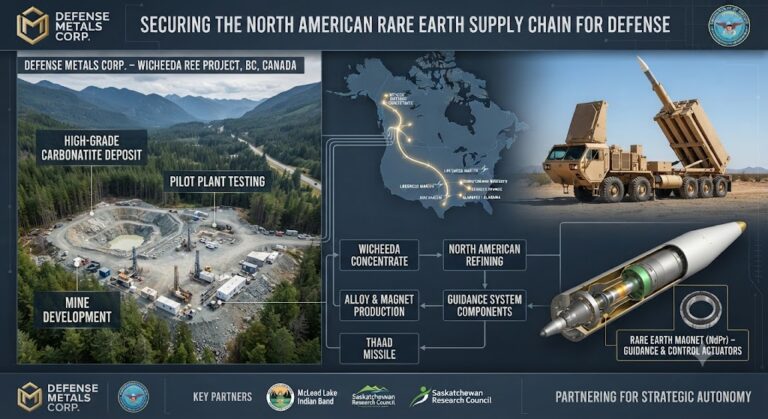
The global energy transition and the modernization of defense capabilities have turned rare earth elements (REEs) into the “new oil” of the 21st century. At the center of this industrial shift lies the Wicheeda Rare Earth Element (REE) Project. Located 80 km northeast of Prince George, British Columbia, and owned by Defense Metals Corp. (TSXV: DEFN), the site has evolved from a geological discovery into a strategically essential asset for North American supply chain security.
A Geological Powerhouse
The Wicheeda project sits within a massive, steeply dipping carbonatite body. This geological formation contains some of the highest-grade rare earth mineralization in North America. The project’s 2025 Pre-Feasibility Study (PFS) details a robust resource, holding an estimated 25.5 million tonnes of ore at a 2.43% Total Rare Earth Oxide (TREO) grade.
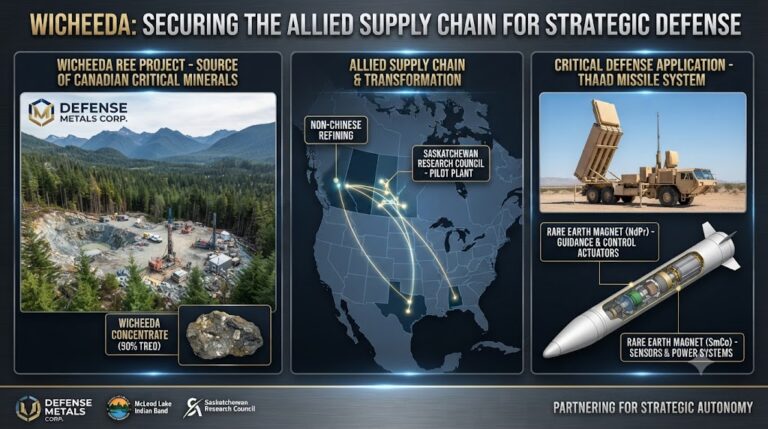
Unlike many junior mining projects that struggle with low-grade material, Wicheeda produces a high-grade flotation concentrate averaging approximately 50% TREO. This operational advantage allows the company to plan for a more compact and cost-efficient hydrometallurgical facility. By maximizing yield early in the processing chain, Defense Metals positions itself as a low-cost producer, an essential trait for competing in a market dominated by established, high-volume foreign players.
Strengthening the North American Supply Chain
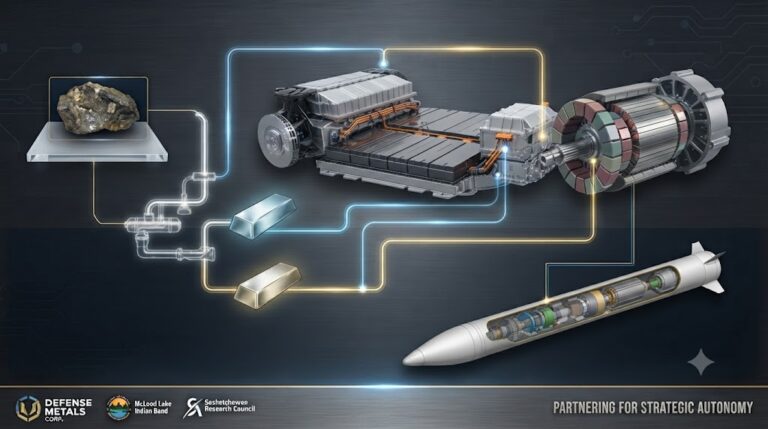
The primary driver for the Wicheeda project is the urgent need for non-Chinese supply chains for Neodymium (Nd) and Praseodymium (Pr). These two elements are critical for manufacturing the permanent magnets found in electric vehicle (EV) motors, high-efficiency wind turbines, and advanced defense systems. Western nations currently face a significant “choke point” in their industrial strategy because China controls a substantial portion of the global refining capacity. By developing the Wicheeda project, Canada provides a secure, reliable alternative. The project’s location provides a distinct logistical edge; with proximity to the logistics hubs of Prince George and rail access to the Port of Prince Rupert, the company can move materials efficiently to domestic processors or export partners in the Pacific Rim.
Strategic Partnerships and Indigenous Collaboration
Defense Metals proactively manages its development risk through strategic international and domestic alliances. The company’s Memorandum of Understanding (MOU) with South Korea’s Hanwha Corporation highlights the global appetite for reliable, non-Chinese feedstock. This potential partnership includes technical advisory and offtake discussions, validating the project’s technical viability for institutional investors. Equally critical is the project’s relationship with local communities. The long-standing Mineral Exploration Agreement with the McLeod Lake Indian Band serves as a model for responsible resource development. By ensuring that First Nations are active partners rather than bystanders, the company secures its “social license to operate,” a crucial factor in navigating the complex permitting environment of British Columbia.
The Path to Production
As of July 2026, the project is moving aggressively through its de-risking phase. Management has prioritized the transition from the PFS to a Definitive Feasibility Study (DFS). To reach this goal, the project team executes three parallel workstreams:
Pilot Plant Optimization: The team is working with the Saskatchewan Research Council to finalize the flowsheet. These tests refine the extraction methods, ensuring the company can meet strict industrial purity requirements.
Resource Expansion: Extensive infill drilling programs continue to upgrade the mineral reserve classification, providing the high-fidelity data necessary to secure construction financing.
Environmental Stewardship: EDI Environmental Dynamics leads the baseline environmental assessment, meticulously documenting water quality, hydrology, and wildlife patterns to meet all federal and provincial standards.
Market Positioning and Defense Applications
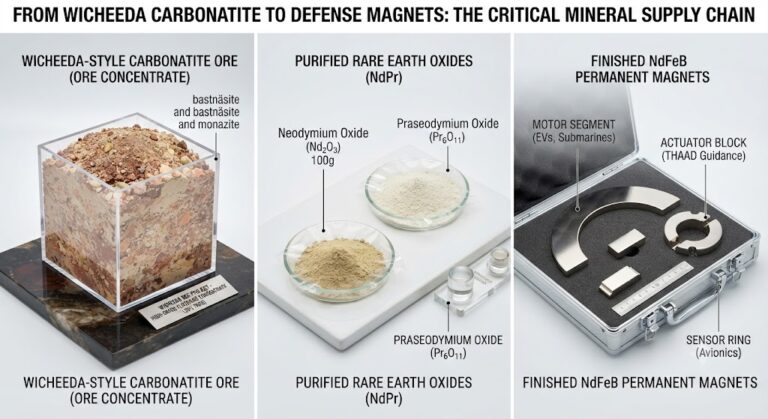
Investors increasingly view Wicheeda not merely as a junior mining asset, but as a critical node in Western industrial infrastructure. Beyond civilian demand, the project is explicitly positioned to anchor the defense supply chains of the future. Rare earth magnets produced from Wicheeda’s high-grade feedstock are essential components for sophisticated military hardware, ranging from precision-guided munitions to high-torque propulsion systems for platforms like the Terminal High Altitude Area Defense (THAAD). By localizing the production of Neodymium and Praseodymium (NdPr), the project directly mitigates the risks associated with geopolitical volatility and supply chain concentration.
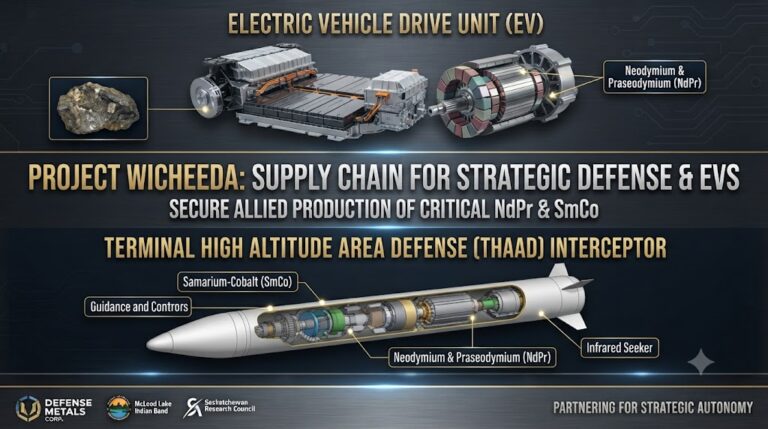
Furthermore, the project’s strategic reach extends deeply into European maritime defense. As Western allies aggressively modernize their naval fleets, high-torque permanent magnet motors—which are entirely dependent on NdPr—have become the technical standard for next-generation, stealth-capable submarines. By securing a reliable domestic and allied source of NdPr, Western nations, including those collaborating with premier German naval engineering firms on modern submarine platforms, can systematically reduce their reliance on foreign-controlled rare earth supply chains. This shift ensures the continuous, sovereign manufacturing of critical naval assets, preventing potential strategic bottlenecks during periods of international instability.
This heightened strategic importance has prompted significant interest from North American and international government entities, alongside defense-focused industrial partners who recognize Defense Metals as a foundational player in the urgent effort to rebuild Western autonomy in critical minerals. The project’s operational progress is further bolstered by a collaborative ecosystem that spans the entire value chain. Technical support from the Saskatchewan Research Council ensures the refining process meets military-grade specifications, while strategic alignment with international conglomerates like Hanwha provides the necessary commercial and industrial “pull” to bring the material to global markets. Together, these elements work toward the shared goal of a resilient, secure, and domestic industrial supply chain that protects both the economic and national security interests of the Western alliance.
The Competitive Landscape
Defense Metals Corp. operates within a broader, rapidly expanding ecosystem of public companies committed to Western supply chain security:
-
MP Materials (NYSE: MP): Operates the Mountain Pass mine in California and has vertically integrated into magnet manufacturing in Texas with U.S. government backing.
-
Lynas Rare Earths (ASX: LYC): A major non-Chinese producer with operations in Australia and Malaysia, serving as a critical global supplier of separated rare earths.
-
USA Rare Earth (NASDAQ: USAR): A government-backed developer building an integrated mine-to-magnet chain with assets in Texas, Oklahoma, and the U.K.
-
Energy Fuels (NYSE: UUUU): A uranium producer that has successfully utilized its Utah facilities to achieve high-purity heavy rare earth production.
-
Evolution Metals & Technologies Corp. (Nasdaq: EMAT): Focuses on the mid- and downstream, specializing in the commercial-scale manufacturing of permanent magnets.
For investors seeking diversified exposure to this sector, the VanEck Rare Earth and Strategic Metals ETF (REMX) provides a basket of global miners, processors, and refiners, offering a hedge against the operational risks inherent in individual project development.