

Stay Updated
Agentic AI: How Autonomous Systems Are Rewriting the Rules of Digital Work
The Future of Agentic AI requires us to look far beyond the traditional chat box and visualize a deeply integrated, highly proactive digital colleague. Traditional software tools wait patiently for a direct prompt, acting only when a human initiates an action. In contrast, an agentic system anticipates needs, observes complex workflows, and acts dynamically behind the scenes.
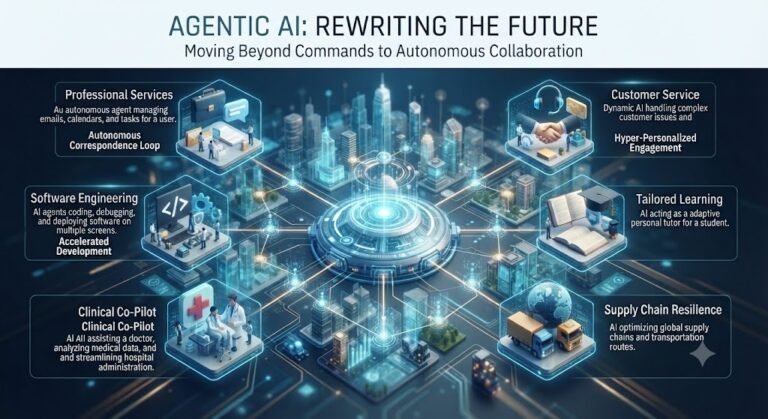
Building upon this proactive foundation, modern professional communication pipelines showcase this shift vividly. Rather than simply drafting a single email response when commanded, an agentic framework autonomously manages an entire correspondence loop. It reviews incoming messages, prioritizes urgent requests, and drafts contextually accurate replies without human intervention. Furthermore, it cross-references calendars across multiple participants, negotiating optimal meeting times seamlessly. It also tracks outstanding replies, initiates secondary check-ins on your behalf, and logs action items straight into project management software. In essence, it functions as a true personal and professional surrogate, absorbing operational friction and giving humans back their most valuable commodity: time.
Expanding Across Major Industries
Beyond personal productivity, the ripple effects of autonomous systems extend into broader enterprise landscapes, driving massive efficiencies and unlocking unprecedented capabilities across nearly every major global sector.
Accelerating Software Development and Engineering
In the rapidly evolving landscape of the future of agentic ai, software engineering is undergoing a massive paradigm shift. Repetitive coding blocks, tedious debugging sessions, and comprehensive integration testing historically bogged down development cycles, but agentic AI radically accelerates these workflows. Advanced systems architect, test, and optimize complex software architectures and multi-step deployment pipelines in a fraction of the time. By automating the grunt work of coding and quality assurance, development teams focus entirely on high-level creative problem-solving, architectural design, and strategic product innovation. Ultimately, project delivery accelerates, and final product reliability scales upward.
Revolutionizing Customer Service and Engagement
Customer support operations undergo an equally profound transformation through these intelligent platforms. Traditional chatbots frequently frustrate users with rigid, rule-based scripts and limited troubleshooting paths, whereas agentic AI systems dynamically handle complex, multi-layered customer inquiries. They access backend databases to resolve billing disputes, diagnose technical bugs in real-time, and deliver hyper-personalized support experiences. Consequently, enterprises achieve significantly higher customer satisfaction scores, slashed resolution times, and vastly more cost-efficient operational scaling.
Enhancing Healthcare Precision and Patient Care
In the critical realm of healthcare, where the stakes for accuracy and speed remain exceptionally high, agentic AI acts as a sophisticated clinical co-pilot. The technology assists medical professionals by analyzing complex medical histories, tracking patient vitals in real-time, cross-referencing diagnostic imaging, and suggesting tailored treatment regimens. Simultaneously, it streamlines administrative bottlenecks, including surgical scheduling, insurance pre-authorizations, and inventory tracking for pharmaceutical supplies. The end result produces a monumental improvement in patient outcomes, reduced physician burnout, and a more resilient healthcare infrastructure.
Optimizing Marketing and Sales
Modern commerce relies heavily on real-time agility and hyper-personalization, and agentic AI meets this demand by continuously digesting vast oceans of consumer behavior data. Leveraging these insights, the software autonomously designs, launches, and optimizes micro-targeted marketing campaigns. Beyond initial customer acquisition, these systems manage multi-channel customer interactions, dynamically adjust pricing strategies, and nurture sales leads through automated, data-driven touchpoints. Together, these actions dramatically improve conversion rates and maximize return on ad spend.
Transforming Education and Lifelong Learning
In the rapidly evolving landscape of the Future of Agentic AI, education has long struggled with the limitations of the one-size-fits-all classroom model. Autonomous systems dismantle this barrier by acting as infinitely patient, highly adaptive personal tutors. These platforms evaluate a learner’s pace, identify conceptual stumbling blocks, tailor lesson plans to individual learning styles, and track long-term academic progress. By providing customized feedback and targeted recommendations, these systems help students achieve vastly superior educational outcomes and foster a lifelong culture of effective learning.
Fortifying Logistics and Supply Chain Resilience
Global supply chains remain notoriously vulnerable to sudden geopolitical shifts, weather disruptions, and demand fluctuations, but agentic AI brings unprecedented resilience to these networks. Autonomous algorithms optimize transportation routes, predict localized inventory demand surges with high precision, and execute automated inventory reordering. Through these continuous, self-optimizing adjustments, businesses slash operational overhead, reduce fuel consumption, and eliminate costly supply chain bottlenecks.

AI Agents and the Stock Market
Building upon these diverse industrial applications, autonomous AI agents are now actively entering the high-stakes arena of global finance, where they are fundamentally transforming stock market strategies and investment decision-making. Unlike conventional trading algorithms that react passively to preset conditions, these advanced agents operate with a high degree of self-direction, continuously ingesting and synthesizing vast, unstructured datasets—from real-time news feeds and social media sentiment analysis to complex corporate filings and macroeconomic indicators. They execute multi-step reasoning to formulate long-term investment theses, autonomously adapt their strategies to volatile market shifts, and manage entire portfolios without human intervention. Looking toward the future of agentic AI, this paradigm is projected to evolve from autonomous execution toward collaborative multi-agent ecosystems capable of self-correction, predictive risk mitigation, and cross-market arbitrage on a global scale. Consequently, the companies poised for explosive growth in this sector are not merely traditional financial institutions, but rather the hyperscalers, cloud providers, and specialized AI infrastructure firms supplying the massive computational power and foundational models required to deploy these high-frequency financial agents.
AI Companies and Infrastructure Providers for Investors to Watch
Evaluating the long-term potential of autonomous multi-step systems means looking closely at the primary enterprise platforms, cloud giants, and hardware enablers shaping the ecosystem:
-
Microsoft (MSFT): A titan of the enterprise agent footprint, anchoring massive capital expenditure to scale global Azure infrastructure and expanding commercial cloud backlogs.
-
Amazon (AMZN): A dominant player providing advanced cloud-native architectures, web browser agent toolkits like Nova Act, and expansive global AWS capabilities.
-
Alphabet (GOOGL): A high-growth cloud ecosystem driver leveraging custom Tensor Processing Units (TPUs) and cutting-edge Gemini model integration for enterprise applications.
-
Salesforce (CRM): A frontrunner in CRM-grounded enterprise agents via its Agentforce platform, which utilizes the Atlas Reasoning Engine to automate tasks at scale.
-
Advanced Micro Devices (AMD) & Broadcom (AVGO): Essential hardware and custom silicon providers delivering the robust, full-stack computing power required to train and run complex agentic workloads.

Navigating the Road Ahead
As foundational machine learning models continue to scale, incorporate advanced multimodal reasoning, and gain tighter integrations with external software tools, the capabilities of Agentic AI expand exponentially.
Looking toward the future, we are moving rapidly away from an era where humans must manually operate every digital lever. By systematically absorbing routine cognitive labor and augmenting human decision-making, Agentic AI does not just streamline existing processes—it fundamentally rewrites the economics of business and creativity. Ultimately, the successful integration of autonomous agents fosters more productive work environments, catalyzes unprecedented waves of technological innovation, and delivers smarter, more sustainable solutions for the challenges of tomorrow.