
Stay Updated
How AI Agents Will Transform Video Games Into Living Worlds
AI agents are emerging as a potential game-changing technology for the video game industry as it faces a growing production crisis. Players now wait years, sometimes more than a decade, for major releases such as Grand Theft Auto 6 and The Elder Scrolls 6, while development budgets continue climbing into the hundreds of millions of dollars. Studios respond by expanding teams, outsourcing more work, and extending development timelines, but this traditional approach is becoming increasingly difficult to sustain.
However, a different technological shift is emerging beneath the surface of the gaming industry. Artificial intelligence is moving beyond simple content generation and entering a new era powered by AI agents—autonomous systems capable of making decisions, learning from interactions, and coordinating with other AI systems.
The next major evolution of gaming may not come from larger development teams creating more scripted content. Instead, it may come from human creators directing networks of intelligent AI agents that can build, manage, and evolve digital worlds.
While many gamers currently associate AI with basic image generation, automated dialogue, or low-cost content creation, they are overlooking the deeper transformation. The real disruption will come from multi-agent systems (MAS) integrated directly into game engines.
These systems could transform video games from fixed entertainment products into dynamic digital environments that continuously adapt to the player.
From Scripted Worlds to Living Simulations
For nearly four decades, video games have followed a predictable structure. Developers design a world, write the rules, create characters, and program possible outcomes. Players explore the experience, but they ultimately operate inside boundaries created years earlier by human developers.
Even the most advanced open-world games still rely heavily on predefined systems.
In games such as Skyrim, Fallout, and other large-scale RPGs, developers manually create thousands of quests, dialogue options, character behaviors, and possible consequences. If a player makes an unexpected decision, the game can only respond if developers previously designed that possibility.
AI agents could fundamentally change this model.
Instead of creating every possible scenario beforehand, developers could create intelligent systems that generate responses dynamically. The game would no longer simply follow a script—it would simulate a world where characters, economies, and conflicts evolve based on player actions.
The Rise of Autonomous AI Characters
The biggest transformation may happen through non-player characters (NPCs).
For decades, NPCs have followed predictable patterns. They repeat dialogue, follow scheduled routines, and react only to specific triggers programmed by developers.
Agent-powered games could replace these static characters with autonomous digital personalities.
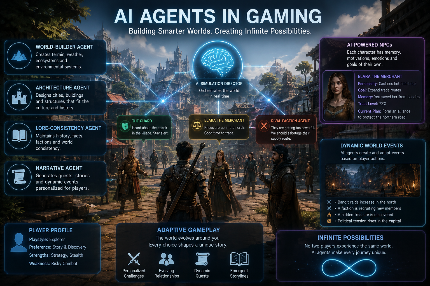
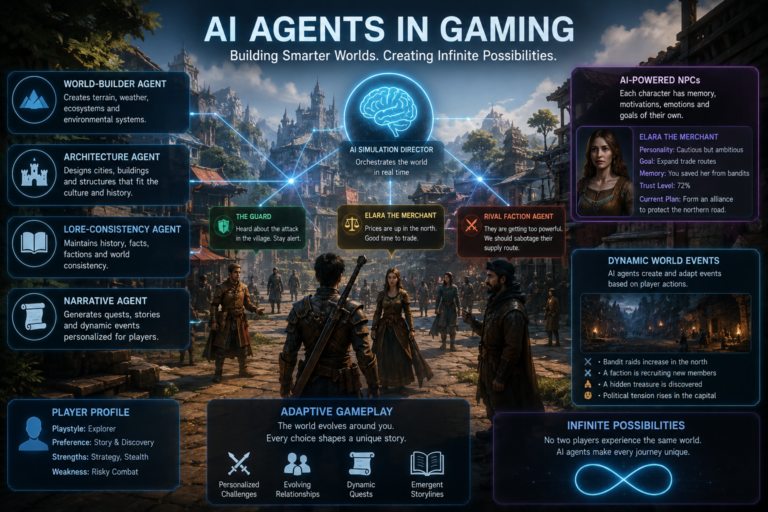
Imagine entering a fantasy city where every important character has its own AI agent. Each character maintains memories, relationships, goals, fears, and motivations that change over time.
If a player betrays a powerful town leader, the reaction would not come from a single pre-written dialogue option. Instead, the leader’s AI agent could analyze the situation, evaluate the player’s threat level, and choose a response.
The character might attempt diplomacy, seek allies, influence other factions, or create new challenges based on the player’s actions.
The result would not be a developer-written storyline. It would become an evolving narrative created through interaction between the player and the AI-powered world.
The AI Game Director: Building Worlds in Real Time
The impact of AI agents extends beyond characters. They could transform how developers create entire environments.
Traditional procedural generation has attempted to solve the problem of creating larger worlds, but many generated environments feel repetitive because they rely on mathematical randomness rather than understanding context.
Agentic systems introduce a different approach.
Instead of randomly placing objects, specialized AI agents could work together under the direction of an AI simulation system.
A future game engine could include:
World-Building Agents that design landscapes, ecosystems, weather patterns, and geographic structures based on realistic rules.
Architecture Agents that create cities, villages, and ruins that match the culture and history of each region.
Lore Agents that maintain consistency across thousands of characters, locations, books, and historical events.
Narrative Agents that create missions, conflicts, and storylines based on the player’s unique journey.
Together, these systems could create worlds that feel less like collections of developer-created assets and more like living ecosystems.
The End of Static Content?
For decades, players have measured games by the amount of content developers can create before release. A larger map, more missions, and more characters often determine the perceived value of a game.
Agentic gaming could change that measurement.
The future value of a game may not depend only on how much content developers include on launch day. Instead, it may depend on how intelligently the world continues to evolve after players enter it.
A player could discover new conflicts, new relationships, and new experiences months or even years after release because the game continues generating meaningful interactions.
The concept of replay value could also change dramatically.
Two players could purchase the same game but experience completely different adventures because their worlds adapt to their individual choices, strategies, and preferences.
Personalized Gaming Experiences Powered by AI
Another major shift will come from personalization.
Current games offer difficulty settings and limited customization options, but every player ultimately experiences the same designed world.
AI-driven systems could create a more personalized experience by analyzing how each person plays.
If a player enjoys exploration, the game could generate more discoveries and hidden locations.
If another player prefers political strategy, the world could create more diplomatic challenges and faction-based conflicts.
If someone enjoys intense action, the AI system could adjust enemy behavior and encounters to create more engaging battles.
Instead of millions of players experiencing one version of a game, developers could create millions of personalized variations of the same universe.
Why Gaming Companies Will Embrace Agentic AI
The adoption of AI agents will not happen only because of creativity. Economics will play an equally important role.
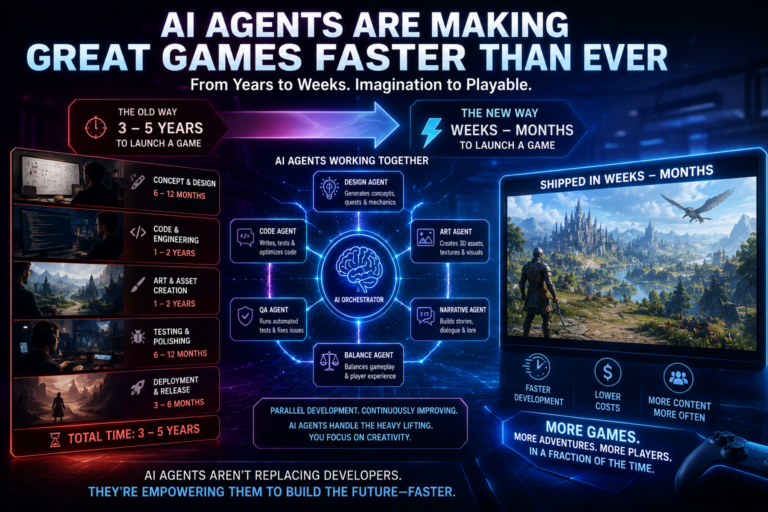
AAA game development has become increasingly expensive and time-consuming. Studios spend years building massive worlds, testing thousands of systems, recording dialogue, and creating content for global audiences.
AI agents could help developers reduce production bottlenecks by assisting with:
- NPC behavior design
- game testing
- world creation
- dialogue generation
- localization
- balancing gameplay systems
Human developers would remain essential, but their role could shift from manually building every component to designing, guiding, and supervising intelligent systems.
Companies including NVIDIA, Unity Technologies, and Epic Games are already exploring AI tools that could influence the next generation of game development.
The Road Ahead: Challenges Before the Revolution
Despite the excitement, agentic gaming still faces major challenges.
Developers must solve problems involving consistency, creativity, computing costs, moderation, and maintaining player trust. A world generated by AI must still feel intentional, balanced, and meaningful.
The goal is not to replace human creativity.
The most successful future games will likely combine human imagination with AI-powered systems. Developers will create the vision, rules, and emotional foundation, while AI agents expand the possibilities within that framework.
The Moment Gamers Experience a True AI World
The gaming community has historically resisted major technological changes. Many players initially questioned digital graphics, online multiplayer, and live-service games before those innovations became industry standards.
AI agents may follow a similar path.
Early AI-powered experiences may feel limited, but as the technology improves, players may begin demanding worlds that respond intelligently, remember their choices, and evolve alongside them.
The future of gaming may not be defined by bigger maps or longer campaigns.
It may be defined by worlds that think, adapt, and grow.
The shift from scripted games to agentic universes could become one of the biggest transformations in entertainment history—changing not only how games are created, but how players experience digital reality itself.