
Addverb Technologies: India’s Ambani-Backed Robotics Startup Aiming for Global Leadership
India has produced many successful software and internet companies over the last two decades, but only a handful of startups have ventured into advanced robotics and automation. Among these emerging deep-tech companies, Addverb Technologies stands out as one of the country’s most ambitious ventures. Backed by Reliance Retail and supported by the vision of business leader Mukesh Ambani, Addverb has grown from a warehouse automation startup into a company that aims to compete on the global robotics stage.
Today, Addverb is developing autonomous mobile robots, warehouse automation systems, humanoid robots, and artificial intelligence-powered solutions. As industries worldwide increasingly adopt automation, the company hopes to position India as a significant player in the robotics revolution.
The Origins of Addverb
Addverb Technologies was founded in 2016 by Sangeet Kumar and a team of engineers with experience in supply chain management and industrial automation. The founders recognized a growing need for smarter logistics and warehouse operations, particularly as e-commerce expanded rapidly across India.
Initially, the company focused on solving practical business problems. Warehouses often struggled with inefficient inventory management, slow order fulfillment, and rising labor costs. Consequently, Addverb developed robotic systems that could automate many of these tasks while improving speed and accuracy.
Rather than importing foreign technology, the company chose to design and manufacture many of its solutions in India. This decision helped establish Addverb as one of the country’s leading homegrown robotics firms.
Reliance’s Strategic Investment
A major turning point arrived when Reliance Retail acquired a majority stake in Addverb. The investment provided not only financial resources but also access to one of India’s largest retail and logistics networks.
As a result, Addverb gained an opportunity to deploy and test its technologies at scale. The partnership allowed the startup to accelerate research and development while expanding manufacturing capacity. Furthermore, the backing of Reliance increased Addverb’s credibility among global customers and investors.
The relationship benefits both organizations. Reliance gains access to advanced automation technologies that can improve operational efficiency, while Addverb receives the resources necessary to pursue larger ambitions in robotics and artificial intelligence.
Core Robotics Solutions
Addverb’s business initially centered on warehouse automation, and this area remains one of its strongest capabilities.
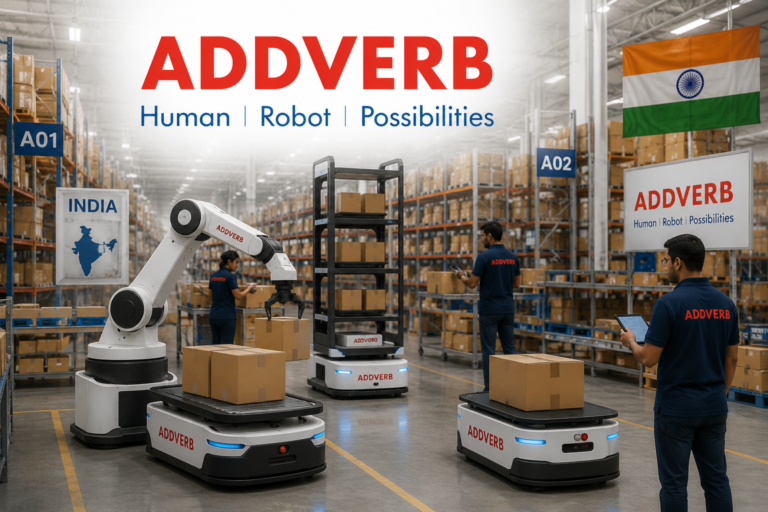
The company develops autonomous mobile robots that transport goods throughout warehouses without human intervention. These robots navigate using sensors, cameras, and software algorithms that help them avoid obstacles and optimize routes.
In addition, Addverb produces automated storage and retrieval systems. These systems store products efficiently and retrieve them quickly when needed. Consequently, businesses can process customer orders faster while reducing operational costs.
The company also offers robotic sorting systems, picking solutions, and warehouse management software. Together, these technologies create an integrated ecosystem that allows businesses to automate large portions of their supply chains.
Many organizations have adopted Addverb’s solutions to improve logistics performance. As demand for faster delivery continues to rise, automation becomes increasingly important for maintaining competitiveness.

Expansion Beyond Warehouses
Although warehouse automation remains a major focus, Addverb has expanded its vision considerably. Instead of limiting itself to logistics, the company now seeks opportunities in advanced robotics applications.
For example, Addverb has invested in artificial intelligence, machine vision, sensor technologies, and autonomous navigation systems. These capabilities form the foundation for next-generation robots that can operate in more complex environments.
Moreover, the company has explored applications in manufacturing, healthcare, retail, and defense sectors. Each of these industries faces labor shortages, safety concerns, or efficiency challenges that robotics can address.
By diversifying its technology portfolio, Addverb aims to create multiple growth opportunities while reducing dependence on any single market segment.

The Push Toward Humanoid Robots
One of Addverb’s most ambitious initiatives involves the development of humanoid robots. Around the world, companies are racing to build machines that resemble humans and can perform a wide range of tasks.
Humanoid robots attract attention because they can potentially work in environments already designed for people. Unlike specialized industrial machines, they can navigate buildings, operate tools, and interact with existing infrastructure.
Addverb believes that humanoids could eventually perform what many experts call the “three D” jobs—tasks that are dull, dirty, or dangerous. These jobs often involve repetitive labor, hazardous conditions, or physically demanding work.
Therefore, the company is developing robots equipped with advanced perception systems that combine visual, auditory, and tactile information. Through artificial intelligence, these robots can interpret their surroundings and make decisions in real time.
If successful, Addverb’s humanoid platform could serve industries ranging from logistics and manufacturing to healthcare and public services.
Global Ambitions
While Addverb began as an Indian startup, its ambitions extend far beyond domestic markets. The company has already expanded internationally and serves customers in multiple regions.
Global demand for robotics continues to increase as businesses confront rising labor costs and growing productivity requirements. Consequently, robotics companies have an opportunity to scale rapidly if they can deliver reliable and cost-effective solutions.
Addverb’s leadership has publicly expressed a desire to become one of the world’s leading robotics firms within the next several years. To achieve this objective, the company plans to invest heavily in research, product development, and international expansion.
Additionally, management has discussed raising significant new funding and potentially pursuing a public listing in the future. Such moves would provide additional capital for long-term growth initiatives.
Challenges Ahead
Despite its impressive progress, Addverb faces substantial challenges. The robotics industry is highly competitive, and many global companies possess significant technological advantages and financial resources.
For instance, established players in the United States, Europe, China, and Japan continue to invest billions of dollars in robotics research. As a result, Addverb must innovate rapidly to remain competitive.
Furthermore, humanoid robots remain an emerging technology. Many companies have demonstrated prototypes, but widespread commercial adoption has yet to occur. Technical reliability, production costs, and regulatory considerations all present obstacles.
Nevertheless, Addverb’s combination of engineering expertise, manufacturing capabilities, and strategic backing positions it well to compete in this evolving market.
Addverb Technologies represents a new generation of Indian deep-tech companies seeking to build globally competitive hardware and artificial intelligence solutions. Since its founding in 2016, the company has evolved from a warehouse automation startup into a robotics enterprise with international ambitions.
Through strong support from Reliance Retail, ongoing investment in research and development, and an expanding portfolio of advanced robotic systems, Addverb aims to play a significant role in the future of automation. Moreover, its efforts in humanoid robotics demonstrate a willingness to tackle some of the industry’s most complex technological challenges.
As automation reshapes industries around the world, Addverb’s journey will serve as an important test of whether an Indian robotics company can emerge as a global leader in one of the most transformative technologies of the twenty-first century.