

Stay Updated
🏠📊 Should Canadians Invest in Real Estate or the Stock Market in 2026?
In 2026, Canadians are rethinking how they build wealth. As interest rates, inflation pressures, and housing affordability challenges continue to reshape the economy, investors are comparing real estate with financial market options like stocks, ETFs, and crypto as separate asset classes.
Today, the key decision is not just about returns. Instead, it is about risk, diversification, and flexibility in uncertain economic conditions.
🏠 Real Estate in Canada: A Concentrated and Debt-Heavy Investment
Real estate has traditionally been a major wealth-building tool in Canada. However, it concentrates capital into a single physical asset.
Most Canadians invest in:
- a home
- a condo
- or a rental property
As a result, their wealth becomes tied to:
- one location
- one housing market cycle
- and one mortgage structure
⚠️ The Mortgage Shock and 7% Interest Rate Era
Between 2022 and 2023, Canada experienced a sharp interest rate shock. The Bank of Canada raised its policy rate from 0.25% to 5%, which triggered a rapid increase in borrowing costs.
Consequently:
- variable mortgage rates rose quickly
- fixed mortgage rates climbed significantly
- some mortgage products reached the 7% range
This created a major stress period for homeowners and investors. Many households that entered the market during the low-interest era suddenly faced much higher monthly payments when renewing mortgages.
As a result, the housing market shifted from ultra-low borrowing conditions to a high-cost debt environment in a very short time.

📉 Why Real Estate Became Riskier
Real estate investing now carries several structural risks:
- 🏦 High dependence on mortgage rates and debt
- 📍 Exposure to a single local housing market
- 🔄 Low liquidity and slow selling process
- 🧾 High maintenance, tax, and ownership costs
- 📉 Sensitivity to economic and interest rate cycles
Therefore, real estate acts as a highly concentrated investment, where outcomes depend heavily on timing and leverage.
📊 Stock Market Investing: More Flexible and Diversified
In contrast, the stock market provides Canadians with a more flexible investment system. Instead of investing in one property, investors can spread money across stocks, ETFs, and other financial assets.
This creates a broader structure that offers:
- 🌍 exposure to global markets
- 💧 high liquidity (easy entry and exit)
- 📊 diversification across industries
- 💸 dividend income potential
- 🔄 portfolio flexibility
Moreover, investors are not locked into one asset. They can adjust their portfolios based on economic conditions.

📈 Individual Stocks: Direct Ownership of Companies
When Canadians buy individual stocks, they directly own shares in a company such as a bank, tech firm, or energy company.
For example:
- RBC or TD Bank
- Apple or Microsoft
- Energy and industrial companies
This approach offers:
- high control over investment choices
- potential for strong returns
- but also higher risk
However, performance depends entirely on a single company. Therefore, lack of diversification increases volatility.
📊 ETFs: Built-In Diversification Across Markets
ETFs (Exchange-Traded Funds) offer a simpler way to reduce risk. Instead of buying one company, investors buy a basket of many companies in one product.
As a result:
- risk spreads across hundreds of companies
- exposure includes multiple industries
- portfolios become more stable over time
For example, ETFs may include:
- banks
- energy companies
- technology firms
- healthcare companies
- global markets
This structure allows investors to participate in overall economic growth without relying on one stock.
₿ Crypto: A Separate High-Risk Asset Class
Crypto is not part of stocks or ETFs. Instead, it represents a separate digital asset class.
Examples include:
- Bitcoin
- Ethereum
Unlike stocks:
- crypto does not represent company ownership
- it does not generate dividends
- value depends on demand and adoption
- it is highly volatile
Therefore, investors treat crypto as a speculative and high-risk asset category, separate from traditional investing.
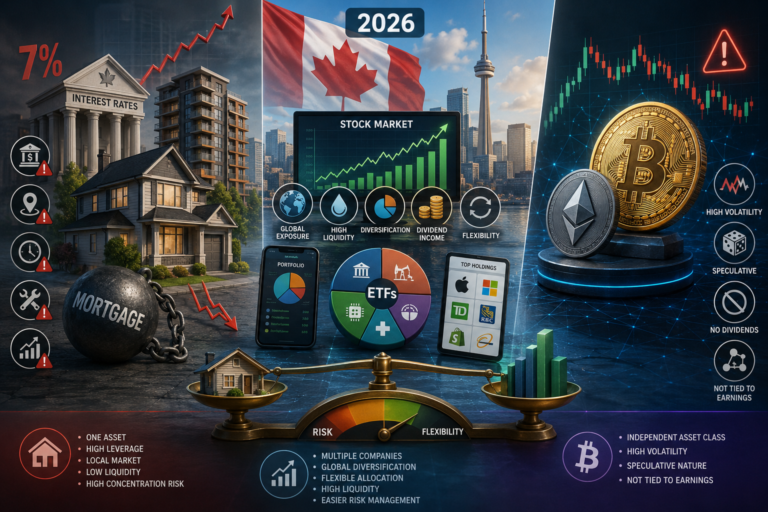
Real Estate vs Stock Market: Key Differences
🏠 Real Estate
- One asset per investment
- High leverage through mortgages
- Local market dependency
- Low liquidity
- High concentration risk
📊 Stocks and ETFs
- Multiple companies in one portfolio
- Global diversification
- Flexible allocation
- High liquidity
- Easier risk management
₿ Crypto
- Independent digital asset class
- High volatility
- Speculative nature
- Not tied to corporate earnings
Key Insight for Canadian Investors
The biggest shift in 2026 is not just about returns—it is about risk distribution and flexibility.
Real estate locks capital into one physical asset. In contrast, financial markets allow investors to spread money across:
- individual companies
- diversified ETFs
- global sectors
- and alternative assets like crypto
This creates a more balanced and adaptable investment system.
Final Verdict
There is no single best investment for Canadians.
- 🏠 Real estate offers ownership but comes with high concentration risk and sensitivity to interest rates
- 📊 stocks and ETFs offer diversification, liquidity, and flexibility
- ₿ crypto provides high-risk, speculative exposure
Ultimately, the strongest strategy is not choosing one option, but understanding how each asset class behaves differently and using them wisely based on risk tolerance and economic conditions.