
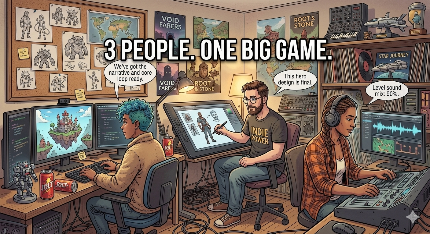
3 Developers vs. AAA: Why Small Game Studios Are Changing Gaming
The future of gaming may be getting smaller. While major publishers continue to build games with enormous budgets and hundreds of developers, small game studios are proving that ambitious ideas do not always require a massive workforce. Studio Reset, an Edmonton-based three-person team whose members previously worked together at several companies, including BioWare, the studio behind Mass Effect and Dragon Age, is a compelling example of that shift.
Studio Reset’s story reflects a broader change across the industry. Experienced developers are leaving or moving beyond traditional AAA environments and creating smaller teams where they can have more control over the games they build. At the same time, digital distribution, modern game engines and new development tools have made it easier for indie game developers to reach players around the world.
The numbers reinforce the trend. The 2026 GDC State of the Game Industry report found that 45% of respondents working at game companies or studios worked at independent studios, compared with 31% at AAA studios. Among developers working at younger indie studios, 77% said their companies had fewer than 20 employees.
That puts a three-person studio like Studio Reset into a much larger movement.
Small Teams, Big Experience
A small studio does not necessarily mean inexperienced developers. In Studio Reset’s case, its members bring experience from BioWare and other studios into an organization that has only three people.
That combination is particularly interesting because developers who have worked on large productions understand the challenges involved in building complex games.
However, they can now apply that knowledge on a much smaller scale.
Instead of passing decisions through multiple departments, a small team can discuss an idea together and make changes quickly. Consequently, development can become more focused. Every mechanic, character and feature has to justify the time required to build it.
That limitation can actually encourage creativity.
A large studio might have the resources to create an enormous open world, while a three-person team can concentrate on one compelling mechanic or a distinctive atmosphere. The result does not have to compete with a blockbuster on size. It can compete on personality.
AAA vs. Indie Games Is Changing
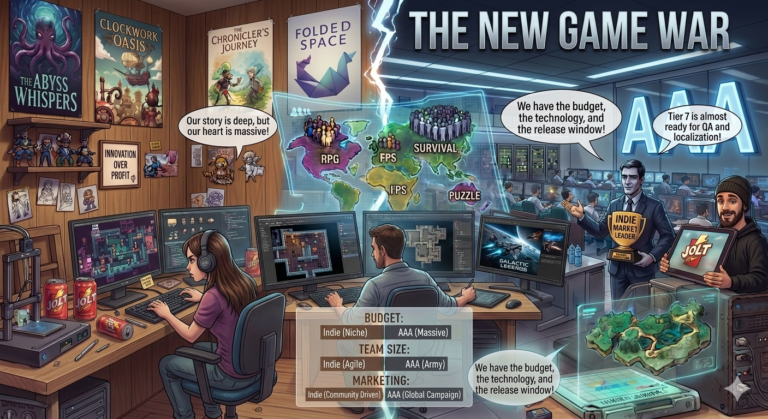
The traditional AAA vs indie games debate often makes the two sides appear completely separate. In reality, the relationship is becoming more complicated.
AAA studios still have enormous advantages. They can employ specialized artists, programmers, writers, designers and producers while spending heavily on marketing and technology.
Indie developers, however, have something different: flexibility.
A small team can experiment without carrying the same production structure as a major publisher. If an idea does not work, the team can change direction. If a particular mechanic becomes the heart of the game, developers can build around it.
That flexibility has helped create an increasingly diverse market for indie games 2026.
Players can move from a massive open-world release to a two-person horror project, a deckbuilder or a quirky management game without leaving the same digital ecosystem.
The Lessons of Balatro and Slay the Spire 2
The popularity of games such as Balatro demonstrates how powerful a simple but highly polished concept can become. Its combination of poker-inspired mechanics, deckbuilding and roguelike progression created something that was immediately recognizable while still feeling different.
That formula has encouraged more interest in games like Balatro, particularly among players looking for strategy games that can be played in short sessions but still offer enormous replayability.
The same applies to the growing interest surrounding Slay the Spire 2 new characters. The Necrobinder and Regent expand the game’s strategic possibilities while showing how a relatively focused genre can continue evolving.
For small game studios, these examples are important because they demonstrate that players do not always demand the largest possible production. They want games with ideas that keep them coming back.
That gives independent developers room to compete through creativity rather than budget.
Why Small Teams Can Move Faster
One of the biggest advantages of small game studios is communication.
When three developers sit around the same project, everyone understands what the others are doing. There are fewer meetings, fewer layers of management and fewer opportunities for an important idea to become lost between departments.
That does not make development easy.
In fact, small teams face enormous pressure because each person often has to handle several responsibilities. A programmer may contribute to design, a designer may help with production, and everyone may have to think about marketing.
Still, the structure can create a strong sense of ownership.
The developers are closer to the final product, and that can make experimentation easier.
Friends Are Becoming Part of the Game
Another important development is the growing popularity of social multiplayer experiences.
Games built around friends can generate their own momentum because players naturally share funny moments, difficult challenges and unexpected events. The growing interest in friendslop games reflects this appetite for experiences that become more entertaining when played with a group.
That creates opportunities for co-op indie games to play with friends.
A small studio does not necessarily need to build a gigantic multiplayer world. It can instead create a compact experience built around cooperation, competition or chaos.
For independent developers, that design philosophy can also help marketing. Players who enjoy a game with friends can introduce it to another group of players without the studio having to reach every person directly.

Steam Deck Is Expanding the Audience
Hardware is also influencing the indie market.
The popularity of handheld gaming has created new opportunities for developers whose games do not require enormous graphical resources. Steam Deck indie games can benefit from strong gameplay, distinctive visual styles and short play sessions that work particularly well on a handheld device.
The same opportunity exists for players with older computers.
Not every gamer owns a high-end gaming PC, and that creates demand for low spec laptop indie games that can deliver interesting experiences without requiring expensive hardware.
For small teams, this can be an advantage. Developers can focus on design and atmosphere rather than attempting to compete with the visual spectacle of the largest AAA productions.
Microsoft Store Gives Indie Developers Another Route
Distribution has changed the economics of game development.
In the past, reaching a large gaming audience often required a publisher, physical distribution and substantial marketing resources. Today, developers can release games digitally and build communities directly.
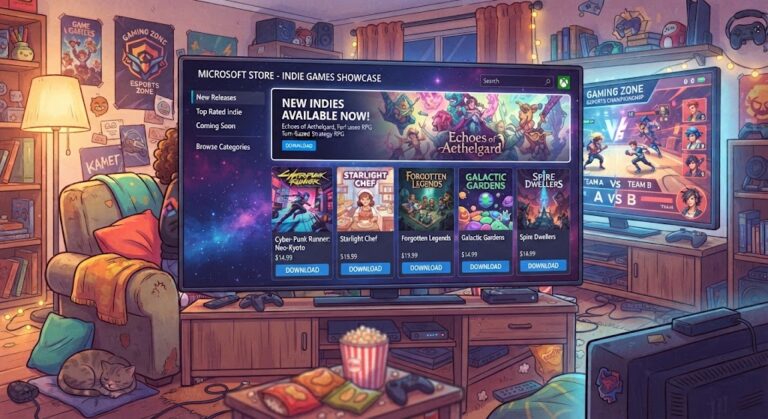
The Microsoft Store indie games ecosystem provides another potential route to Windows players, while Xbox gives independent developers access to a console audience.
That matters because a small studio can now think about distribution much earlier in development. Instead of asking whether a major publisher will accept the project, developers can consider how they can reach players themselves.
Digital storefronts do not guarantee success, but they remove some of the barriers that once stood between independent developers and global audiences.
AI Could Change the Economics of Small Studios
The next major change could come from AI game development.
Developers are already experimenting with AI-assisted tools across different parts of production. Coding assistance, testing, concept development and repetitive production tasks could potentially become faster as these tools improve.
For a massive studio, efficiency matters.
For a three-person studio, it could matter even more.
If a small team can reduce the time spent on repetitive work, developers can devote more energy to gameplay, art direction, storytelling and polish. AI will not replace the creative judgment required to make a great game, but it could give experienced developers more leverage.
That could make small teams increasingly competitive.
Edmonton’s Role in the Indie Future
Studio Reset also represents something important for Edmonton.
The city already has a connection to major game development through BioWare. Its developers helped create some of the industry’s most recognizable role-playing franchises, and that experience created a pool of talent familiar with building games for a global audience.
Now, developers with that background are exploring what happens when the team becomes dramatically smaller.
That transition could become increasingly common across the industry.
As experienced developers seek greater creative control, more veteran talent may move toward independent studios. Instead of building another enormous organization, they can create focused teams around specific ideas.
The Next Chapter of Gaming
The rise of small game studios does not mean AAA gaming is going away.
Big-budget games will continue to dominate sales charts, generate enormous launches and push technology forward. However, independent developers are changing what players expect from the wider industry.
The most interesting games do not always need the biggest worlds, the largest teams or the highest production budgets.
They need a strong idea.
Studio Reset’s three-person structure captures that philosophy. Its developers have already experienced the world of major game production. Now they are taking that knowledge into a much smaller environment.
That is why the story extends beyond one Edmonton studio.
From indie games 2026 and deckbuilding titles to friendslop games, Steam Deck indie games, Microsoft Store indie games and AI game development, the industry is giving smaller teams more ways to create, distribute and find audiences for their work.
The gaming industry is becoming bigger in one sense and smaller in another.
The budgets may keep growing at the top.
But the number of people required to create something players genuinely care about may be shrinking.
And that could make the three-person game studio one of the most interesting models in gaming’s next chapter.