

Stay Updated
Pixxel Series C Funding: $100 Million Raised
Indian space-tech company Pixxel has raised $100 million in Series C funding, giving the Bengaluru-based company fresh capital to expand its satellite capabilities, Earth-intelligence software and space infrastructure. The investment marks the largest single funding round raised by an Indian space-technology company and takes Pixxel’s total funding to approximately $195 million.
The Pixxel Series C funding round was co-led by Singapore state investor Temasek and UK-based Seraphim Space Investment Trust. New investors 360 ONE Asset and IMM Investment also joined the round, while existing backers including Radical Ventures and growX Ventures continued to support the company.
The size of the investment highlights how quickly India’s private space industry is developing. More importantly, Pixxel is no longer positioning itself simply as a satellite-imaging company. It is building a broader business around space-based sensing, software and Earth intelligence.
From Two Founders to a Major Space-Tech Company
Pixxel was founded by Awais Ahmed and Kshitij Khandelwal, who started the company with an ambitious goal: use advanced satellite technology to understand the Earth in greater detail. The company initially focused on hyperspectral imaging, a technology that captures information across many wavelengths of light. Unlike conventional satellite imagery, hyperspectral systems can reveal characteristics of materials that may not be visible in ordinary photographs. That capability can have applications across agriculture, mining, environmental monitoring, climate analysis and defence. The Pixxel Series C funding now gives the founders significantly more resources to take that original vision to the next level.
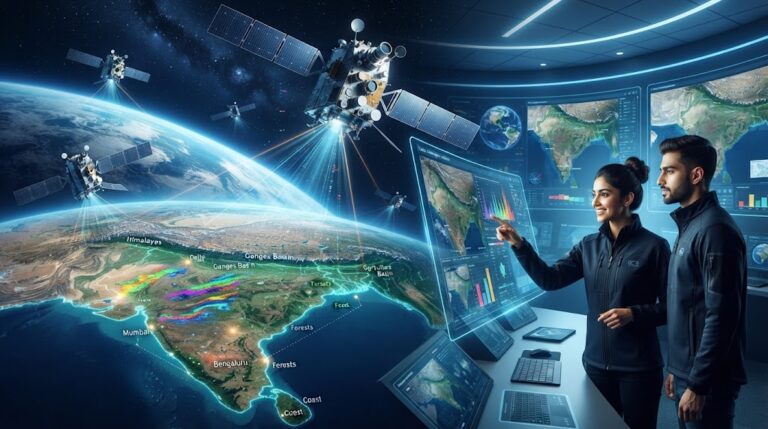
Over time, however, Pixxel expanded its ambitions. The company now combines satellite systems with Earth-observation data and software, creating what it describes as planetary infrastructure. Instead of focusing solely on collecting images from space, Pixxel is building a broader system designed to capture, process and deliver useful intelligence from Earth-observation data. This shift has allowed the company to move from a specialised hyperspectral imaging business toward a more comprehensive space-tech and Earth-intelligence platform.
Meet Pixxel’s Founders: Awais Ahmed and Kshitij Khandelwal
The company’s growth has been closely associated with its two founders. Awais Ahmed serves as founder and CEO, while Kshitij Khandelwal is founder and CTO. Their technical background helped Pixxel develop its satellite-focused strategy from an early stage.
Ahmed has described the company’s beginnings as a period when he and Khandelwal were still students with an ambitious idea to build a kind of health monitor for the planet. That original idea has since evolved into a much larger vision.
Rather than simply collecting images from orbit, Pixxel wants to create an infrastructure layer that connects sensors, satellites, software and intelligence.

Why the $100 Million Round Matters
The latest investment gives Pixxel significant financial firepower at an important stage of its development. The company plans to use the capital to expand its sensing capabilities through the Honeybee satellite constellation, high-resolution optical imaging satellites and other technologies. It also plans to continue developing Aurora, its Earth-intelligence software platform.
That means the new money will support both sides of Pixxel’s business. On one side, the company needs satellites and advanced sensors capable of collecting increasingly detailed information. On the other, it needs software capable of turning that enormous volume of data into useful information for customers.
This combination could become one of Pixxel’s biggest competitive advantages.
From Hyperspectral Imaging to Earth Intelligence
Pixxel’s original focus on hyperspectral imaging remains important, but the company is now moving further up the value chain. Traditional satellite companies can generate images and sell access to that information. Pixxel wants to go further by helping customers understand what those images mean.
That is where Aurora comes into the picture. Aurora is designed to combine different datasets and transform them into decision-ready insights. Instead of leaving customers with large quantities of satellite information to analyse themselves, Pixxel wants its software to help turn that information into something they can act on.
Consequently, Pixxel’s opportunity is not limited to the satellite-imaging market. Its long-term business could also involve software, analytics and recurring Earth-intelligence services.
Pixxel Is Already Operating Satellites
The company is not starting from zero. Over the past two years, Pixxel has deployed six Firefly satellites, which the company says form the world’s highest-resolution commercial hyperspectral constellation. These satellites give Pixxel an operational foundation as it prepares for its next generation of spacecraft.
The next step is the Honeybee constellation. Pixxel plans to expand its sensing capabilities through Honeybee while also developing high-resolution optical imaging satellites. The company expects its first Honeybee satellite to launch in 2027.
The expansion could allow Pixxel to gather different types of information rather than relying on one specialised imaging technology.
Aurora: Turning Satellite Data Into Actionable Intelligence
The Pixxel Series C funding gives the company more room to develop the software side of its business alongside its growing satellite network. Pixxel is not only putting satellites into orbit; it also wants to make the information those satellites collect more useful to businesses and governments. That is where Aurora, Pixxel’s Earth-intelligence platform, comes in.
Satellites can collect enormous amounts of information about the Earth, but raw data is not always easy to interpret. A customer may want to know whether crops are under stress, where environmental changes are occurring, how a mining site is developing or whether infrastructure is changing. Instead of requiring customers to analyse multiple sources of satellite data themselves, Pixxel is developing Aurora to bring those datasets together and turn them into useful insights.
This gives Pixxel a way to build a business beyond selling satellite imagery. Its satellites provide the data, while Aurora helps customers understand what that data means and apply it to real-world decisions. In that sense, Pixxel is connecting its space hardware with a software platform that sits closer to the end customer.
The strategy also explains why Pixxel is investing in different types of satellite imaging. Hyperspectral data can reveal information about materials and conditions on the Earth’s surface, while radar and high-resolution optical imagery can provide different perspectives. Combining these sources could give Aurora a much richer dataset to analyse.
As a result, Pixxel is positioning itself as an Earth-intelligence company, rather than simply a satellite manufacturer or imagery provider. The satellites are the foundation, but turning the information they collect into practical intelligence could become an equally important part of Pixxel’s long-term business.
Expansion Into New Imaging Technologies
The latest funding will also allow Pixxel to move beyond hyperspectral imaging. The company plans to develop additional capabilities including shortwave infrared sensing, synthetic aperture radar and ultra-high-resolution optical imaging.
That expansion matters because different sensing technologies reveal different information. Hyperspectral imaging can identify material characteristics, while radar can provide information in conditions where conventional optical imaging struggles. High-resolution optical systems, meanwhile, can provide extremely detailed views of objects and locations.
By combining these technologies, Pixxel could eventually offer customers a much broader view of the planet.
Building Sovereign Space Infrastructure
Pixxel also sees government and sovereign missions as an important part of its future. The company has secured contracts involving NASA and the U.S. National Reconnaissance Office, while also participating in India’s defence-focused iDEX programmes. Pixxel has additionally been selected to lead the development of India’s first public-private Earth-observation constellation of 12 satellites under IN-SPACe. The Pixxel Series C funding gives the company additional resources to expand these capabilities and develop more advanced Earth-observation systems for both commercial and government customers.
These relationships could become increasingly important as governments look for reliable access to critical Earth-observation data. Satellite intelligence can support agriculture, infrastructure planning, environmental monitoring, disaster response and national security. As demand for this information grows, companies capable of building and operating advanced satellite systems could play a larger role in national space strategies.
For Pixxel, that creates an opportunity that goes well beyond commercial satellite imagery. The company is working to build the technology and infrastructure that governments and industries can use to monitor changes on Earth, analyse complex data and make better-informed decisions. With its expanding satellite constellation, Earth-intelligence platform and new capital, Pixxel is positioning itself to become a significant player in the global space-data industry.
Why Investors Are Betting on Pixxel
The latest funding round also says something about investor confidence in India’s space sector. Temasek and Seraphim led the investment, while both new and existing investors participated. That combination suggests Pixxel has managed to attract international capital while also maintaining support from investors who backed the company earlier.
The timing is important. India’s private space industry has expanded rapidly as policy changes have opened more opportunities for private companies. Startups are now working across launch vehicles, satellites, propulsion, Earth observation and space-based data.
Pixxel is emerging as one of the companies trying to capture the data and intelligence opportunity.
What Comes Next for Pixxel?
The $100 million investment gives Pixxel the resources to pursue its next stage of growth, but the company still faces significant challenges. Building advanced satellites requires substantial engineering expertise, manufacturing capacity and capital. Scaling the business also means finding enough customers willing to pay for increasingly sophisticated Earth intelligence.
At the same time, Pixxel must prove that it can turn its growing satellite infrastructure into a scalable commercial business.
So far, the company has established a strong foundation with its Firefly constellation, Aurora platform and government relationships. Now it wants to build much more.
The Future of Indian Space Startups
The story behind the Pixxel Series C funding is ultimately bigger than one $100 million investment. It demonstrates how Indian founders are moving into industries that once appeared almost exclusively reserved for governments and major aerospace corporations.
Pixxel started with an ambitious idea around hyperspectral satellite imaging. Today, it is developing a broader ecosystem involving satellites, sensors, software and Earth intelligence.
That evolution could become a blueprint for other Indian space startups. As the cost of building and launching satellites continues to change and demand for Earth data grows, the companies that can combine hardware with software may have the strongest opportunity to scale.
For Pixxel, the next chapter will be about execution. The company now has $195 million in total funding, a growing satellite infrastructure and a much bigger technological ambition. The challenge is to turn that capital and technology into a global Earth-intelligence business.
If Pixxel succeeds, its $100 million Series C could eventually be remembered not simply as a record funding round, but as the investment that helped transform an ambitious Indian space startup into a major player in the global space economy.