
Stay Updated
Palantir Billionaire Peter Thiel Bets on Energy and Nuclear Stocks
Palantir billionaire Peter Thiel is making a notable new bet on the infrastructure behind the artificial intelligence boom. Through his investment firm, Thiel Macro, Thiel returned to publicly disclosed U.S. equity positions in the second quarter of 2026 with a concentrated portfolio built around Amazon and energy companies, rather than the semiconductor stocks that have dominated the AI trade. Thiel Macro reported approximately $418.7 million across eight U.S.-listed positions as of June 30, 2026. Amazon was the largest holding at roughly $118 million, while the other seven positions were tied to energy, electricity, utilities or nuclear technology. Notably, Nvidia was not among the disclosed holdings.
That portfolio composition raises a bigger question: Why is one of Silicon Valley’s best-known technology investors putting so much capital into energy? The 13F filing does not provide Thiel’s personal explanation for each purchase. However, the composition of the portfolio suggests a potentially important theme: the AI boom may eventually run into a power bottleneck. As AI companies build larger data centers and deploy increasingly powerful computing systems, access to reliable electricity could become just as important as access to advanced chips.
Palantir Billionaire Peter Thiel Is Looking Beyond Nvidia
The AI investment story has largely revolved around Nvidia, advanced semiconductors, cloud computing and software. Nvidia has become one of the biggest beneficiaries of the AI infrastructure boom, but the latest Thiel Macro portfolio points toward a different part of the ecosystem. The Palantir billionaire Peter Thiel does not have Nvidia among the positions disclosed in Thiel Macro’s latest 13F. Instead, Amazon is the portfolio’s only technology company. The remaining seven positions include Vista Energy, Vistra, American Electric Power, DTE Energy, FirstEnergy, CMS Energy and X-Energy.
That distinction matters because AI requires much more than chips. AI models require enormous computing capacity, while computing capacity requires data centers. Data centers require servers, networking equipment, cooling systems and, above all, large amounts of reliable electricity. As hyperscalers and other companies continue expanding AI infrastructure, electricity availability could become an increasingly important constraint. That creates a potential investment opportunity beyond the traditional semiconductor trade. In that sense, Thiel’s portfolio appears to look further down the AI supply chain. Rather than focusing only on the companies producing AI technology, it also includes businesses that could benefit from the growing physical infrastructure required to operate it.
Why Amazon Is His Biggest Bet
Amazon represents the technology and cloud-computing side of the strategy. Thiel Macro’s Amazon position was worth approximately $118 million, making it the firm’s largest disclosed holding and roughly 28% of the portfolio. Amazon provides exposure to several major businesses, including e-commerce, digital advertising and, most importantly for the AI thesis, Amazon Web Services.
AWS is a major part of the AI infrastructure buildout. Cloud providers are investing heavily in computing capacity so businesses can access AI services without building their own massive data-center infrastructure. That creates demand for servers, networking equipment, custom chips and electricity. Amazon therefore gives Thiel exposure to the demand side of AI infrastructure, while his energy holdings provide exposure to some of the infrastructure needed to support that demand. The strategy is particularly interesting because it does not depend entirely on predicting which AI chipmaker will dominate the next generation of computing. Instead, it potentially captures multiple layers of the AI infrastructure chain.

The Energy Portfolio Is the Bigger Story
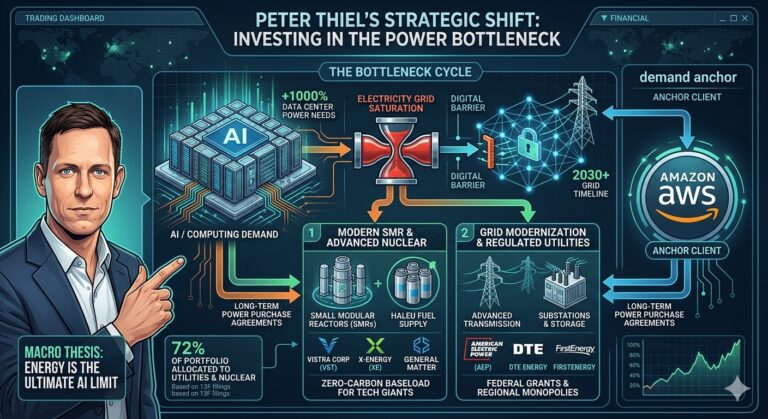
The most striking feature of Thiel Macro’s filing is the concentration in energy and power. Seven of the eight disclosed positions are associated with energy, electricity, utilities or nuclear technology, representing approximately 72% of the portfolio’s disclosed value. That concentration makes the energy component difficult to overlook.
Vistra (VST) is one of the largest positions at approximately $59 million. The company operates a large power-generation portfolio, including nuclear assets, giving investors exposure to electricity generation and the potential demand for reliable power. Thiel Macro also owns major utility companies including American Electric Power (AEP), DTE Energy (DTE), FirstEnergy (FE) and CMS Energy (CMS).
These companies are not AI businesses in the traditional sense. Their relevance comes from the infrastructure they operate. If electricity demand rises significantly because of data centers and other large industrial loads, utilities could face increasing pressure to expand generation, transmission and distribution capacity. That creates a potential second-order AI investment theme. For years, investors have asked which companies will supply the chips needed to power the AI revolution. Thiel’s portfolio raises another question: Who will supply the electricity needed to run those chips?
Why Vista Energy Is Different
Vista Energy (VIST) is particularly interesting because it is not primarily a utility, nuclear or electricity-generation investment. Thiel Macro disclosed approximately $76 million in Vista Energy, making it the second-largest position. Reuters reported that Thiel Macro acquired approximately 1.2 million American Depositary Shares, equivalent to about a 1% stake in the Argentine oil producer.
Vista operates in Argentina’s Vaca Muerta shale formation, one of the world’s major unconventional oil and gas regions. The investment also comes amid Thiel’s growing interest in Argentina. Reuters reported that Thiel met Argentine President Javier Milei several months before the Vista investment was disclosed.
However, investors should be careful about automatically linking Vista to the AI power thesis. Unlike Vistra and the regulated utilities, Vista is primarily an oil and gas producer. Its inclusion could represent a broader bet on energy supply, oil production or Argentina rather than a direct bet on electricity demand from AI. That makes the portfolio more diverse than a simple nuclear-and-utilities strategy.
X-Energy Is the High-Risk Nuclear Bet
The most speculative holding in the portfolio is X-Energy (XE). Thiel Macro disclosed approximately $3.7 million in X-Energy, making it by far the smallest of the eight positions at less than 1% of the reported portfolio.
X-Energy is developing advanced nuclear reactor technology, including small modular reactor systems that could eventually provide reliable low-carbon electricity for industrial users and potentially large data centers. The size of the position is important. It would be misleading to describe X-Energy as Thiel’s largest nuclear conviction or as the centerpiece of his portfolio. Instead, the relatively small position gives Thiel Macro exposure to a potentially transformative technology without making it a major component of the disclosed portfolio.
If electricity demand from AI and other industries continues to rise, advanced nuclear technology could become increasingly important. However, commercialization, construction timelines, regulation and financing remain significant challenges.
The AI Power Bottleneck
The most interesting interpretation of the portfolio is that Palantir billionaire Peter Thiel may be looking beyond the obvious AI winners and toward the physical infrastructure required to sustain the AI economy. The AI industry can only expand as quickly as the infrastructure supporting it.
Data centers require land, servers, networking equipment, cooling systems and enormous amounts of electricity. Building the necessary power infrastructure can take years, creating potential bottlenecks even when demand for computing is growing rapidly. That is where Thiel Macro’s portfolio becomes particularly interesting.
Amazon represents the cloud and AI-demand side of the equation. Vistra provides exposure to power generation, including nuclear assets. AEP, DTE, FirstEnergy and CMS Energy provide exposure to utilities and electricity infrastructure. X-Energy represents advanced nuclear technology, while Vista Energy adds exposure to conventional oil and gas production.
Taken together, these investments create a portfolio that can be interpreted as a bet on several parts of the physical foundation beneath the AI economy. That does not prove that Thiel made every investment specifically because of AI. The 13F does not provide that level of detail. However, the concentration in power and energy is difficult to ignore.
What Investors Should Watch
There is an important limitation. Thiel Macro’s latest 13F reflects its disclosed U.S. long positions as of June 30, 2026. It does not reveal what the fund has bought or sold since that date, and it does not explain the exact reason behind each investment. Investors should therefore avoid treating the filing as a real-time recommendation from Thiel.
Nevertheless, the concentration is significant enough to attract attention. The Palantir billionaire Peter Thiel has a long history of making concentrated bets on technologies and businesses that he believes could reshape the economy, and his latest disclosed portfolio suggests that he may now see another opportunity emerging alongside AI: the enormous energy infrastructure required to support it.
The next stage of the AI boom may therefore extend far beyond Nvidia and other chipmakers. It could create winners in cloud computing, electricity generation, utilities, nuclear technology and conventional energy. That is what makes Thiel’s latest portfolio so interesting: the AI boom needs more than intelligence. It needs power.