
CXMT IPO: China’s DUV Breakthrough Shakes Chips
China’s semiconductor industry has found itself at the center of global attention following two major developments that unfolded almost simultaneously. First, ChangXin Memory Technologies Inc. (Shanghai STAR: CXMT) delivered one of the most talked-about initial public offerings (IPOs) of the year, with its share price soaring roughly 450% to 500% during its market debut. At nearly the same time, reports emerged that Chinese companies had begun initial production of domestically developed immersion deep ultraviolet (DUV) lithography machines. Together, these events have sparked intense discussions among investors, engineers, policymakers, and technology enthusiasts worldwide.
Although these stories are separate, they represent a broader trend: China is accelerating its efforts to strengthen its semiconductor industry despite ongoing export restrictions. The combination of investor enthusiasm and technological progress has made the semiconductor sector one of the hottest topics across financial markets and social media.
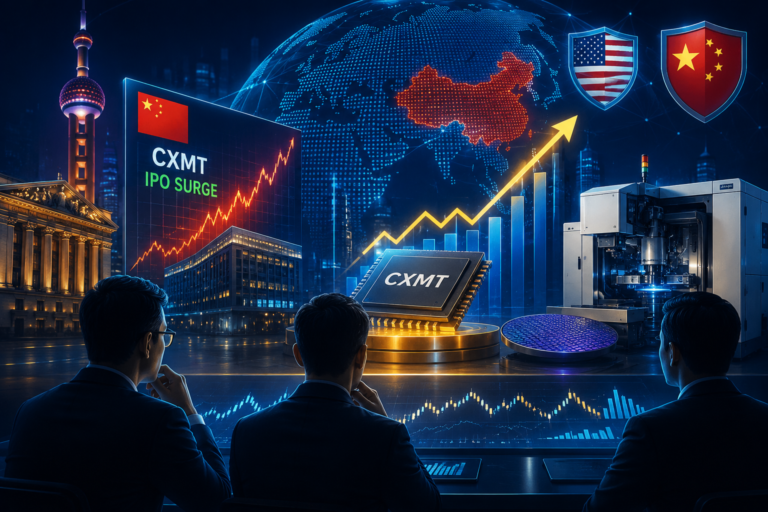
CXMT Historic IPO Puts China’s Memory Chip Ambitions in the Spotlight
The excitement surrounding CXMT began with its highly anticipated listing on the Shanghai Stock Exchange. The memory chip manufacturer experienced an extraordinary first day of trading, with shares climbing several hundred percent and pushing the company’s market value beyond several long-established global semiconductor firms. Such a dramatic debut immediately attracted the attention of both retail investors and institutional funds.
The enthusiasm reflects growing confidence in the long-term outlook for memory chips. Demand for artificial intelligence, cloud computing, autonomous vehicles, edge computing, and data centers continues to drive the need for DRAM memory. Every major AI server requires enormous amounts of high-speed memory, making DRAM one of the most important components of modern computing infrastructure.
Many investors believe this represents the beginning of another memory super-cycle. Historically, DRAM prices have moved through periods of oversupply and shortage. However, the rapid expansion of AI infrastructure has created expectations that demand could remain stronger for longer than in previous cycles. That optimism has fueled significant interest in companies capable of supplying memory products.
Despite the excitement, valuation remains one of the biggest discussion points. Some analysts argue that the company’s market capitalization reflects years of future growth already being priced into the stock. Others believe China’s domestic memory industry still has considerable room to expand as local manufacturers reduce reliance on imported chips.
CXMT Challenges the Global Lithography Landscape
At almost the same time as CXMT’s blockbuster IPO, another story captured the technology community’s attention. Reports indicated that Chinese manufacturers have begun producing their own immersion DUV lithography machines, with plans to manufacture a small number of systems initially before increasing production next year.
Lithography machines are among the most complex manufacturing tools ever created. They are responsible for projecting intricate circuit patterns onto silicon wafers, allowing chipmakers to manufacture increasingly advanced semiconductors. For many years, this market has been dominated by ASML, whose equipment is considered essential for producing cutting-edge chips.
The emergence of domestic Chinese DUV systems has therefore generated enormous discussion. While these machines do not match the capabilities of the most advanced extreme ultraviolet (EUV) technology, they represent an important milestone in China’s long-term effort to develop its own semiconductor manufacturing ecosystem.
Technology forums, investment communities, and industry analysts have debated whether this progress could gradually reduce China’s dependence on foreign equipment suppliers. The development has also renewed discussions about the effectiveness of export controls and whether domestic innovation can eventually offset some of those restrictions.
Geopolitics Continues to Shape the Industry
The semiconductor industry has become one of the most strategically important sectors in the global economy. Governments increasingly view advanced chips as critical national infrastructure because they power artificial intelligence, telecommunications, defense systems, automobiles, and industrial automation.
Export restrictions introduced over the past several years have limited China’s access to certain advanced semiconductor equipment and technologies. As a result, Chinese companies have invested heavily in domestic research, manufacturing capabilities, and supply chains.
The reported progress in DUV lithography is viewed by many observers as evidence that these investments are beginning to produce tangible results. Even if current systems remain less advanced than global leaders, the ability to manufacture increasingly sophisticated equipment domestically represents meaningful progress toward greater technological self-sufficiency.
This explains why investors are paying close attention not only to chip manufacturers like CXMT but also to companies throughout the semiconductor equipment supply chain.
Engineering Experts Urge Caution
Despite the growing excitement, many semiconductor engineers caution against drawing overly optimistic conclusions. Developing a competitive lithography ecosystem involves much more than building a functioning machine.
Industry experts note that performance depends on numerous factors, including precision optics, manufacturing consistency, throughput, reliability, software integration, and long-term maintenance. High production yields are equally important because even small defects can significantly increase manufacturing costs.
Current reports suggest that China’s domestic immersion DUV machines still trail global leaders in several performance areas. Some specialized components may also continue to rely on international suppliers, meaning complete supply-chain independence has not yet been achieved.
For this reason, many analysts describe the latest developments as an important beginning rather than a complete technological breakthrough. Significant engineering work remains before domestic systems can compete directly with the world’s most advanced lithography platforms at commercial scale.
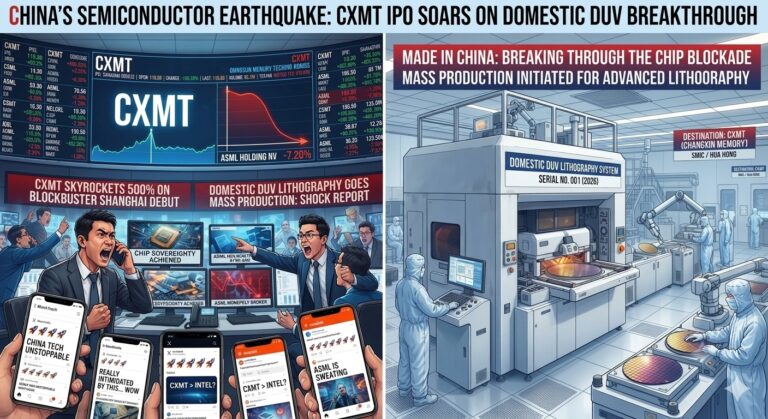
Why Investors Are Watching Closely
The convergence of CXMT’s remarkable IPO and China’s reported progress in semiconductor equipment has created a powerful narrative for global markets. Investors increasingly recognize that semiconductor leadership will influence economic growth, artificial intelligence development, and national competitiveness for decades to come.
If China’s domestic memory industry continues expanding while local equipment manufacturers steadily improve their technology, the global semiconductor landscape could become increasingly competitive. Established industry leaders will likely maintain important technological advantages for the foreseeable future, but emerging competitors are demonstrating faster progress than many expected only a few years ago.
Whether CXMT’s valuation ultimately proves justified remains uncertain, and domestic lithography systems still face considerable technical challenges. Nevertheless, both developments highlight the rapid pace of change occurring across the semiconductor industry. As AI demand continues to grow and geopolitical competition intensifies, investors, engineers, and policymakers will be watching China’s next semiconductor milestones more closely than ever before.
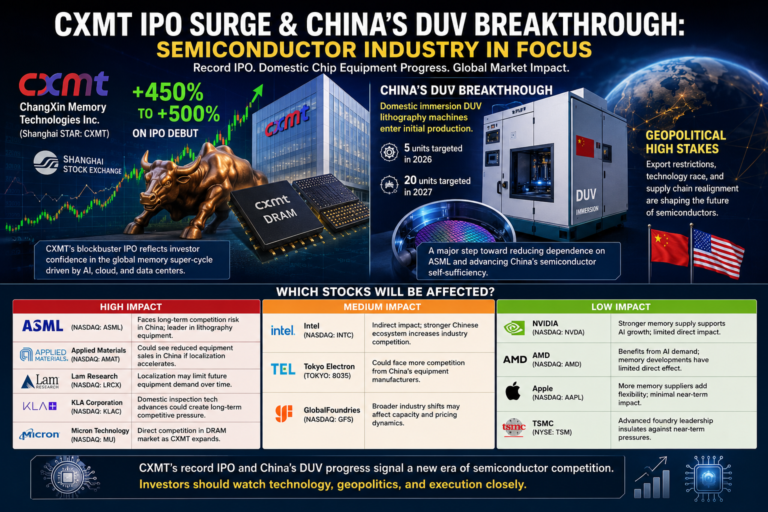
Which Stocks Could Benefit or Face Pressure?
The semiconductor industry is deeply interconnected, meaning breakthroughs in China’s memory chips and lithography equipment could create both winners and losers. While it is still too early to predict the long-term outcome, investors are already assessing which companies could see the biggest impact if China continues making rapid progress.
High Impact
ASML Holding (NASDAQ: ASML)
ASML is likely the company most closely watched because it dominates the global lithography market. If Chinese manufacturers successfully commercialize domestic immersion DUV systems and continue improving performance, ASML could eventually face greater competition in China, one of its largest historical markets. However, ASML still maintains a significant technological lead in both advanced DUV and EUV lithography.
Applied Materials (NASDAQ: AMAT)
Applied Materials supplies semiconductor manufacturing equipment worldwide. If Chinese chipmakers increasingly purchase domestic equipment, future sales opportunities in China could become more limited. Nevertheless, the company remains diversified across many global customers.
Lam Research (NASDAQ: LRCX)
Lam Research provides wafer fabrication equipment used throughout semiconductor manufacturing. Continued localization of China’s semiconductor supply chain could gradually reduce demand for some imported equipment, although the company continues to benefit from global AI-driven semiconductor investments.
KLA Corporation (NASDAQ: KLAC)
KLA specializes in process control and inspection systems. While demand remains strong globally, successful development of competing domestic inspection technologies in China could create long-term competitive pressure.
Medium Impact
Intel (NASDAQ: INTC)
CXMT’s rapid expansion in the DRAM market increases competitive pressure on established semiconductor companies. Intel is primarily a CPU manufacturer rather than a memory producer, so the impact is indirect. However, a stronger Chinese semiconductor ecosystem could intensify competition across the broader industry.
Micron Technology (NASDAQ: MU)
Micron is one of the world’s leading DRAM manufacturers, making it one of the companies most closely compared with CXMT. If CXMT successfully expands production while maintaining competitive pricing, Micron could eventually face greater competition in certain markets. On the other hand, continued AI-driven memory demand may allow both companies to grow simultaneously.
Tokyo Electron (Tokyo: 8035)
The Japanese semiconductor equipment maker could face increasing competition if China’s domestic equipment industry continues advancing. However, its technological expertise and broad product portfolio remain important competitive strengths.
Low Impact
NVIDIA (NASDAQ: NVDA)
NVIDIA’s AI GPUs require enormous amounts of high-bandwidth memory, meaning a stronger global memory supply could actually support AI infrastructure growth. While geopolitical developments remain important, NVIDIA’s primary business drivers are AI accelerator demand rather than memory manufacturing.
Advanced Micro Devices (NASDAQ: AMD)
Like NVIDIA, AMD depends on memory suppliers but does not manufacture DRAM itself. Increased global memory production could support future AI server deployments without materially changing AMD’s competitive position.
Apple (NASDAQ: AAPL)
Apple purchases memory components from multiple suppliers worldwide. Additional memory capacity could improve supply-chain flexibility, but CXMT’s expansion is unlikely to significantly affect Apple’s business in the near term.
Taiwan Semiconductor Manufacturing Company (NYSE: TSM)
TSMC manufactures chips for customers around the world rather than competing directly in memory production. Although geopolitical developments remain important, the company’s leadership in advanced chip manufacturing means the immediate impact from CXMT’s IPO or China’s DUV progress is relatively limited.
The Bottom Line
The companies facing the highest potential long-term impact are ASML, Applied Materials, Lam Research, KLA, and Micron Technology, as their businesses are directly connected to semiconductor manufacturing equipment or DRAM memory. Intel and Tokyo Electron could experience a moderate impact, while AI leaders such as NVIDIA, AMD, Apple, and TSMC are expected to see only limited direct effects, although they will continue benefiting from the broader expansion of the global AI semiconductor ecosystem.