
Stay Updated
Palantir Expands Its Role as AI Software and Defense Infrastructure Narrative Deepens
AI Sector Momentum and NVIDIA’s Broader Influence
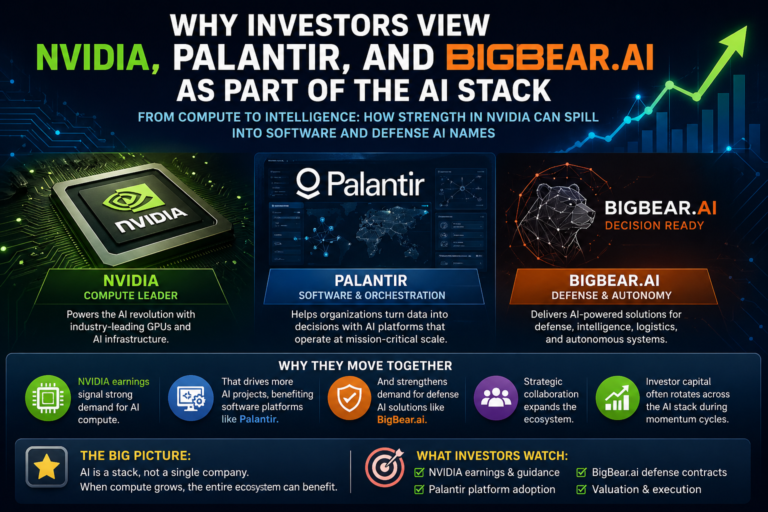
NVIDIA continues to lead the AI sector through its dominance in high-performance compute, and its strong market performance often shapes overall sentiment across AI-related stocks. As NVIDIA drives the foundation of AI infrastructure, investors increasingly look beyond chips and into the software layer where real-world applications are deployed. In this environment, capital and attention often flow into companies like Palantir Technologies and BigBear.ai, which focus on turning AI capabilities into operational systems for enterprises and government users. As a result, these companies frequently trade in line with broader AI momentum, even though they operate in different parts of the technology stack.
AI Deployment Moves Beyond Experimentation
Palantir Technologies continues attracting investor attention as markets increasingly focus on companies enabling artificial intelligence deployment, not just supplying compute. While much of the AI narrative still centers on semiconductor leaders, Palantir has positioned itself in the software layer where organizations turn data into operational decisions.
At the center of that discussion is Palantir’s Artificial Intelligence Platform (AIP). Rather than competing as a foundation model developer, the company focuses on helping enterprises and government agencies operationalize AI through automation, forecasting, and decision support workflows.
As a result, investors continue watching whether growing demand for production-scale AI can support long-term expansion.
Commercial Growth Broadens the Story
Enterprise Adoption Supports Expansion
At the same time, Palantir’s commercial growth has become increasingly important to the investment narrative. What was once viewed primarily as a government-focused company is now being evaluated more broadly as an enterprise software infrastructure platform.
Businesses continue adopting AI-driven analytics and automation tools to improve operations, while investors watch whether those deployments lead to larger recurring revenue opportunities.
Consequently, the story has expanded well beyond government contracts alone.
BigBear.ai Collaboration Adds Ecosystem Potential
Strategic Partnerships Draw Attention
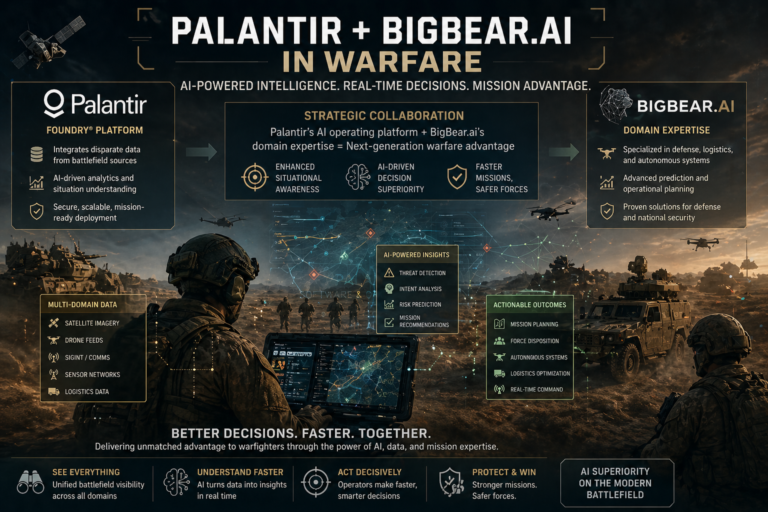
Another area drawing interest is Palantir’s collaboration with BigBear.ai. Investors continue monitoring whether the relationship can expand Palantir’s ecosystem reach, particularly in defense, predictive intelligence, and operational decision software.
Through the partnership, Palantir’s Foundry platform has been linked with BigBear.ai capabilities to support anticipatory intelligence and optimization use cases. Some investors see that collaboration as reinforcing Palantir’s role as a platform rather than a standalone product company.
In addition, some market participants view BigBear.ai’s exposure to autonomous systems and defense software as complementary to Palantir’s broader software stack. That has contributed to discussion around whether collaboration—not just competition—could become part of the evolving AI defense narrative.
Analyst Targets Add Another Layer of Focus
Price Objectives Fuel Debate
Meanwhile, analyst price targets have added another dimension to the discussion. While targets vary widely, several bullish analysts continue framing upside around expanding AI software adoption, defense exposure, and operating leverage.
Some projections have outlined upside scenarios in the $150 to $180 range, while more aggressive bull cases have pushed higher. However, skeptics continue arguing that valuation assumptions remain stretched.
That divergence itself has become part of the story.
For bullish investors, higher targets reflect confidence that Palantir may be evolving into a strategic AI infrastructure platform. For cautious investors, those same targets raise questions about whether expectations have moved ahead of execution.
Policy Tailwinds Support the Strategic Narrative
Government Alignment Remains in Focus
At the same time, investors have been watching whether policy alignment could support the company’s long-term positioning.
Palantir’s role in defense modernization, federal software systems, and security-related technologies has drawn attention as some investors view government priorities as potentially favorable to additional contract opportunities.
Recent reporting around a $300 million USDA software agreement has added support to that narrative.
Public Support Adds Visibility
Separately, President Donald Trump’s positive remarks about Palantir’s “great warfighting capabilities” have been cited by some investors as symbolic support for the company’s defense profile. While commentary alone does not change fundamentals, supporters argue it reinforces visibility around Palantir’s strategic relevance.
Key Areas Investors Are Watching
- AIP adoption: Markets continue monitoring whether AI deployments expand across enterprise and government customers.
- Commercial growth: Investors remain focused on broader customer adoption and recurring revenue expansion.
- BigBear.ai collaboration: Some are watching whether ecosystem partnerships expand Palantir’s software reach.
- Analyst targets: Bullish price scenarios continue fueling debate over upside potential.
- Policy tailwinds: Government priorities remain viewed by some as supportive for long-term demand.
- Margin performance: Operating leverage remains critical as growth scales.
- Competitive differentiation: Markets continue assessing whether Palantir can sustain an edge.
Defense Exposure Remains a Strategic Driver
National Security Demand Supports the Thesis
Meanwhile, government and defense exposure remains a major pillar of the investment case. Interest in AI-enabled defense modernization has kept attention on software platforms involved in mission planning, logistics intelligence, and operational analytics.
Supporters argue the company benefits from long-term structural demand tied to national security digitization.
As governments continue investing in autonomous systems and intelligence software, Palantir is increasingly discussed as part of that broader infrastructure ecosystem.
As a result, some investors now view the company not only as a software provider but as a strategic technology asset tied to defense transformation.
Valuation and Competition Stay in Focus
Risks Continue Balancing Optimism
Despite optimism, valuation remains one of the biggest areas of scrutiny. High expectations can make shares sensitive to earnings results, guidance revisions, or contract timing.
At the same time, competition remains a central question.
Large cloud vendors and AI providers continue expanding enterprise offerings, which has raised questions about long-term differentiation.
Supporters argue Palantir’s advantage lies in secure deployment inside highly regulated and mission-critical environments. Critics argue competition could intensify as larger platforms move deeper into the software stack.
That debate remains central to the long-term investment case.
Looking Ahead
Execution Remains the Core Catalyst
Going forward, investor focus is likely to remain centered on several catalysts: AI platform adoption, commercial expansion, defense opportunities, strategic partnerships, and policy-related tailwinds.
If execution remains strong, Palantir could continue strengthening its position within the broader conversation around AI deployment infrastructure.
However, if growth slows or competition intensifies, valuation concerns could return to the forefront.
For now, the debate appears larger than whether Palantir is simply a software company. Increasingly, investors are weighing whether it represents exposure to enterprise AI deployment, defense intelligence systems, and a growing software ecosystem that may include collaboration-driven upside.