Stay Updated
Calling All Pre-Seed and Seed Startups: What Every Founder Should Know Before Raising Capital
Building a startup is one of the most challenging and rewarding journeys an entrepreneur can undertake. Every successful company starts with an idea, but turning that idea into a sustainable business requires far more than a great product. Founders must understand customers, validate demand, build the right team, manage resources effectively, and eventually secure funding to accelerate growth.
Many first-time founders focus heavily on product development while overlooking the fundamentals of fundraising and startup growth. As a result, they often enter investor meetings unprepared and struggle to communicate why their startup deserves investment. Understanding how the startup ecosystem works can dramatically improve a company’s chances of success.
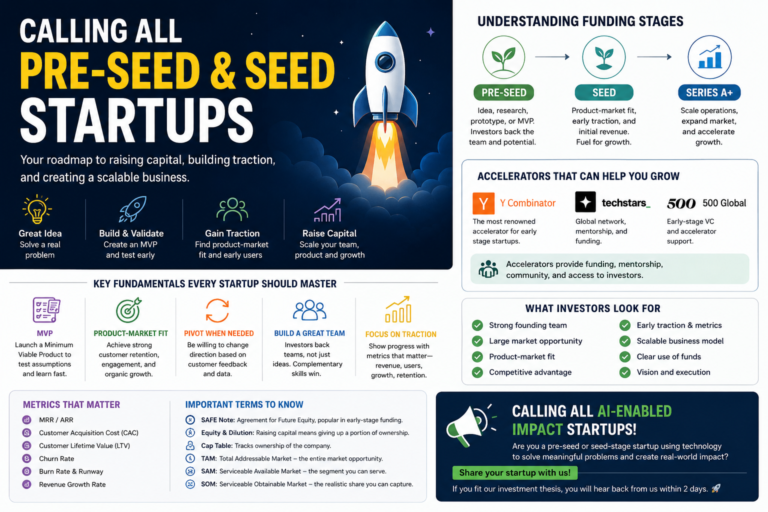
Understanding Startup Funding Stages
Most startups do not raise millions of dollars overnight. Funding typically happens in stages as the company grows and reduces risk.
Bootstrapping
Many startups begin by bootstrapping, which means founders use their own savings or early revenue to fund operations. Bootstrapping allows founders to retain ownership and maintain control while validating their idea.
Pre-Seed Funding
Pre-seed funding is usually the first external capital a startup receives. At this stage, founders may have an idea, prototype, or Minimum Viable Product (MVP), but limited traction.
Investors evaluating pre-seed startups focus primarily on:
- The founding team
- The problem being solved
- Market opportunity
- Product vision
- Execution capability
Seed Funding
Seed funding helps startups move from validation to growth. By this stage, founders should have evidence that customers want their product.
Seed funding is commonly used to:
- Expand product development
- Hire employees
- Acquire customers
- Build marketing efforts
- Improve operations
Investors expect to see signs of market validation before participating in a seed round.
What Is an Accelerator and Why Does It Matter?
One of the most common questions new founders ask is whether they should apply to an accelerator.
Startup accelerators help early-stage companies grow faster by providing mentorship, funding, education, and investor introductions.
The most well-known accelerator is Y Combinator. Some of the world’s most successful startups received support from Y Combinator during their early stages.
Other respected programs include:
- Techstars
- 500 Global
Accelerators often provide founders with access to experienced entrepreneurs, investors, and a network that might otherwise take years to build.
For first-time founders, these programs can significantly shorten the learning curve.
Start With an MVP, Not a Perfect Product
Many entrepreneurs make the mistake of spending months or years building products before speaking with customers.
Successful startups typically launch an MVP, or Minimum Viable Product, as early as possible.
An MVP is the simplest version of a product that solves a core customer problem. Its purpose is not perfection. Its purpose is learning.
Launching an MVP helps founders:
- Validate assumptions
- Collect customer feedback
- Reduce development costs
- Identify product opportunities
- Demonstrate traction
The best startups learn quickly and adapt rather than spending years building features nobody wants.
Understanding Product-Market Fit
Product-market fit is one of the most important concepts in the startup world.
A startup achieves product-market fit when customers genuinely want its product and continue using it because it solves a meaningful problem.
Common signs of product-market fit include:
- Strong customer retention
- Growing revenue
- Positive customer reviews
- Organic referrals
- Increasing demand
- High engagement
Many investors will not invest substantial capital until they see evidence of product-market fit.
Without product-market fit, raising money becomes significantly more difficult.
Why Startups Pivot
The startup journey rarely follows the original plan.
Many successful companies changed direction before finding success. This process is known as a pivot.
A pivot occurs when founders adjust their product, business model, target market, pricing strategy, or technology based on customer feedback and market realities.
A pivot is not a sign of failure. In many cases, it is evidence that founders are listening to customers and responding to data.
The most successful entrepreneurs remain committed to solving problems while staying flexible about how they solve them.
What Investors Actually Want
Founders often assume investors care only about revenue. In reality, investors evaluate multiple factors before making decisions.
Strong Team
Investors frequently invest in founders before products.
They look for teams with:
- Industry expertise
- Leadership ability
- Technical skills
- Persistence
- Execution capability
Large Market Opportunity
Investors want to know that a startup can become a large business. A strong solution in a tiny market may never generate venture-scale returns.
Competitive Advantage
Founders must explain why competitors cannot easily copy their solution.
Advantages may include:
- Proprietary technology
- Exclusive partnerships
- Industry expertise
- Strong distribution
- Unique data
- Intellectual property
Early Traction
Traction proves customers care.
Examples include:
- Revenue
- User growth
- Customer retention
- Pilot projects
- Strategic partnerships
The more evidence founders can provide, the stronger their investment case becomes.
Understanding SAFE Notes and Startup Equity
Many founders encounter the term SAFE during fundraising.
SAFE stands for Simple Agreement for Future Equity. It allows investors to provide capital today in exchange for future ownership when the company raises a larger funding round.
SAFE agreements have become extremely popular because they are faster and simpler than traditional financing structures.
Founders should also understand dilution.
Every funding round typically requires founders to exchange a portion of ownership for capital. While ownership percentages may decrease, the overall value of the company ideally increases.
Understanding equity and dilution is critical before accepting investment.
What Is a Cap Table?
A capitalization table, commonly called a cap table, tracks ownership within a startup.
It typically includes:
- Founders
- Employees
- Angel investors
- Venture capital firms
As startups grow and raise additional rounds, maintaining a clean cap table becomes increasingly important.
Investors often review cap tables before making investment decisions.
Startup Metrics Every Founder Should Know
Modern investors rely heavily on data.
Founders should understand the key metrics used to evaluate startup performance:
- Monthly Recurring Revenue (MRR)
- Annual Recurring Revenue (ARR)
- Customer Acquisition Cost (CAC)
- Customer Lifetime Value (LTV)
- Churn Rate
- Burn Rate
- Runway
- Revenue Growth Rate
Strong founders know these metrics and can explain how they impact growth.
Understanding TAM, SAM, and SOM
Investors frequently ask founders about market size.
TAM (Total Addressable Market)
The total potential market if every possible customer purchased the product.
SAM (Serviceable Available Market)
The portion of the market that fits the startup’s target audience.
SOM (Serviceable Obtainable Market)
The realistic market share the startup expects to capture.
Understanding these numbers demonstrates strategic thinking and market awareness.
Common Reasons Startups Fail to Raise Capital
Many startups struggle to secure funding because they overlook critical fundamentals.
Common reasons include:
- Lack of product-market fit
- Weak founding team
- Small market opportunity
- Poor pitch deck
- Unrealistic valuation
- Insufficient traction
- Unclear business model
- Weak understanding of customers
Fundraising success often depends on preparation as much as the quality of the idea itself.
Calling All AI-Enabled Impact Startups
While startups exist across every industry, artificial intelligence continues to attract significant investor interest. Investors are actively seeking founders who use AI to solve meaningful challenges across healthcare, education, sustainability, enterprise software, robotics, cybersecurity, and financial services.
If you are a pre-seed or seed-stage AI-enabled startup currently raising capital, we would love to learn more about your company, vision, and growth plans.
Share your startup details with us.
If your startup aligns with our investment thesis, you can expect to hear back within two business days.
The next generation of transformative companies is being built today, and your startup could be one of them.
Are you a pre-seed/seed AI enabled impact driven #startup, creating something that the world really needs, and raising? We want to hear from you!
Fill out your details here
You will hear back from me within 2 days if you fit our thesis #venturecapital