
Rivian R2 vs. Tesla Model Y: The Stock Story Investors Can’t Ignore
The electric vehicle sector has moved decisively beyond early-adopter enthusiasm and into a fiercely competitive mass-market phase. As pricing pressures intensify and consumers demand both affordability and functionality, automakers must now prove they can scale efficiently. Within this environment, the Rivian R2 represents the company’s most consequential strategic move to date, with significant implications for RIVN stock performance.
Establishing Brand Credibility
Rivian first built its reputation by entering the electric truck segment ahead of many established manufacturers. With the launch of the R1T, the company demonstrated that a fully electric pickup could combine performance, utility, and premium design. Shortly thereafter, the R1S reinforced Rivian’s positioning as an adventure-oriented brand rather than a conventional urban EV maker.
At the same time, Rivian strengthened its credibility through strategic partnerships. Its commercial delivery van agreement with Amazon signaled institutional confidence in Rivian’s engineering and production capabilities. The company’s initial public offering further elevated its profile, drawing widespread investor attention and briefly placing its valuation alongside established automakers.
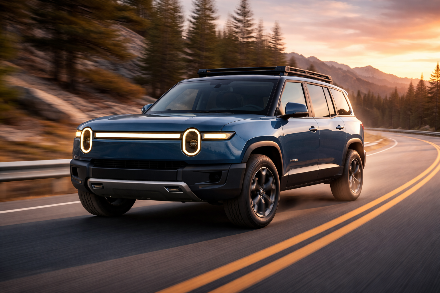
Moreover, Rivian deliberately cultivated a distinctive brand identity. Its signature lighting design and rugged styling created immediate visual recognition. Importantly, the company also invested heavily in vertical integration, developing much of its vehicle software and electrical architecture internally. By doing so, Rivian positioned itself closer to Tesla’s technology-forward model than to traditional legacy OEM structures. This combination of innovation and strategic backing now sets the stage for the Rivian R2, which has already captured growing public attention.

Transitioning from Premium Niche to Volume Strategy
While Rivian’s early vehicles established credibility, their premium pricing constrained volume expansion. Consequently, management designed the R2 Rivian to address a broader consumer base. Unlike the body-on-frame construction used in the R1 lineup, the R2 utilizes a unibody architecture engineered for cost efficiency and production simplicity. This reduces manufacturing complexity and supports higher output.
Analysts estimate annual deliveries of 62,000–67,000 units in 2026, marking a 50% increase over 2025. The Rivian R2’s $45,000 starting price positions it competitively against the Model Y while retaining Rivian’s adventure SUV identity. By achieving volume production at this price, Rivian could materially improve margins and accelerate the path toward profitability—an essential driver for RIVN stock appreciation.
Already, public interest in the R2 Rivian is growing, particularly in North America, where curiosity about the vehicle is accelerating. Potential buyers are actively searching for information about the Rivian R2, from features to availability, signaling that market awareness and early adoption intent are building even before the vehicle hits showrooms. This heightened attention strengthens the company’s revenue potential and bolsters investor confidence.
Competing Directly with the Tesla Model Y
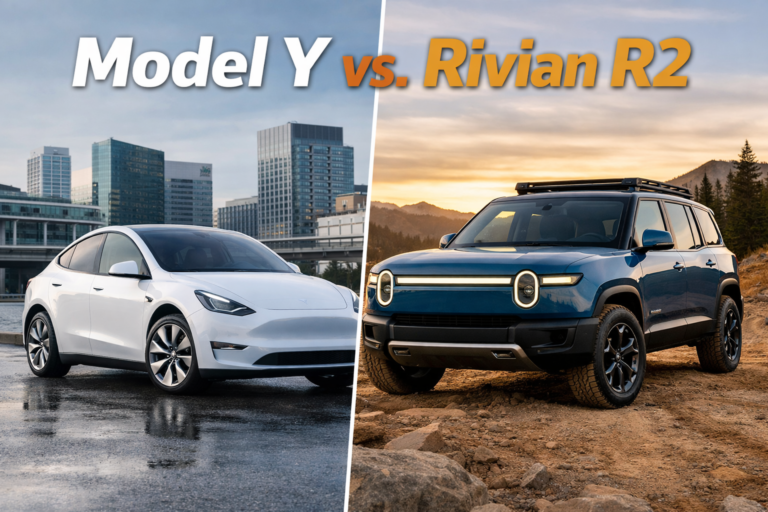
Naturally, the Rivian R2 enters a segment long dominated by the Tesla Model Y. Yet Rivian approaches the competition with a differentiated strategy. Where Tesla emphasizes aerodynamic efficiency and minimalist design, Rivian prioritizes outdoor utility and cargo flexibility. As Wassym Bensaid Hammoud notes, “Even though we had this really nice two-box silhouette, aerodynamic efficiency was still very important.” The R2 Rivian retains practical configurations that appeal to lifestyle-oriented buyers, reinforcing the company’s adventure-driven identity.
Charging accessibility has evolved significantly. By adopting the North American Charging Standard (NACS), Rivian vehicles now integrate with Tesla’s Supercharger network, diminishing Tesla’s historic infrastructure advantage. Additionally, Rivian maintains higher ground clearance (≈9.8 inches) and off-road tuning relative to many crossover competitors, strengthening its niche differentiation.
Engineering and Technology Comparison: R2 Rivian vs. Model Y
Aerodynamics and Design: Tesla’s Model Y reduces drag with a sleek fastback profile (Cd ~0.23). Rivian balances aerodynamics with utility, refining underbody airflow, wheel design, and front-end geometry to maintain efficiency without compromising the SUV’s functional silhouette.
Platform: The R2 Rivian uses a midsize unibody platform optimized for cost-effective mass production. In contrast, the Model Y relies on Tesla’s Modular Platform with integrated battery packs for low center of gravity and structural rigidity.
Battery and Range: Tesla offers long-range variants exceeding 330 miles. The Rivian R2 targets 300+ miles with modular battery packs that allow faster manufacturing and future upgrades. Both support fast charging, but Rivian’s NACS integration allows access to Tesla Superchargers.
Powertrain and Software: Tesla’s dual/tri-motor configurations focus on efficiency and software-optimized torque vectoring. Rivian equips the R2 Rivian with dual-motor AWD, torque vectoring, and adaptive off-road modes. Both vehicles deliver software updates over-the-air (OTA) to enhance performance and safety.
Safety and ADAS: Tesla emphasizes autopilot and FSD capabilities. Rivian focuses on adventure-oriented safety, including adaptive traction control, enhanced suspension tuning, and off-road obstacle detection.
Strategic Implication: By emphasizing rugged utility and lifestyle-focused features, the Rivian R2 maximizes niche appeal while maintaining competitive efficiency. This positioning targets a segment Tesla’s Model Y leaves partially unaddressed, strengthening Rivian’s growth potential and investor appeal.
Strengthening Financial Position and Stock Considerations
Rivian’s recent earnings reports indicate progress toward profitability, including a milestone quarter of gross profit. Liquidity stands at $6.6 billion, providing ample operational runway. The joint venture with Volkswagen offers technological collaboration and production flexibility during the R2 ramp.
Wall Street sentiment has shifted positively. Analysts, including Deutsche Bank, upgraded RIVN to Buy with upside estimates exceeding 20%. However, production complexity, capital expenditure (~$2B planned for 2026), and execution risks remain critical factors for investors.
Balancing Opportunity with Execution Risk
Rivian’s growth potential comes with operational challenges. Scaling the Rivian R2 platform requires supply chain precision, labor coordination, and cost control. Market volatility, regulatory adjustments, and competition from global EV brands further amplify risk.
Investors should monitor key milestones, including production volumes, delivery performance, and market reception, as these factors directly influence RIVN stock trajectory.
A Defining Corporate Transition
Rivian now stands at a pivotal juncture. Early innovation, strategic partnerships, and differentiated design have established credibility, but converting this into scalable execution is critical. If the R2 Rivian rollout succeeds, Rivian could materially enhance its market position and shareholder value. Conversely, operational missteps could rapidly affect sentiment.
From an investment perspective, RIVN represents a high-variability growth opportunity: upside potential is substantial if production, efficiency, and market adoption align, but execution remains the central variable.