

PhonePe IPO 2026: Latest Update and What Canadian Investors Need to Know
PhonePe’s IPO remains one of India’s most closely watched fintech listings, but investors are still waiting for the company to return to the public-market process. The Walmart-backed digital payments giant paused its IPO plans in March 2026, citing geopolitical tensions and volatile global markets. The company said it remains committed to eventually listing in India when market conditions become more favorable.
That makes the PhonePe story very different from the original 2025 IPO expectations. The company is no longer simply a $15 billion IPO story. Investors are now watching its potential valuation, profitability, enormous payments network, expansion into financial services, and its efforts to bring hundreds of millions of additional Indians into the digital economy.
What Is PhonePe?
PhonePe is one of India’s largest digital payments and financial-services platforms. Launched in 2016, the company has grown from a simple payments application into a broader financial ecosystem covering consumer payments, merchant payments, lending and insurance distribution, investments, stock broking, and digital commerce.
At the center of PhonePe’s business is India’s Unified Payments Interface (UPI). UPI allows consumers to transfer money directly between bank accounts and make payments using mobile devices.
PhonePe has built enormous scale around this infrastructure. As of July 2026, the company said it had more than 71.5 crore, or 715 million, registered users and a payments acceptance network covering more than 5 crore, or 50 million, merchants.
That scale is one of PhonePe’s biggest advantages as it prepares for a future public listing.
PhonePe Expands UPI to 200 Million+ Feature-Phone Users
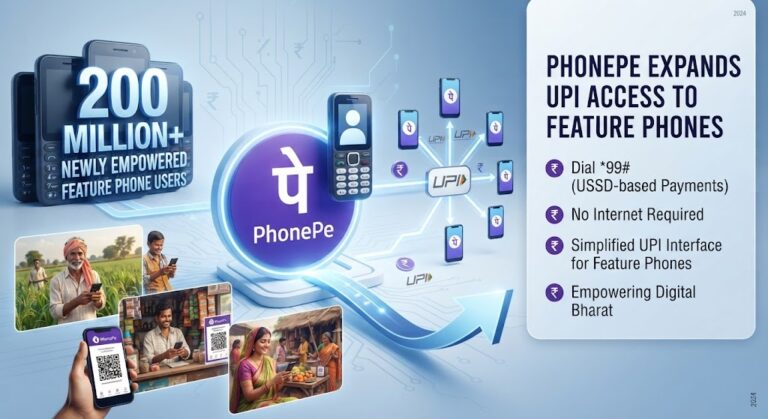
One of PhonePe’s most important recent developments came on August 31, 2026, when the company launched PhonePe UPI 123Pay, bringing UPI payments to feature phones without requiring an internet connection.
The move targets India’s 200 million-plus feature-phone users and makes PhonePe the first major third-party application provider to extend UPI payments to this segment, according to the company’s announcement.
The service uses an SMS-based architecture designed to work even in areas with limited 2G connectivity. Users can make person-to-person transfers using mobile numbers or UPI IDs and make merchant payments through UPI IDs and QR codes on compatible phones. They can also check account balances and transaction histories.
PhonePe UPI 123Pay will initially be pre-installed on selected devices from Nokia, HMD, Lava International and Itel, with additional handset partnerships expected to follow.
PhonePe is also introducing a voice-first, AI-powered helpline supporting English and 12 Indian languages. The system is designed to guide users through activation and answer basic UPI questions, potentially making digital payments easier for people who are less familiar with smartphone applications.
For investors, this is more than a financial-inclusion initiative. It represents a potential expansion of PhonePe’s addressable market. The company already has hundreds of millions of smartphone users, but UPI 123Pay gives it a way to reach another enormous group of consumers who have remained outside the smartphone-driven digital economy.
PhonePe’s CEO Sameer Nigam has described the initiative as an effort to help bring the next 300 million users into India’s digital financial ecosystem.
Why the Feature-Phone Strategy Matters for the IPO
The feature-phone launch gives investors another growth narrative to consider ahead of PhonePe’s eventual IPO.
India’s digital-payment market is already enormous, so simply adding more smartphone users may become increasingly difficult. Expanding into feature phones could give PhonePe another avenue for transaction growth.
However, investors should distinguish between user growth and financial growth. More payment users do not automatically translate into higher profits. PhonePe will ultimately need to monetize its ecosystem through financial products, merchant services, lending, insurance, investments, and other businesses.
That is why the company’s expansion beyond payments could become increasingly important to its public-market valuation.
Why Did PhonePe Pause Its IPO?
PhonePe had been preparing for an Indian stock-market listing, but in March 2026 it temporarily paused the process because of geopolitical tensions and volatile market conditions. The company said the decision was related to broader market conditions rather than a change in its IPO ambitions.
The valuation expectations have also changed.
In March, Reuters reported that PhonePe was targeting a valuation between approximately $9 billion and $10.5 billion, with the IPO potentially raising around $900 million to $1.05 billion. That was substantially below earlier expectations of approximately $15 billion and as much as $1.5 billion in proceeds.
The lower valuation could ultimately make the IPO more attractive to investors if PhonePe continues growing rapidly. However, it also demonstrates that public-market investors may be less willing to accept the lofty valuations attached to some private fintech companies.
Walmart Remains a Major Shareholder
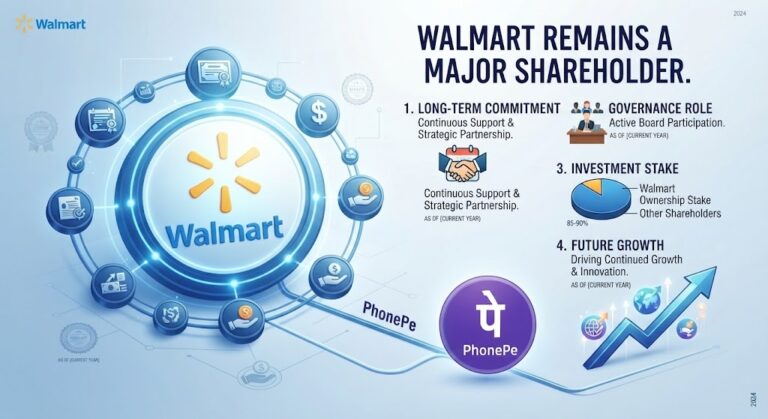
Walmart remains one of the most important shareholders behind PhonePe.
Walmart’s backing has helped PhonePe scale its business while providing the company with a major international corporate investor. The IPO could also provide an opportunity for existing shareholders to sell part of their positions.
Reuters previously reported that Walmart planned to reduce its stake through the IPO, while investors including Tiger Global and Microsoft were expected to sell their holdings.
For investors, Walmart’s continued involvement provides an additional level of credibility, although PhonePe’s eventual stock-market performance will depend on its own financial results.
PhonePe and the Next Generation of AI Payments
Another emerging opportunity for PhonePe is the development of AI-powered payments.
In September 2026, India was preparing a framework that could allow AI agents to conduct certain small digital payments through UPI without requiring users to approve every individual transaction. The proposed system could include spending limits, identity verification, delegated funds, and other safeguards.
This could eventually allow AI assistants to handle routine transactions such as purchases and other low-value payments.
PhonePe is particularly relevant to this development because it remains one of the dominant platforms in India’s UPI ecosystem. In August 2026 alone, UPI processed 24.51 billion transactions worth approximately ₹29.82 trillion, according to Reuters.
The combination of UPI, AI agents, smartphones, feature phones and financial services could therefore create a much larger digital-finance opportunity for companies operating within India’s payment ecosystem.
What Does PhonePe Mean for Canadian Investors?
For Canadian investors, PhonePe is primarily a company to watch rather than a straightforward TSX or Nasdaq investment.
PhonePe intends to list in India, meaning direct participation would depend on access to Indian markets and the investor’s brokerage and eligibility. Canadian investors who cannot directly participate could potentially gain indirect exposure through diversified emerging-market ETFs or mutual funds, although investors would need to verify whether a particular fund owns PhonePe after its listing.
Investors should also consider currency risk, Indian regulatory changes, competition, valuation, profitability and the sustainability of PhonePe’s growth.
Final Takeaway
PhonePe’s IPO story has become much bigger than a potential stock-market listing. The company is expanding its ecosystem at both ends of India’s digital economy.
On one side, PhonePe is serving hundreds of millions of smartphone users and tens of millions of merchants. On the other, its new UPI 123Pay service brings internet-free digital payments to more than 200 million feature-phone users, potentially opening another massive market.
At the same time, India’s move toward AI-agent payments could eventually create another layer of growth for the UPI ecosystem.
The IPO itself remains paused rather than cancelled, and the valuation will be one of the most important things investors watch when PhonePe eventually returns to the market.
For Canadian investors, PhonePe represents a compelling case study in India’s digital-finance revolution. But the eventual investment decision should come down to the IPO price, valuation, profitability, competitive position and the company’s ability to turn its enormous user base into sustainable long-term earnings.