
Nvidia vs Google: Why Both Could Win the AI Infrastructure Race
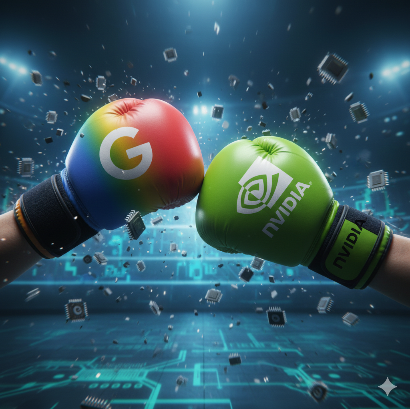
Artificial intelligence is creating one of the largest technology infrastructure buildouts in history. Hyperscalers, AI laboratories and enterprises are spending enormous amounts on GPUs, custom accelerators, networking, data centers and the electricity required to operate them. At the center of this transformation are NVIDIA and Google, but the competition is often framed incorrectly. The AI infrastructure market does not necessarily have to produce one winner. NVIDIA and Google are targeting different pillars of the AI computing market, and both companies are positioned to benefit from the long-term expansion of artificial intelligence.
NVIDIA is building a broad, general-purpose AI infrastructure platform designed to support almost every major AI workload. Google is pursuing a more vertically integrated strategy based on custom Tensor Processing Units, Gemini models, Google Cloud and its own massive technology ecosystem. As AI evolves from model training toward inference, reasoning and AI agents, these two strategies could become increasingly complementary rather than mutually exclusive. The result could be a market in which NVIDIA dominates flexible AI infrastructure while Google captures a growing share of specialized, efficient and vertically integrated AI computing. The ultimate winner, therefore, may not be one company. It may be both.

Nvidia vs Google: Two Different AI Strategies
The biggest difference between NVIDIA and Google is how they approach AI infrastructure. NVIDIA wants its technology to power as many different AI workloads as possible, while Google has more control over its own environment and can design hardware specifically around the workloads generated by its models, cloud customers and consumer products. This creates two distinct competitive advantages: NVIDIA’s advantage is flexibility, while Google’s advantage is vertical integration.
Neither strategy requires the other company to fail. In fact, the rapid expansion of AI computing could create enough demand for both approaches to thrive. The AI industry is becoming large enough that specialized and general-purpose computing can coexist, with companies choosing different architectures depending on the workload, cost, availability and performance requirements.
NVIDIA: The General-Purpose AI Infrastructure Powerhouse
NVIDIA has built one of the most powerful positions in modern computing by turning its GPUs into the foundation of the AI infrastructure boom. However, describing NVIDIA simply as a GPU company is increasingly outdated. The company now provides GPUs, CPUs, networking, interconnects, complete AI systems and software designed to operate massive AI factories.
Its latest Vera Rubin platform has also moved beyond being merely a future roadmap. NVIDIA said in August 2026 that Vera Rubin was in full production, with systems being deployed by major infrastructure providers including Google Cloud, Microsoft Azure, Oracle Cloud Infrastructure and other partners.
NVIDIA’s financial performance demonstrates the scale of demand. For its fiscal second quarter ended July 26, 2026, NVIDIA reported $96.2 billion in quarterly revenue, up 106% year over year. Data Center revenue reached $89.0 billion, up 117%, while the company guided for approximately $108 billion in revenue for fiscal Q3. These numbers reinforce an important point: NVIDIA is not merely participating in the AI infrastructure cycle. It is one of its primary beneficiaries.
NVIDIA’s strength is particularly powerful for companies that need flexibility. AI laboratories and enterprises can use NVIDIA infrastructure to train different models, experiment with new architectures, run inference and adapt their systems as AI technology changes. That flexibility has significant economic value because AI workloads are evolving rapidly, and companies do not necessarily know what their computing requirements will look like several years from now.
Google: The Vertically Integrated AI Infrastructure Player
Google’s strategy is different. Rather than relying entirely on third-party accelerators, Google has spent years developing its own AI chips through its TPU program. Its latest generation, Ironwood, represents the company’s push toward large-scale AI inference and reasoning.
Google says Ironwood can scale to 9,216 chips in a single pod and deliver 42.5 exaflops of compute. But the most important advantage is not simply the number of chips. Google controls multiple layers of the AI stack, including its TPUs for AI acceleration, JAX and TensorFlow for software, Gemini for frontier AI models, Google Cloud for infrastructure and products such as Search, YouTube, Android and Workspace for distribution.
This gives Google something NVIDIA cannot completely replicate: the ability to optimize its hardware, models, software and applications together. Google can design an accelerator around the needs of Gemini, optimize its software around the accelerator and then deploy the technology across Google Cloud and its enormous internal product ecosystem. That creates a powerful feedback loop between hardware, software and applications.
Google therefore does not necessarily need to build a chip that is better than NVIDIA’s technology in every category. Its opportunity is to make its own infrastructure highly efficient for the workloads it cares about most and then extend that advantage to customers through Google Cloud.
Training and Inference Are Creating Different Opportunities
One of the most important changes in AI infrastructure is the growing importance of inference. The first phase of the AI boom was heavily focused on training increasingly large models. That environment strongly favored flexible, high-performance accelerators such as NVIDIA’s GPUs because frontier AI companies needed massive amounts of computing capacity to train increasingly sophisticated models.
But once models are trained, they must be used. Every chatbot interaction, generated image, coding request, reasoning task and AI-agent action consumes inference compute. As AI applications become more widespread, the economics of inference become increasingly important.
This creates an opportunity for specialized architectures. Google’s TPU strategy is particularly relevant because the company can optimize its infrastructure around large-scale workloads where efficiency and system-level performance matter. However, NVIDIA is not standing still. Its Vera Rubin platform is also designed around training, inference and increasingly complex AI workloads.
That means the inference market does not have to belong exclusively to Google. Instead, inference could become another enormous battlefield where both companies compete, innovate and grow.
Why Google Does Not Need to Replace NVIDIA
This is where the traditional NVIDIA-versus-Google narrative breaks down. Google does not need to replace every NVIDIA GPU in every data center to succeed. It only needs to capture workloads where its custom silicon provides a compelling economic or technical advantage.
Similarly, NVIDIA does not need to prevent every company from developing custom chips. It needs to remain the most attractive general-purpose platform for a huge range of AI workloads. That is a much more realistic competitive framework.
Consider the needs of a large AI company. It may want NVIDIA GPUs for some training workloads, Google TPUs for other workloads and Amazon’s Trainium accelerators for additional capacity. It may even develop its own custom silicon. From the customer’s perspective, using multiple architectures can reduce dependency on any single supplier, improve negotiating power and allow different workloads to run on the infrastructure best suited to them.
This makes a multi-architecture AI ecosystem increasingly logical.
Anthropic Shows Why Multiple Architectures Matter
Anthropic provides one of the clearest examples of this changing environment. The company has significantly expanded its use of Google Cloud TPUs and announced a partnership with Google and Broadcom involving multiple gigawatts of next-generation TPU capacity expected to come online beginning in 2027.
Anthropic had also announced plans to use up to one million Google TPUs, representing tens of billions of dollars of infrastructure investment and more than one gigawatt of capacity expected in 2026.
However, this does not mean Anthropic is abandoning NVIDIA. Instead, Anthropic’s infrastructure strategy illustrates the broader trend toward hardware diversification. The company has discussed using Google TPUs, NVIDIA GPUs and Amazon Trainium across its infrastructure.
That is significant because it suggests that the future of AI infrastructure may be less about finding one perfect accelerator and more about matching different architectures to different workloads. If that happens, both NVIDIA and Google can win without one company needing to eliminate the other.
NVIDIA’s Biggest Moat: Software and Flexibility
NVIDIA’s strongest competitive advantage may ultimately be software rather than silicon. CUDA has become deeply embedded in the AI development ecosystem, and researchers, developers and enterprises have spent years building software, libraries and optimization layers around NVIDIA hardware.
That creates significant switching costs. Even if another accelerator can deliver strong benchmark results, convincing developers and companies to redesign established workloads can be difficult. NVIDIA also benefits from its ability to support a broad range of workloads, which becomes particularly valuable as AI models and applications continue to change.
A company investing billions of dollars in AI infrastructure may not want to optimize its entire operation around a single specialized workload. A flexible platform can reduce that uncertainty, giving NVIDIA an important long-term advantage even as custom accelerators gain market share.
Google’s Biggest Moat: Vertical Integration
Google’s competitive advantage is different. Google does not need to convince the entire AI industry to use its hardware. It can optimize its own infrastructure at enormous scale.
The company controls the models, chips, cloud platform and many of the applications consuming AI compute. This means Google can make decisions that a standalone chip company cannot. If Google improves its TPU architecture, it can optimize Gemini around it. If it improves Gemini, it can redesign workloads around the TPU. If the resulting infrastructure becomes attractive to customers, Google Cloud can sell that capacity externally.
That vertical integration creates a powerful economic advantage and gives Google multiple opportunities to capture value from AI.
The Hyperscaler Battle Could Benefit Both Companies
The largest technology companies are becoming increasingly strategic about AI infrastructure. Hyperscalers want access to enormous amounts of computing power, but they also want greater control over costs, supply, performance and capacity.
This creates incentives to use a combination of NVIDIA GPUs, custom ASICs, Google TPUs, Amazon Trainium, AMD accelerators and other specialized AI chips. NVIDIA can benefit because its technology remains broadly deployable, while Google can benefit because its custom accelerators offer an alternative architecture that can operate at enormous scale.
The customer does not necessarily need to choose one architecture permanently. It can use several, and that creates room for both companies to succeed.
Nvidia vs Google Is Becoming a Battle of Economics
The future competition will increasingly be determined by economics rather than headline specifications. The important questions will be how much it costs to train a model, how much it costs to generate millions or billions of tokens, how much power the infrastructure consumes, how quickly thousands of chips can communicate with one another, how easy the hardware is to program and how much computing capacity a company can obtain.
Those questions favor different companies in different situations. NVIDIA’s flexibility and software ecosystem can justify its infrastructure for many workloads, while Google’s vertically integrated approach can become particularly attractive when custom optimization produces meaningful efficiency improvements.
That means the market can support both.

The Investment Case: NVIDIA and Google Represent Different AI Bets
For investors, the NVIDIA-versus-Google debate is therefore not simply about picking the better company. The two companies provide different exposure to the AI revolution.
NVIDIA represents the infrastructure buildout itself. The company sells the computing platforms, networking and systems required by many of the world’s largest AI companies. If AI infrastructure spending continues expanding rapidly, NVIDIA has direct exposure to that spending and to the capital expenditures of hyperscalers and AI laboratories.
Google represents a different form of AI exposure. Alphabet can invest in AI infrastructure while also monetizing AI through Google Cloud, Search, YouTube, Workspace and Gemini. That gives the company multiple ways to capture AI-related economic value rather than relying solely on selling computing hardware.
NVIDIA is therefore more directly tied to the capital expenditure cycle surrounding AI infrastructure, while Google has multiple avenues through which AI can contribute to revenue and profitability. Investors do not necessarily need to decide that one company will destroy the other. Instead, they can recognize that both companies can capture different portions of the same enormous AI opportunity.
Why the AI Market Can Support Two Winners
The size and diversity of the AI opportunity are perhaps the strongest reasons to believe that NVIDIA and Google can both succeed. AI is not a single application. It includes search, chatbots, coding, enterprise software, robotics, autonomous systems, AI agents, drug discovery, scientific computing, content generation, cybersecurity, healthcare, industrial automation and cloud computing.
Each of these applications can have different hardware requirements. A chip optimized for massive model training does not necessarily have to be the ideal solution for every inference workload. Likewise, a custom accelerator optimized for one company’s models does not necessarily replace a flexible platform used by thousands of developers.
That diversity creates room for multiple winners. NVIDIA can serve companies looking for broad compatibility and flexibility, while Google can target workloads where its vertically integrated architecture creates economic and performance advantages.
The Bigger Picture: A Multi-Architecture AI Economy
The AI infrastructure industry is increasingly moving toward a multi-architecture model. NVIDIA can remain the leading provider of flexible, general-purpose AI infrastructure while Google expands its TPU business and captures more specialized and inference workloads. Amazon can continue developing Trainium, AMD can compete for accelerator share and other technology companies can develop custom ASICs for particular applications.
This does not necessarily shrink NVIDIA’s opportunity. It may actually expand the overall AI infrastructure market. The more AI workloads that become economically viable, the more computing the world needs. And the more computing the world needs, the more opportunities exist for different architectures to coexist.
The industry therefore does not have to choose between NVIDIA and Google. The market can reward both approaches simultaneously.
Nvidia vs Google: Why Both Could Win
The most important conclusion from the NVIDIA-versus-Google battle is that AI infrastructure does not have to be a winner-takes-all market.
NVIDIA’s strength is its broad ecosystem. Its GPUs, CPUs, networking, systems and software allow it to provide a flexible infrastructure platform for a rapidly changing AI industry. Its enormous data-center business and continuing product development demonstrate the scale of demand for that approach.
Google’s strength is different. Its TPUs, Gemini models, Google Cloud infrastructure and massive consumer ecosystem allow it to optimize AI computing from silicon through applications. Ironwood demonstrates how far Google’s custom accelerator strategy has progressed, while Anthropic’s expanding TPU commitments demonstrate that major AI companies are willing to deploy Google’s architecture at significant scale.
The two companies can therefore compete for workloads while simultaneously expanding the overall AI computing market. NVIDIA does not need Google to disappear, and Google does not need NVIDIA to disappear.
The Bottom Line
The Nvidia vs Google rivalry should not be viewed as a race where one company must eventually eliminate the other. It is better understood as a competition between two different approaches to AI infrastructure.
NVIDIA is positioned to lead the flexible, general-purpose AI infrastructure market, while Google is positioned to become increasingly important in custom silicon, inference and vertically integrated AI computing.
As AI models become more capable and AI agents generate increasingly large amounts of inference demand, the total market for computing could become enormous. That creates room for multiple winners.
The ultimate outcome may therefore be neither NVIDIA beats Google nor Google beats NVIDIA. It could be something much more important for investors: NVIDIA and Google both win, but they win in different parts of the AI infrastructure economy.