
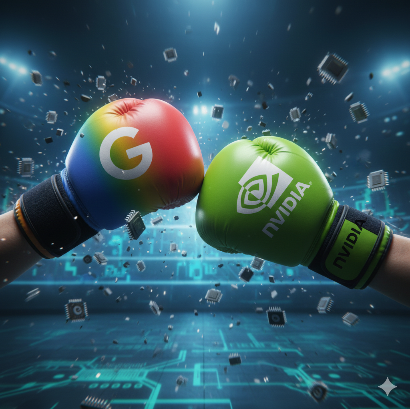
Nvidia vs Google: Who Will Be the Ultimate Winner?
Artificial intelligence no longer represents a future theme — it defines the present technology cycle. From cloud platforms and robotics to enterprise automation and consumer applications, AI drives capital spending at historic levels. At the center of this surge, the Nvidia vs Google rivalry now defines the AI infrastructure race.
As of early 2026, the debate has shifted. The question is no longer either/or. The industry has reached a more nuanced conclusion: both companies are winning — but in different categories.

Nvidia vs Google: The Winner by Category
The AI hardware market now reflects specialization rather than absolute dominance.
Nvidia: The Hardware Generalist
Nvidia remains the undisputed king of AI training and general-purpose compute.
Its Blackwell architecture — and the upcoming Rubin platform — continue to set the gold standard for flexibility. Nvidia chips can run virtually every major AI model across every cloud platform. That universality matters.
The numbers reinforce this dominance. Nvidia still controls roughly 85–90% of the discrete GPU market, an extraordinary concentration of power in one company.
More importantly, Nvidia’s strength extends beyond silicon. The CUDA ecosystem remains its most powerful moat. Developers have spent over a decade building tools, libraries, and optimization layers around CUDA. Most AI engineers still “think in CUDA.” That inertia makes switching costly, technically complex, and strategically risky.
As long as cutting-edge AI labs prioritize maximum performance and compatibility, Nvidia retains the upper hand in large-scale model training.
Google: The Efficiency Specialist
If Nvidia owns the flexibility crown, Google now holds the efficiency throne.
Google’s seventh-generation TPU, Ironwood (TPU v7), reportedly delivers up to 4x better performance per dollar than comparable GPUs for specific large-scale workloads. That cost advantage becomes decisive at hyperscale.
Unlike Nvidia, Google does not need to serve every workload. Instead, it optimizes for targeted AI use cases — particularly inference and specialized training — where performance-per-watt and performance-per-dollar matter more than peak versatility.
Google also benefits from full-stack ownership:
-
The chip (TPU)
-
The framework (JAX / TensorFlow)
-
The models (Gemini)
-
The cloud platform (Google Cloud)
-
The consumer endpoints (Search, Workspace, YouTube)
This vertical integration allows Google to optimize across the entire AI pipeline. At scale, that integration translates into lower cost, lower energy usage, and tighter system efficiency.
In a capital-intensive AI era, efficiency is not a minor advantage — it is strategic leverage.
Nvidia vs Google: The Key Battlefronts of 2026
The competition now centers on three decisive fronts.
Scalability
While Nvidia continues to lead in single-chip architecture performance, Google has advanced aggressively in system-level scaling.
Through optical switching innovations, Google can reportedly interconnect over 9,000 TPU chips per pod, achieving multi-exaflop performance comparable to the world’s largest supercomputers.
This matters because AI scaling increasingly depends on system architecture — not just individual chip power. In other words, compute density and interconnect efficiency now rival raw transistor performance as competitive differentiators.
Customer Shift
A subtle but important transition is underway.
Major AI players such as Anthropic, Meta, and Midjourney now deploy workloads on Google TPUs. Their motivation is straightforward: bypass the high “Nvidia tax” and avoid long lead times for GPU allocations.
During peak AI cycles, Nvidia supply constraints created bottlenecks. Google offers an alternative channel.
This shift does not dethrone Nvidia. However, it reduces absolute dependency — and that incremental diversification matters over time.
The Software Moat
Despite hardware advances, software remains Nvidia’s strongest defense.
CUDA’s maturity spans decades. PyTorch — now the dominant AI research framework — integrates seamlessly with Nvidia hardware. That compatibility ensures that cutting-edge research often defaults to Nvidia infrastructure.
Google’s frameworks, including JAX and TensorFlow, remain powerful. Yet friction persists when bridging to PyTorch-based ecosystems. That friction slows broader TPU adoption among developers who prioritize portability.
As long as developers “think in CUDA,” Nvidia maintains a structural advantage.
Market Outlook: Growth vs. Valuation
From an investor perspective, the story becomes even more nuanced.
Wall Street analysts increasingly favor Alphabet as a diversified AI exposure for 2026. With a price-to-earnings ratio near 30x, compared to Nvidia’s roughly 40x, Google offers a lower valuation multiple and a higher revenue floor supported by advertising and cloud services.
In contrast, Nvidia trades at a premium — but for good reason. Its AI infrastructure growth remains extraordinary. Global AI infrastructure spending could reach $3–4 trillion by 2030, and Nvidia continues to capture the majority of high-performance training demand.
Thus, investors face a classic trade-off:
-
Nvidia offers explosive growth with ecosystem dominance.
-
Google offers diversified resilience with structural efficiency gains.
Both narratives remain compelling.
Nvidia vs Google: The Bigger Picture: A Multi-Architecture AI World
The industry no longer appears headed toward a single winner-takes-all outcome.
Instead, AI infrastructure is fragmenting into a multi-architecture ecosystem:
-
Nvidia dominates flexible, high-performance training compute.
-
Google leads in vertically integrated, cost-efficient inference and specialized training.
-
AMD, Amazon (Trainium), and custom ASIC designers compete for niche segments.
Rather than replacing GPUs, TPUs increasingly complement them. Enterprises may train frontier models on Nvidia clusters and deploy inference on Google TPUs to optimize cost and power consumption.
In this scenario, competition expands the total addressable market instead of collapsing it.
The Bottom Line
The AI infrastructure war has matured.
Nvidia remains the king of general-purpose AI training, backed by unmatched software lock-in and market share dominance. Google, meanwhile, has evolved into the efficiency specialist, leveraging vertical integration and TPU innovation to challenge Nvidia’s pricing power.
The result is not displacement — it is strategic coexistence.
As AI investment accelerates toward a multi-trillion-dollar decade, the real winner may be the scale of the opportunity itself.