
Stay Updated
CoreWeave: The Hyperscaler Driving the Next Generation of Infrastructure
Last Updated: October 7, 2026
In the accelerating AI economy, infrastructure has become a competitive advantage of its own, and CoreWeave is emerging as one of the most closely watched names in the AI cloud market. Jim Cramer recently said he prefers CoreWeave over Nebius, arguing that he feels particularly good about CoreWeave CEO Michael Intrator and the company’s position in the rapidly expanding neocloud industry. While technology giants still dominate the broader cloud market, CoreWeave has carved out a distinct position by building infrastructure specifically for artificial intelligence workloads. The company trades on the Nasdaq under the ticker CRWV, giving investors direct exposure to one of the most specialized AI infrastructure businesses in the public market.
That opportunity, however, comes with enormous financial and execution demands. CoreWeave is growing at extraordinary speed, but it is also spending tens of billions of dollars to expand computing capacity, finance data centers and secure the power required to support the next generation of AI workloads. As a result, the CoreWeave stock story has moved beyond simple AI enthusiasm. Investors now have to balance explosive revenue growth and a massive contracted backlog against debt, capital spending, customer concentration and the challenge of deploying infrastructure fast enough to meet demand.
From Cryptocurrency Origins to AI Infrastructure Leader
The Great Pivot
CoreWeave did not begin as an AI infrastructure company. Founded in 2017, the business initially built its expertise around GPU-based computing, including cryptocurrency mining. As demand for artificial intelligence accelerated, management redirected that GPU infrastructure toward machine learning, high-performance computing and cloud services.
That pivot proved transformative. Instead of competing directly with Amazon Web Services, Microsoft Azure and Google Cloud across every type of workload, CoreWeave focused its resources on the demanding computing requirements created by AI training and inference. That specialization helped the company establish itself as one of the leading players in the rapidly expanding AI infrastructure and neocloud market.
CoreWeave IPO and the Rise of CRWV
CoreWeave completed its IPO in March 2025, selling its Class A common stock at $40 per share under the Nasdaq ticker CRWV. The offering gave public-market investors access to a company positioned directly at the center of the AI infrastructure boom.
The market initially treated CoreWeave stock as a high-growth AI opportunity. Since then, the investment case has become more complicated. Investors increasingly focus on CoreWeave revenue, profitability, financing requirements and the company’s ability to turn contracted demand into physical computing capacity.
Strategic Specialization as a Competitive Advantage
Engineering the AI Cloud
CoreWeave designs its cloud platform around GPU-intensive workloads rather than trying to become a general-purpose cloud provider. Its infrastructure supports AI model training, inference and other high-performance computing applications that require enormous amounts of processing power, networking and storage.
That specialization gives CoreWeave an important advantage when customers need large GPU clusters quickly. The company can build its technology stack around the requirements of AI developers instead of adapting a broad legacy cloud architecture to a rapidly changing workload.
The strategy has also expanded beyond simply renting computing power. CoreWeave increasingly combines infrastructure, software, storage, networking and developer tools into a broader AI cloud platform. That shift could become increasingly important as AI workloads move from model training toward continuous inference and autonomous AI agents.
CoreWeave Nvidia Relationship
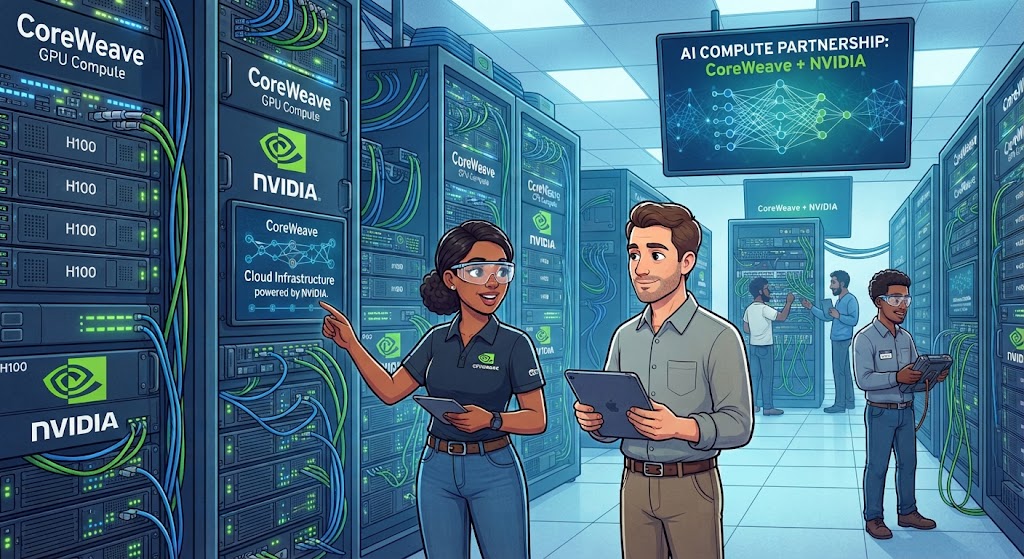
Nvidia remains central to the CoreWeave story. In January 2026, Nvidia invested $2 billion in CoreWeave at $87.20 per share, purchasing approximately 22.9 million Class A shares. The companies also announced plans to deepen their relationship and accelerate the buildout of more than 5 gigawatts of AI factories by 2030.
The relationship gives CoreWeave access to Nvidia’s rapidly evolving computing platforms while giving Nvidia another important channel for deploying its GPUs at scale. CoreWeave’s infrastructure currently relies heavily on Nvidia technology, making the relationship strategically important to both companies.
That connection became even more significant as CoreWeave moved into Nvidia’s next generation of AI hardware.
Vera Rubin Gives CoreWeave Another Technology Lead
CoreWeave achieved an important milestone in 2026 by bringing up Nvidia’s Vera Rubin NVL72 platform. In September, the company expanded that work into a multi-rack configuration containing hundreds of Nvidia Rubin GPUs in a single scale-out cluster designed for agentic AI workloads.
The development moved beyond testing when CoreWeave announced on September 30 that NVIDIA Vera Rubin NVL72 was available at production scale, with Cognition becoming the first customer anywhere to run production workloads on the system.
CoreWeave is also adding the NVIDIA Vera CPU, which Nvidia designed specifically for AI-agent workloads. Together, these developments show how CoreWeave is positioning its platform around the next stage of AI computing rather than simply expanding its existing GPU fleet.
For CRWV investors, that matters because leadership in AI infrastructure depends not only on owning computing capacity but also on deploying new architectures quickly enough for customers to use them.
CoreWeave Forge Expands the AI Platform
CoreWeave’s most important recent development may extend beyond hardware.
In September 2026, the company launched CoreWeave Forge, a development environment designed to connect training, inference, evaluation and agent development in one platform. Instead of treating infrastructure as a standalone computing service, CoreWeave is increasingly trying to become part of the complete AI development workflow.
Forge connects the infrastructure CoreWeave already provides with tools that help teams build, evaluate and improve AI models and agents. MasterClass and Canva were already building on the platform when CoreWeave announced the product at its Fully Connected conference.
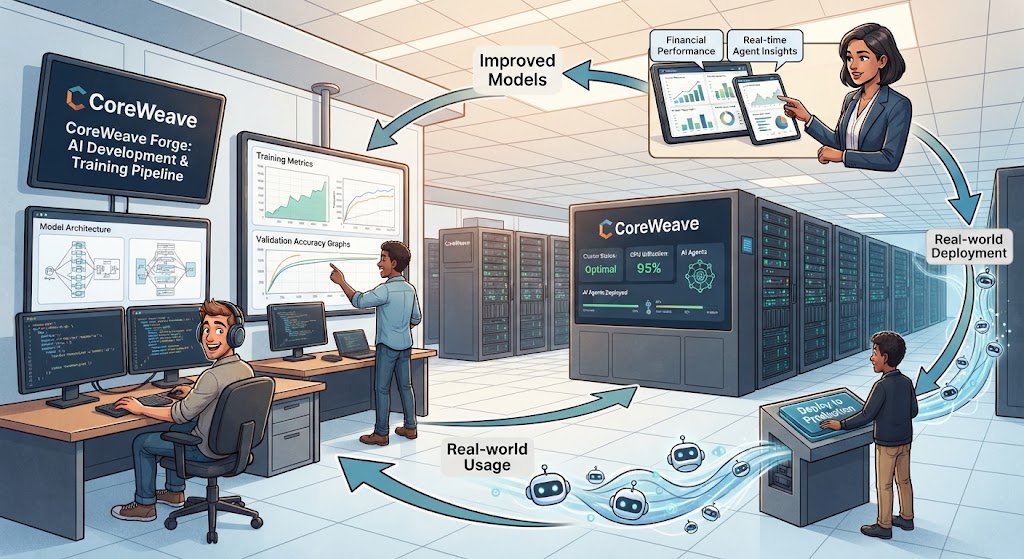
That evolution strengthens the company’s CoreWeave AI strategy. If customers use CoreWeave for computing, storage, model development and AI-agent workflows, the company could create a deeper relationship with developers while expanding the amount of infrastructure and software each customer uses.
The integration of Weights & Biases also becomes more important in this strategy. CoreWeave completed its acquisition of the AI developer platform in May 2025, and the technology now forms part of CoreWeave Forge.
Revenue Explodes as the Backlog Passes $100 Billion
The strongest argument for CoreWeave stock remains the extraordinary growth in demand.
CoreWeave generated approximately $2.575 billion in second-quarter 2026 revenue, up 112% from $1.212 billion in the same quarter of 2025. Adjusted EBITDA reached approximately $1.51 billion, while GAAP net loss stood at $626 million.
The bigger headline, however, came from the company’s contracted demand.
CoreWeave reported approximately $104 billion in revenue backlog as of June 30, 2026. The figure did not include more than $25 billion of additional net customer commitments secured in early Q3.
That distinction matters. The $104 billion figure represents the reported backlog at the end of June, while the additional commitments came afterward. Investors therefore should not simply add the two figures and assume that CoreWeave has formally reported a $129 billion backlog. Instead, the numbers demonstrate how quickly customer demand continued to expand after the second quarter closed.
CoreWeave also increased total contracted power from approximately 3.7 gigawatts at June 30 to about 4.2 gigawatts by August 2026. Active power reached approximately 1.5 gigawatts at the end of the second quarter.
The company has therefore moved from an AI infrastructure story built primarily around future potential to one supported by rapidly growing revenue, contracted customers and physical computing capacity.
CoreWeave Revenue Guidance Moves Higher
The strength of demand has also pushed management to raise its expectations for 2026.
CoreWeave now expects full-year 2026 revenue of approximately $12.4 billion to $13.2 billion, compared with earlier expectations. Management also expects adjusted operating income of approximately $960 million to $1.15 billion and an end-of-year annualized revenue run rate of approximately $18.5 billion to $19.5 billion.
The company simultaneously raised its 2026 capital expenditure forecast to $35 billion to $39 billion. CoreWeave spent approximately $9.4 billion on capital expenditures during the second quarter alone as it accelerated infrastructure expansion.
That creates the central tension surrounding CoreWeave valuation. Revenue is growing extraordinarily quickly, but the company must spend enormous amounts of capital to support that growth.
The Reality of Scale: Massive Leverage and Data Center Delays
CoreWeave’s expansion requires significant financing. As of June 30, 2026, the company reported approximately $35.6 billion of total indebtedness, with future principal payments totaling approximately $35.55 billion across the remaining portion of 2026 and subsequent years.
The company also reported approximately $5.52 billion in cash and cash equivalents at June 30, alongside roughly $10 billion of available capacity under existing financing facilities.
That balance sheet creates both leverage and opportunity. Debt allows CoreWeave to build infrastructure before it collects the full economic value of long-term customer contracts, but it also increases interest costs and makes execution more important.
CoreWeave recorded approximately $558 million of total interest expense in the second quarter under its debt accounting presentation.
The company therefore cannot afford major construction delays, prolonged capacity shortages or significant deterioration in customer demand. Every additional dollar of debt increases the importance of keeping expensive AI infrastructure productive.
New Financing Adds Flexibility — and Dilution Risk
CoreWeave continued to raise capital in 2026 as it expanded.
In September, the company priced an upsized $3.7 billion convertible senior notes offering due in 2033. The notes carry a 2.875% interest rate and an initial conversion price of approximately $97.85 per share.
CoreWeave also established an at-the-market offering program that could allow it to sell up to 35 million Class A shares over time. The company said the program would provide financing flexibility and support its objective of moving toward an investment-grade credit profile.
For investors, these financing moves create an important trade-off. Additional capital can help CoreWeave capture the enormous demand for AI infrastructure, but future equity issuance or conversion of securities can increase dilution risk.
From Data Center Delays to an Execution Test
CoreWeave’s rapid expansion has not been without setbacks.
The company’s earlier data center delays demonstrated how difficult it can be to translate signed customer contracts into operational computing capacity. Power availability, construction schedules, equipment delivery and third-party infrastructure partners can all determine how quickly CoreWeave can recognize revenue.
That lesson remains relevant even as the company expands. CoreWeave can sign billions of dollars in customer commitments, but those contracts only become revenue when the required infrastructure becomes available and customer workloads begin running.
The company’s recent progress provides a more encouraging picture. Active power reached 1.5 gigawatts by June 30, while contracted power reached approximately 4.2 gigawatts by August. The company is also continuing to secure additional capacity at increasingly attractive prices.
The next stage of the CoreWeave story therefore depends on execution. Investors need to see the company convert contracted demand into functioning AI infrastructure while improving operating leverage.
CoreWeave’s Customer Concentration Remains a Key Risk
The massive backlog creates impressive revenue visibility, but it does not eliminate risk.
CoreWeave relies heavily on a relatively small group of major customers. Large AI companies and technology businesses can commit billions of dollars to computing infrastructure, which creates tremendous upside when those commitments expand. At the same time, losing or delaying a major customer contract could have a meaningful impact on future revenue.
That makes customer concentration one of the most important issues to monitor alongside the headline backlog.
The company is working to broaden its customer base across AI labs, enterprises, financial services and other industries. Recent customer additions and expansions include companies such as Bentley Systems, Caterpillar, Grammarly, Isomorphic Labs and Sunday Robotics.
If enterprise adoption continues to expand, CoreWeave could gradually reduce its dependence on a handful of enormous AI customers while opening a larger market for its AI cloud platform.
Securities Litigation Adds Another Layer of Uncertainty
CoreWeave also continues to face legal risk.
A putative securities class action was filed against CoreWeave and certain officers in January 2026 in the U.S. District Court for the District of New Jersey. The lawsuit alleges violations of federal securities laws related to statements made by the company and seeks unspecified damages. Three stockholder derivative actions were also filed in New Jersey during February and March 2026.
The litigation does not determine the company’s operating performance, but it adds another source of uncertainty for investors. CoreWeave’s ability to execute its growth strategy remains the more important long-term issue, while the legal proceedings could contribute to volatility as they progress.
CoreWeave Stock: The Bull Case
The bull case for CoreWeave stock starts with demand.
AI computing requirements continue to expand, and CoreWeave has positioned itself directly in the middle of that demand. Revenue more than doubled year over year in Q2 2026, the revenue backlog reached approximately $104 billion, and additional commitments continued to arrive after the quarter ended.
The company also continues to expand its infrastructure at a remarkable pace. Contracted power reached approximately 4.2 gigawatts, while CoreWeave’s 2026 revenue guidance increased to $12.4 billion to $13.2 billion.
Technology leadership adds another potential advantage. CoreWeave has moved quickly onto Nvidia’s latest Vera Rubin architecture and is expanding from GPU infrastructure into software, storage, networking and AI-agent development through CoreWeave Forge.
If CoreWeave can convert its backlog into revenue while improving operating leverage, the company could become one of the defining AI infrastructure stocks of the decade.
CoreWeave Stock: The Bear Case
The bear case begins with capital intensity.
CoreWeave plans to spend $35 billion to $39 billion on capital expenditures in 2026, a staggering amount relative to its current revenue base. The company must continuously raise or borrow capital to expand its infrastructure, while its debt load creates substantial interest obligations.
The business also faces technology risk. AI hardware evolves rapidly, which means today’s expensive GPU infrastructure can lose economic value as newer and more efficient architectures reach the market.
Customer concentration represents another risk. A handful of major customers can drive enormous growth, but the same concentration can amplify the consequences of contract changes, delays or cancellations.
Finally, CoreWeave must prove that its infrastructure spending can generate sustainable returns. A $104 billion backlog sounds extraordinary, but the ultimate investment question is how much profit and free cash flow CoreWeave can generate after paying for GPUs, data centers, power, financing and ongoing technology upgrades.
CoreWeave Valuation: What Investors Need to Watch
The valuation debate around CoreWeave is fundamentally different from the debate around a mature cloud company.
Investors are not simply valuing current earnings. They are attempting to estimate the future economic value of a rapidly expanding AI infrastructure platform. That requires assumptions about revenue growth, customer retention, GPU utilization, pricing, financing costs, capital intensity and long-term margins.
The company’s enormous backlog provides unusual visibility, but investors should not confuse backlog with immediate revenue or profit. CoreWeave still has to deploy the infrastructure required to fulfill those contracts.
That is why the next several quarters could be particularly important for CRWV. Investors will be watching revenue growth, backlog expansion, active power, contracted power, capital expenditures, interest expense, operating margins and customer concentration.
The Bigger Picture: CoreWeave and the AI Infrastructure Boom
CoreWeave increasingly represents a broader shift in the technology industry.
The first stage of the AI boom focused heavily on chips and model developers. The next stage requires enormous amounts of electricity, data centers, networking, storage and specialized cloud infrastructure. Companies that can turn power and computing hardware into reliable AI capacity could capture a significant portion of that economic expansion.
CoreWeave is attempting to become one of those companies.
Its evolution from a GPU-focused operator into a broader AI cloud platform now includes infrastructure, developer tools, cross-cloud connectivity, storage, inference and agent development. The launch of CoreWeave Forge strengthens that strategy by bringing more of the AI development cycle onto the company’s platform.
At the same time, the company’s enormous spending requirements demonstrate why AI infrastructure is not an easy business. Growth requires billions of dollars in equipment, power and financing before the resulting revenue fully reaches the income statement.
Final Takeaway
CoreWeave has changed dramatically since its $40 IPO.
The company is no longer simply a speculative AI infrastructure newcomer. It now operates at significant scale, generated approximately $2.6 billion in quarterly revenue, reported a roughly $104 billion revenue backlog at the end of June, secured more than $25 billion in additional commitments in early Q3 and expanded contracted power to approximately 4.2 gigawatts by August.
Its partnership with Nvidia, deployment of Vera Rubin NVL72, launch of CoreWeave Forge and expanding enterprise customer base give the company several potential growth engines beyond traditional GPU rental.
But the risks have grown alongside the opportunity. CoreWeave carries approximately $35.6 billion of debt, expects to spend as much as $39 billion on capital expenditures in 2026 and continues to rely on large customers and external financing to support its expansion.
That makes CoreWeave stock one of the clearest tests of the AI infrastructure boom. The company has the demand, the technology partnerships and the contracted revenue visibility. Now it has to prove that it can turn that opportunity into durable profits and cash flow.
For investors watching CRWV, the next chapter will be less about whether AI demand exists and more about whether CoreWeave can scale fast enough, finance that growth responsibly and convert its extraordinary backlog into sustainable economic returns.