

Canada’s Hidden Goldmine: How Digital Trade and AI Could Drive the Next Export Revolution
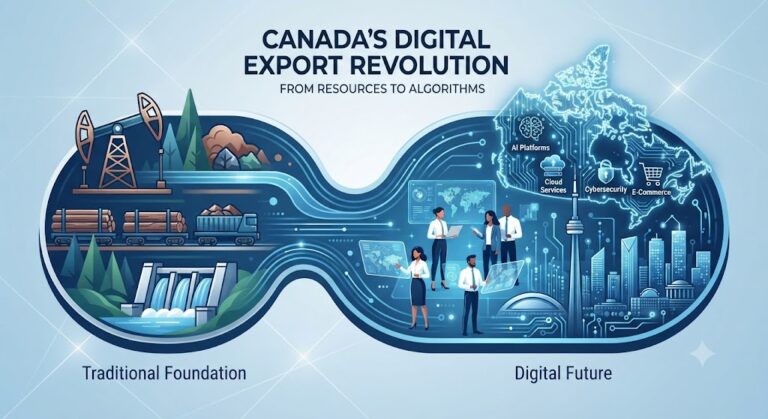
For decades, Canada’s global trade reputation has centered around natural resources. Oil, gas, minerals, agriculture, and lumber have powered the country’s economy and built strong international partnerships.
However, the global economy is entering a new phase. Today, Canada is exporting something far different — digital innovation, artificial intelligence, software, and technology solutions.
Instead of relying only on ships, trucks, and pipelines, Canada can now compete through algorithms, cloud platforms, and AI-powered services. This shift creates a massive opportunity for Canadian businesses to expand globally and capture a larger share of the rapidly growing digital economy.
The next Canadian trade boom may not come from what the country digs out of the ground. It may come from what Canadian innovators build online.

Digital Services Are Becoming Canada’s Fastest-Growing Export Opportunity
The traditional definition of trade is changing. In the past, exports meant physical products moving across borders. Today, digital services allow companies to reach international customers instantly.
Over the past two decades, Canada’s digital exports have grown at an impressive pace. Computer services exports increased more than fourfold between 2005 and 2024, demonstrating how quickly technology has become a major driver of economic growth.
At the same time, digital services now represent a significant portion of Canada’s commercial service exports. From software development and artificial intelligence platforms to cybersecurity and cloud solutions, Canadian companies are increasingly selling knowledge-based products to the world.
Unlike traditional industries, digital businesses can scale faster. A small AI startup in Toronto, Montreal, or Vancouver can serve customers in Europe, Asia, and the Middle East without building factories or shipping products overseas.
As a result, digital trade gives Canada a powerful opportunity to compete in the global economy.
Canada Still Has Room to Capture a Bigger Share of Global Digital Trade
Although Canada has made progress, the country remains a relatively small player in the global digital export market.
This gap represents both a challenge and an opportunity.
Canada already has many of the ingredients needed to become a digital trade leader: strong universities, world-class researchers, innovative entrepreneurs, and a growing technology sector.
However, other countries are moving quickly. The United States continues to dominate global technology markets, while China, India, and other emerging economies are investing heavily in artificial intelligence, automation, and digital infrastructure.
Therefore, Canada must move faster to transform its research strength into commercial success.
Canada’s Dependence on the U.S. Creates a Digital Trade Challenge
For decades, the United States has been Canada’s largest trading partner. Digital exports follow a similar pattern, with many Canadian technology companies relying heavily on the American market.
While the U.S. provides enormous opportunities, excessive dependence on one market creates risks.
Meanwhile, demand for digital solutions is accelerating across Asia and other emerging markets. Countries such as India, Japan, Indonesia, and Singapore are investing heavily in AI, cloud computing, fintech, and automation.
By expanding into these markets, Canadian companies can diversify revenue streams and establish stronger global positions.
Consequently, Canada’s next digital trade strategy must focus on building international partnerships beyond North America.
Canada Has the AI Talent to Become a Global Technology Leader
One of Canada’s biggest advantages is its artificial intelligence ecosystem.
The country has developed a strong reputation as one of the world’s leading AI research hubs, supported by institutions such as the Vector Institute in Toronto, Mila in Montreal, and Amii in Alberta.
These organizations have helped Canada attract researchers, entrepreneurs, and global technology investment.
However, research alone does not create economic growth. Canada must continue improving the connection between innovation and commercialization.
In other words, the country must focus not only on creating AI breakthroughs but also on turning those breakthroughs into successful global businesses.
Canadian Companies Are Already Building the Future of Digital Trade
Several Canadian technology companies are demonstrating how innovation can become a global export advantage.
Shopify has transformed online commerce by helping millions of businesses create digital storefronts and sell products worldwide.
Kinaxis uses artificial intelligence and advanced analytics to help global companies improve supply chain planning and efficiency.
Ada develops AI-powered customer service solutions that allow businesses to automate interactions with customers.
Lightspeed Commerce provides cloud-based retail and restaurant technology solutions used by businesses around the world.
CGI Inc. delivers digital transformation services to governments and enterprises internationally.
ApplyBoard uses technology to connect international students with educational opportunities.
Together, these companies show that Canada’s future exports will increasingly come from software, artificial intelligence, and digital platforms.
What Canada Must Do to Win the Global AI Trade Race
To fully unlock the potential of digital trade, Canada needs a clear and ambitious strategy.
First, Canada must make digital exports a national economic priority. Governments should help startups access international markets, investment, and global partnerships.
Second, Canada should strengthen trade agreements that address artificial intelligence, data flows, cybersecurity, and digital services.
Third, traditional industries must embrace digital transformation. Agriculture, manufacturing, energy, and logistics can become more competitive by adopting AI-powered technologies.
Finally, Canada needs continued investment in AI education and research to maintain its competitive advantage.
By combining innovation with commercialization, Canada can turn its technology ecosystem into a major economic engine.
The Future of Canadian Trade Will Be Powered by AI
The global economy is entering a new era where technology, data, and artificial intelligence will define competitiveness.
Canada has a rare opportunity. The country already possesses world-class AI researchers, innovative startups, and a strong technology foundation.
However, success will depend on execution.
The countries that dominate the next decade will not only export physical products — they will export intelligence, software, and digital solutions.
Canada’s next trade revolution will not be built only through ports and pipelines. It will be built through AI platforms, digital businesses, and technological innovation.
The future of trade is borderless, AI-powered, and rapidly expanding. If Canada successfully transforms its technology strength into global digital exports, it could unlock one of the biggest economic opportunities of the modern era.