
🚀 Palantir AIP: The “Software CUDA” of 2026
As of January 2026, the global technology landscape has transitioned from the era of experimental chatbots to the era of Agentic AI—autonomous software agents capable of executing complex workflows without constant human intervention. In this new “Supercycle,” Palantir Technologies (PLTR) has emerged as the undisputed “Operating System” for the modern enterprise. By successfully positioning its Artificial Intelligence Platform (AIP) as the “Software CUDA,” Palantir has created a market moat that rivals NVIDIA’s hardware dominance. However, the true scale of this revolution is being realized through strategic execution partners like BigBear.ai (BBAI), who are taking this “brain” and applying it to the world’s most critical infrastructure.
The “New CUDA” Narrative Explained
The comparison between Palantir’s AIP and NVIDIA’s CUDA is no longer just investor hyperbole; it is a technical reality. In the previous decade, CUDA provided the software layer that allowed developers to unlock the raw power of GPUs for general-purpose computing. Without CUDA, NVIDIA’s chips were just graphics cards; with it, they became the foundation of the AI revolution.
In 2026, Palantir is playing the exact same role for the corporate “Data Stack.” Most Fortune 500 companies possess massive amounts of siloed, messy data that is unusable for standard AI models. AIP acts as the “Software CUDA” by creating a unified Ontology—a digital map of a business’s entire operation. This allows a company to plug in any Large Language Model (LLM), such as OpenAI’s GPT-5 or Google’s Gemini 3, and turn that model into a functional tool that understands the specific rules, logic, and ethics of that business. By making AI “operational” rather than just “conversational,” Palantir has become the indispensable interface for 21st-century industry.
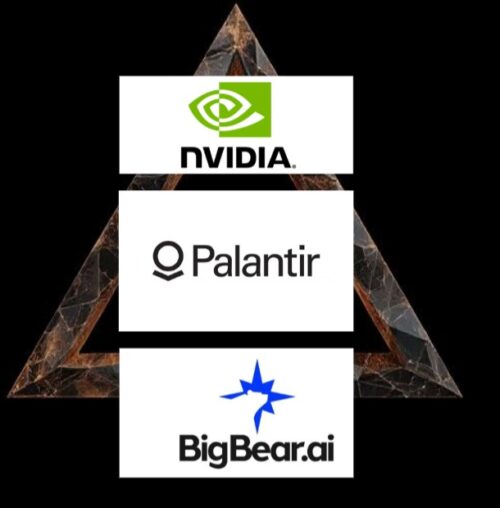
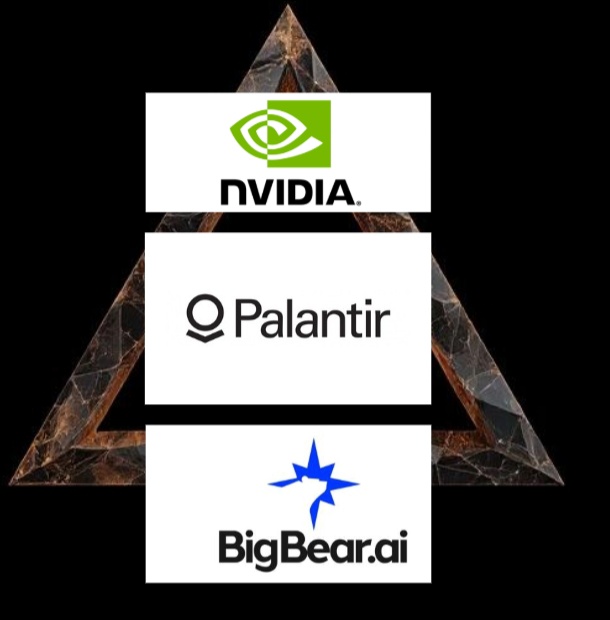
The “Power Triangle”: Hardware, Platform, and Mission Execution
The 2026 AI market is defined by a three-way dependency. NVIDIA provides the raw compute (the engine); Palantir provides the AIP platform (the operating system); and BigBear.ai provides the specialized mission integration (the driver).
The partnership between Palantir and BigBear.ai has matured significantly over the past 12 months. While Palantir focuses on horizontal scaling across all industries, BigBear.ai has doubled down as the “specialist” for national security and critical supply chains. In late 2025 and early 2026, BigBear.ai completed two landmark acquisitions—Ask Sage and CargoSeer.
Ask Sage brought over 100,000 secure government users into the fold, providing a generative AI platform that can run on top of Palantir’s backbone in highly classified environments.
CargoSeer added advanced computer vision and trade-risk algorithms.
Together, they are deploying “swarms” of AI agents that can autonomously re-route global shipping lanes during geopolitical crises or manage nurse scheduling in real-time for hospital networks.
Financial Hyper-Growth and the “Bootcamp” Sales Model
The primary catalyst for Palantir’s 2025–2026 stock surge has been its revolutionary “AIP Bootcamp” model. Traditional enterprise software sales take six to nine months of meetings. Palantir flipped this by inviting companies to 5-day intensive workshops where they go from “zero” to a “live AI application” using their own data.
The financial results have been staggering. In late 2025, Palantir reported U.S. Commercial revenue growth of 121% year-over-year. Even more impressive was the Total Contract Value (TCV) in the U.S. commercial sector, which surged by 342%. This “land and expand” strategy has resulted in a net dollar retention rate of 134%, meaning existing customers are rapidly spending more as they realize the ROI of the platform. Palantir has effectively silenced critics by maintaining GAAP profitability for over three years, with adjusted operating margins hitting a record 51% in the most recent quarter.
Case Studies: From Shipyards to the Battlefield
The 2026 “Palantirization” of industry is visible in massive, multi-hundred-million-dollar deals:
HD Hyundai: In a global first, the world’s largest shipbuilder is using Palantir AIP to manage its “Future Shipyard,” integrating AI into every step of heavy manufacturing.
U.S. Navy: Palantir recently secured a $448 million maritime modernization contract, using AIP to coordinate logistics and production schedules across the fleet.
Commercial Giants: From Walgreens managing 4,000 stores to AIG automating insurance risk assessments 5x faster, the platform is proving that AI is no longer a “luxury” but a survival tool.
Risks and the Valuation Debate
Despite the momentum, 2026 is a year of “price discovery” for Palantir. Trading at over 100x forward price-to-sales, the stock is priced for perfection. Any deceleration in AIP adoption or a shift in government defense spending could trigger a sharp correction. Critics also point to the “Forward Deployed Engineer” (FDE) model, questioning if Palantir can continue this growth without a proportional increase in headcount—essentially, can they scale like a pure software company, or will they always be partially a services firm?
Meanwhile, BigBear.ai faces its own set of challenges. While it is “mission-ready,” its revenue remains “lumpy” due to the timing of government contracts. However, its shift toward recurring SaaS revenue through the Ask Sage platform is projected to significantly improve its margins by the end of 2026.
The narrative for 2026 is clear: Software is eating the AI world, and Palantir is the one holding the fork. By establishing AIP as the “Software CUDA,” Palantir has created an ecosystem where every other AI tool must integrate with them to be useful to a large corporation. With BigBear.ai acting as the expert integrator for the world’s most sensitive missions, the “Power Triangle” is set to dominate the tech conversation for the remainder of the decade. For investors and creators alike, the question is no longer whether this technology works, but how fast it will become the universal standard.