

Startup India Trends 2026: The Rise of DeepTech and Hardware Innovation
The Startup India ecosystem is entering a new phase in 2026. For many years, the country’s startup boom focused mainly on consumer internet platforms such as food delivery apps, ride-hailing services, and e-commerce marketplaces. However, the landscape is now changing rapidly as the ecosystem increasingly supports DeepTech, AI infrastructure, advanced hardware, and defense technology startups.
Instead of building only consumer apps, founders within the Startup India ecosystem are now creating technologies that form the backbone of future industries, positioning India as a global hub for innovation.
As a result, India’s startup ecosystem is evolving into a hub for AI systems, satellites, drones, semiconductor design, and advanced computing platforms.
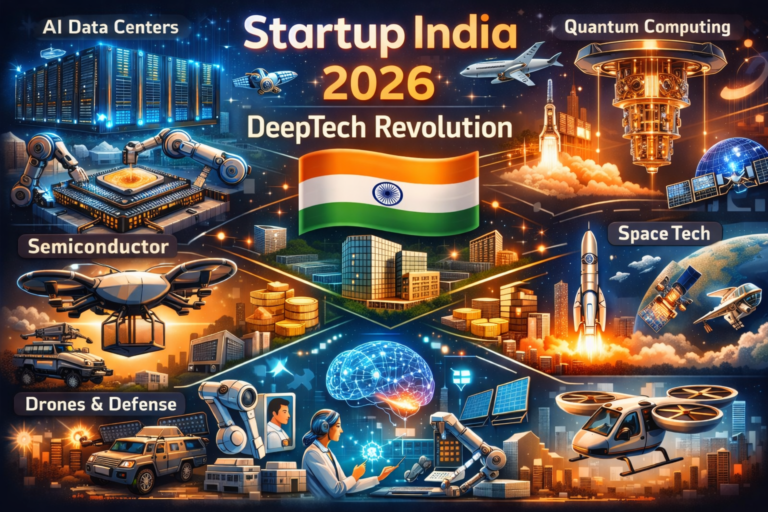
The AI and Data Center Boom
First, the rise of artificial intelligence has triggered an enormous demand for computing infrastructure. Companies need massive data centers and specialized hardware to train and run modern AI systems.
India’s data center capacity is currently expanding at a historic pace. In 2025, the country had around 1.25 gigawatts of data center capacity, but industry forecasts suggest this could reach 2.5 gigawatts by 2028. This growth reflects the increasing reliance on generative AI, cloud computing, and digital services.
At the same time, global technology companies are strengthening their presence in India. For example, AI company Anthropic opened its first Indian office in Bengaluru in early 2026. This move highlights India’s importance in the global AI ecosystem.
Moreover, Anthropic has already begun working with local organizations. The company is collaborating with Air India to deploy AI tools that automate complex software development tasks. In addition, Anthropic partnered with the nonprofit Pratham to provide AI-powered tutoring systems for students.
Meanwhile, Indian startups are solving the infrastructure challenges that come with AI growth. For instance, LightSpeed Photonics is developing optical interconnect systems that use light instead of electricity to move data between processors. This technology could significantly increase the speed and efficiency of hyperscale data centers.
Why Investors Are Focusing on Hardware Startups
While software startups once dominated venture funding in India, investors are now increasingly backing hardware and DeepTech companies.
There are several reasons behind this shift.
First, hardware startups often create defensible intellectual property. Once a company designs a specialized semiconductor chip or advanced robotics system, competitors cannot easily replicate the technology.
Second, hardware forms the foundation of entire technology ecosystems. For example, semiconductor chips power AI systems, smartphones, autonomous vehicles, and robotics platforms.
Finally, geopolitical factors are also influencing investment decisions. Countries now want to develop domestic technology capabilities instead of relying entirely on global supply chains.
Because of these factors, investors are increasingly willing to provide long-term capital to DeepTech startups, even though these companies often require longer development cycles.
Semiconductor and AI Chip Development
One of the most important hardware sectors gaining investor attention is semiconductor technology.
India wants to strengthen its position in chip design and reduce dependence on imported processors. As a result, several startups are working on AI accelerators, embedded processors, and edge computing chips.
For example, semiconductor startup Sensesemi is designing chips for industrial automation, automotive electronics, and medical devices. These chips can process AI workloads directly on devices instead of sending all data to cloud servers.
Consequently, investors view semiconductor startups as critical players in India’s future technology infrastructure.
SpaceTech and Satellite Innovation
Another rapidly growing sector is SpaceTech.
Earlier, the focus of India’s space startups was mainly on launching rockets. However, the industry has now shifted toward building applications that use satellite data.
Today, startups are creating platforms that analyze satellite imagery to provide insights for agriculture, logistics, insurance, and climate monitoring.
For instance, TakeMe2Space is developing satellites capable of running AI workloads directly in orbit. Similarly, companies like Agnikul Cosmos are building small launch vehicles that can deploy satellites efficiently.
In addition, startups such as EON Space Labs are designing miniature imaging systems that can be used on satellites and drones for surveillance and disaster management.
As satellite technology becomes more accessible, investors believe the sector could unlock enormous opportunities across multiple industries.
DefenseTech and Drone Manufacturing
Defense technology is another sector experiencing strong startup growth.
Governments around the world are investing heavily in autonomous drones, surveillance systems, and advanced defense electronics. India has also accelerated its push for domestic defense innovation.
As a result, several startups are developing hardware such as:
-
autonomous surveillance drones
-
electronic warfare systems
-
battlefield robotics
-
radar and sensor technologies
These technologies require deep engineering expertise, which makes them attractive for investors seeking long-term strategic opportunities.
Furthermore, drone startups are also targeting the commercial logistics market. Companies are designing drones that can deliver packages faster and at lower costs compared to traditional transportation systems.
Electric Aviation and Future Mobility
At the same time, startups are exploring next-generation mobility technologies.
Urban congestion has created strong demand for faster transportation solutions. Consequently, startups are developing electric aircraft and aerial taxi systems.
For example, the ePlane Company is building electric air taxis designed to transport passengers across crowded cities. The company is currently raising funding to complete aircraft prototypes and move toward commercial deployment.
Similarly, drone logistics startups are experimenting with new designs that allow drones to take off vertically and then transition into efficient forward flight.
These innovations could transform both urban transportation and last-mile delivery services.

HealthTech Enters the AI Era
HealthTech is also undergoing a major transformation.
Initially, many startups focused on telemedicine and online doctor consultations. However, the next phase of innovation involves AI-driven diagnostics and predictive healthcare systems.
In 2026, the University of Toronto partnered with the Indian Institute of Science (IISc) to launch a Center of Excellence for AI in Healthcare.
This initiative aims to develop systems that can detect diseases earlier and help doctors make better treatment decisions. Researchers will also train healthcare professionals who understand both medicine and artificial intelligence.
Because India has a large population and diverse healthcare needs, the country offers an ideal environment for testing scalable AI health solutions.
The Emergence of “Full-Stack India”
Overall, the Indian startup ecosystem is moving toward what analysts call “Full-Stack India.”
Instead of relying primarily on imported technologies, startups are now building complete technology stacks that include both hardware and software.
This transformation includes:
-
semiconductor chips and AI processors
-
satellite networks and space infrastructure
-
drone logistics and defense systems
-
electric aircraft and advanced mobility
-
AI-powered healthcare technologies
At the same time, Indian founders are becoming more ambitious. Many entrepreneurs are pursuing complex engineering projects that were previously considered too difficult or expensive for startups.
Final Take
The Startup India ecosystem in 2026 looks very different from the consumer-app boom of the previous decade.
Today, founders are building technologies that power entire industries—from AI infrastructure and semiconductor chips to satellites and defense systems.
As venture capital continues to support these sectors, India is steadily positioning itself as a global hub for DeepTech innovation.
In the coming years, this shift toward hardware-driven startups could redefine India’s role in the global technology economy and create a new generation of high-impact companies.