
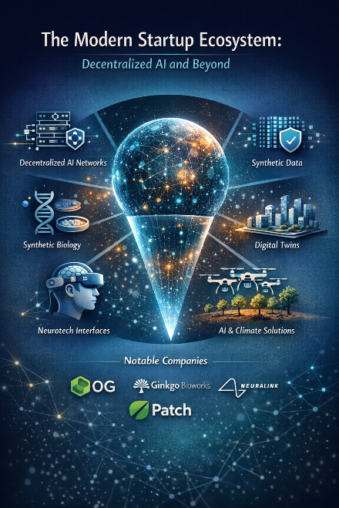
Modern Startup Ecosystem: Decentralized AI and Beyond
The Modern Startup Ecosystem is currently powered by technologies that combine intelligence, autonomy, and human-centered design. While foundational sectors such as fintech, healthtech, and e-commerce remain critical, high-growth areas now operate at the intersection of AI, biology, climate science, and distributed networks. Understanding these sectors allows entrepreneurs to engage with markets that are mature, scalable, and impactful.
Innovation today doesn’t happen in isolation. Each sector complements the others, creating opportunities for convergence. For example, advances in AI accelerate synthetic biology experiments, while digital twins improve climate infrastructure and longevity biotech.
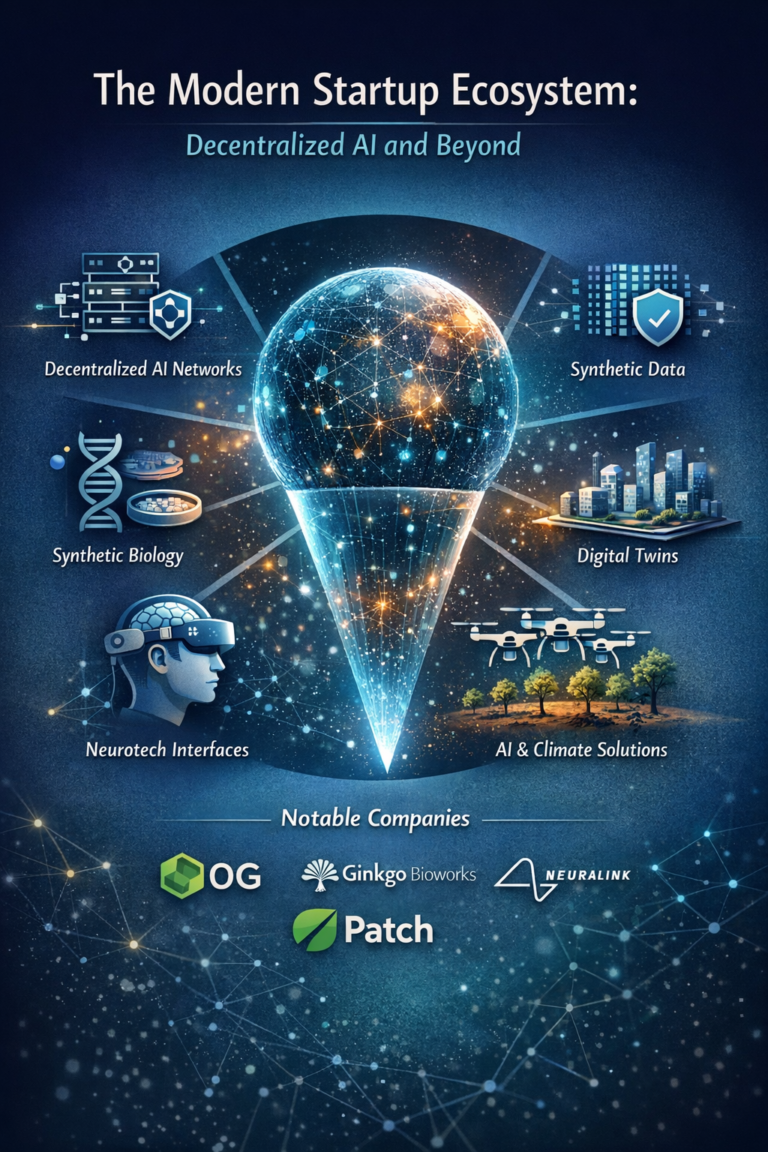
Decentralized AI Networks (DeAI)
The Modern Startup Ecosystem is increasingly shaped by Decentralized AI networks, which operate on distributed systems rather than centralized cloud servers. Instead of a single company controlling AI models, multiple participants contribute computing power, datasets, and algorithms. These networks are actively transforming how AI is built, trained, and deployed, making it more transparent, scalable, and inclusive.
How it works:
- Computers worldwide connect to train a single AI model.
- Participants contribute GPU power, datasets, or algorithm updates.
- Blockchain and other distributed systems track contributions, rewarding participants with tokens, credits, or access rights.
- Federated learning allows AI models to train on local devices and share only updates, protecting sensitive data.
Why it matters:
- Centralized AI is costly and opaque, leaving users uncertain about how their data is used.
- Decentralized networks lower costs, increase transparency, and democratize AI development.
- Entrepreneurs can leverage these networks to create AI products faster while generating revenue from community contributions.
Examples and platforms:
- Compute sharing marketplaces where idle GPUs are contributed for AI training.
- Federated learning platforms for healthcare or finance, keeping data private.
- Collaborative AI marketplaces where contributors earn revenue when models are licensed.
- Notable startups include 0G Labs, Render Network, and Akash.
Current use cases:
- Hospitals collaboratively train diagnostic AI models without sharing patient records.
- Banks combine anonymized transaction data to enhance fraud detection.
- Automotive companies pool driving data to improve self-driving AI systems.
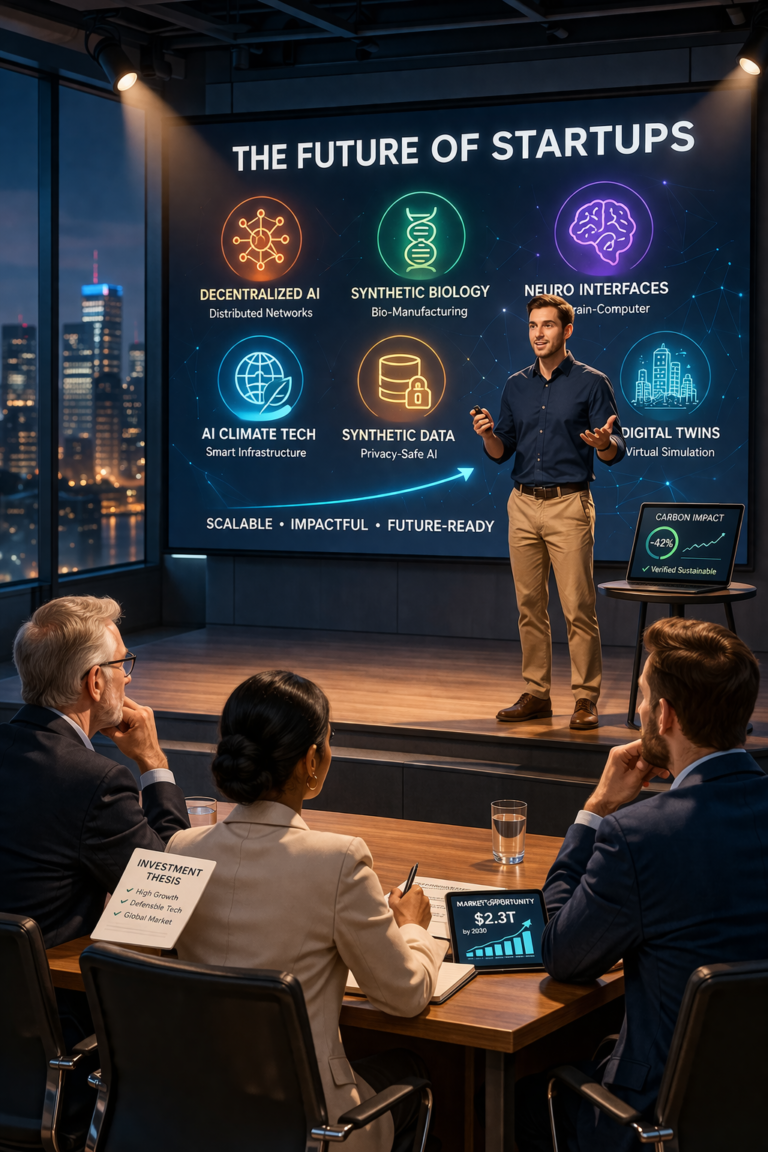
Synthetic Biology and Bio-Manufacturing
In the Modern Startup Ecosystem, synthetic biology merges biology and engineering to design organisms or cellular systems that produce materials and chemicals traditionally made in factories, achieving higher efficiency, sustainability, and precision.
How it works:
- Scientists design microbes or cells that “grow” products such as proteins, enzymes, textiles, or building materials.
- Lab-grown alternatives include cultured meat, lab-grown leather, bio-plastics, and carbon-sequestering materials, reducing environmental impact.
- Cellular systems are optimized for yield, quality, and scale using AI-guided modeling and automation. Startups simulate cellular behavior digitally before scaling production in bioreactors.
- Advanced bio-factories can operate continuously, ensuring consistent quality while minimizing waste.
Why it matters:
- Traditional manufacturing relies on resource extraction, which is expensive, polluting, and supply-chain vulnerable.
- Synthetic biology allows sustainable production at scale while reducing dependence on fragile logistics networks.
- Enables creation of customized or niche products difficult to produce conventionally, such as designer enzymes, personalized nutrition proteins, or specialty chemicals for green energy.
- Entrepreneurs can target B2B bio-manufacturing markets as well as direct-to-consumer goods, leveraging sustainability and ethical production as differentiators.
Current applications:
- Fashion brands using lab-grown leather to reduce animal-based production.
- Food companies producing cultured meat at scale.
- Green construction firms developing carbon-neutral building materials.
With AI-powered design and optimization, synthetic biology directly benefits from decentralized computation, showing how innovation in one sector fuels another.
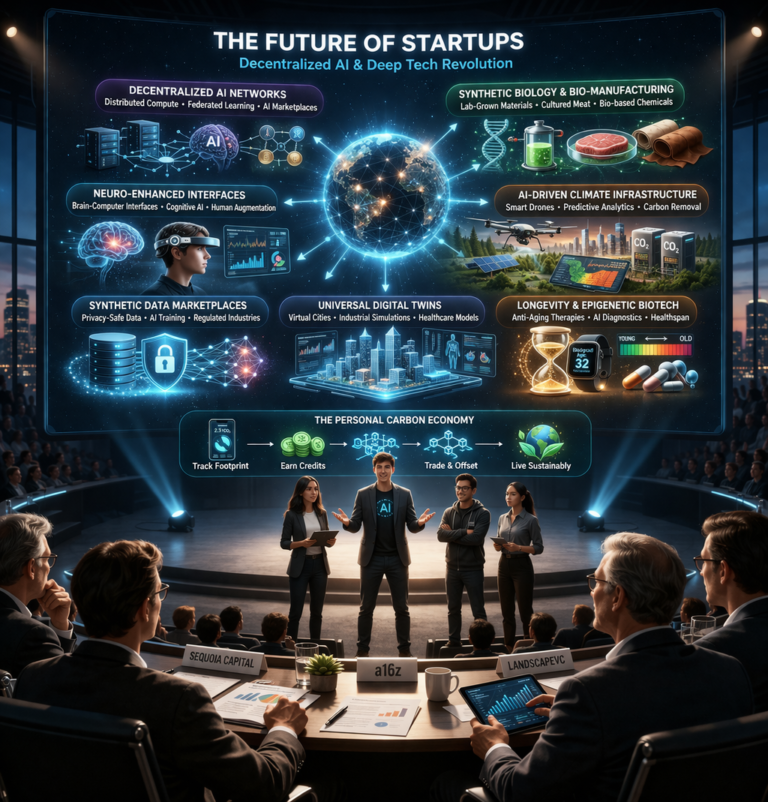
Neuro-Enhanced Interfaces
Neurotechnology now extends beyond clinical research to enhance cognition, productivity, and human-computer interaction. It creates opportunities in education, workplace optimization, gaming, and personal wellness.
How it works:
- Non-invasive brain-computer interfaces (BCIs) monitor neural signals such as focus, stress, and cognitive load in real time.
- AI interprets these signals to adjust software, devices, or digital environments dynamically. For instance, adaptive learning platforms alter lesson pacing when fatigue is detected.
- Productivity apps modify notifications or task reminders based on attention levels.
- BCIs integrate with wearables and APIs, providing neural data to other applications for broader optimization.
Why it matters:
- Enhances human performance in classrooms, workplaces, and gaming environments.
- Enables personalized experiences that respond dynamically to cognitive and emotional states.
- Expands consumer neurotechnology beyond hospitals and labs, creating a Neural Data-as-a-Service (NDaaS) market.
Current applications:
- Educational platforms monitor attention and adjust content delivery.
- Corporate tools optimize workflows and reduce cognitive overload.
- Gaming platforms adapt difficulty or immersive experiences in real time.
Neurotech leverages AI and data from decentralized networks to create smarter, adaptive human-machine interfaces, connecting the dots between biological signals and digital optimization.
AI-Driven Climate Infrastructure
AI-driven climate solutions leverage IoT, robotics, and predictive analytics to monitor, manage, and restore environmental systems efficiently and at scale.
How it works:
- Networks of drones, sensors, and AI models detect environmental changes and autonomously plan interventions.
- Examples include drones planting trees, AI-optimized irrigation, and urban cooling systems that respond to heatwaves.
- Predictive analytics enable proactive interventions instead of reactive responses.
Why it matters:
- Climate change requires scalable, adaptive, and efficient solutions.
- AI-driven infrastructure reduces labor while improving ecological outcomes.
- Governments, cities, and industries use these solutions to meet regulatory and sustainability goals.
Current applications:
- Automated reforestation programs using drone swarms.
- Smart irrigation systems conserving water while maximizing crop yields.
- Urban climate management in high-density cities.
These solutions often rely on digital twins and synthetic data, showing the convergence of multiple high-growth sectors for optimized climate action.
Notable Companies and Platforms
Decentralized AI Networks (DeAI):
- 0G Labs – decentralized compute and AI model training
- Render Network – GPU rental for AI workloads
- Akash Network – cloud computing marketplace for distributed AI
- SingularityNET – decentralized AI services
- Fetch.ai – autonomous AI agents for decentralized networks
Synthetic Biology and Bio-Manufacturing:
- Ginkgo Bioworks – engineered organisms for industrial applications
- Bolt Threads – lab-grown materials for fashion
- Eat Just – cultured meat products
- Zymergen – bio-manufacturing for chemicals and materials
- Modular Biotech – personalized nutrition and specialty enzymes
Neuro-Enhanced Interfaces:
- Neuralink – advanced BCIs for human-computer interaction
- Kernel – neural data analytics for cognitive performance
- NextMind – non-invasive brain sensing for consumer tech
- Emotiv – EEG headsets and software for cognitive tracking
- MindMaze – neural interface solutions for gaming and VR
AI-Driven Climate Infrastructure:
- ClimaCell (Tomorrow.io) – AI-driven weather prediction and urban climate solutions
- DroneSeed – autonomous drones for reforestation
- FarmWise – AI-powered autonomous weeding for agriculture
- Carbon Clean – AI-driven carbon capture and monitoring
- Enerbrain – smart building AI for energy optimization
Synthetic Data Marketplaces:
- Mostly AI – synthetic data generation for finance and healthcare
- Gretel.ai – privacy-preserving synthetic datasets
- MDClone – healthcare synthetic data platform
- Tonic.ai – synthetic data for regulated industries
- Parallel Domain – synthetic data for autonomous vehicles
Universal Digital Twins:
- Siemens – industrial digital twin solutions
- Dassault Systèmes – virtual modeling for manufacturing and healthcare
- Cityzenith – digital twins for smart cities
- ANSYS – simulation-driven product and system optimization
- PTC – IoT and digital twin integration for enterprises
Longevity and Epigenetic Biotech:
- Insilico Medicine – AI for aging research and regenerative therapies
- Life Biosciences – interventions targeting aging mechanisms
- Calico – longevity research with AI-driven analytics
- Elysium Health – consumer epigenetic and healthspan products
- Chronomics – epigenetic testing and lifestyle interventions
The Personal Carbon Economy:
- Klima – personal carbon footprint tracking and offsets
- Patch – blockchain-based carbon credits for individuals
- Pachama – IoT and AI for verified carbon sequestration
- Toucan Protocol – tokenized carbon marketplace
- CarbonPlan – tools for individuals and organizations to monitor emissions