

The Rise of Micro-Robots: How 2026 Is Redefining the Future of Robotics
The year 2026 marks a decisive turning point in robotics. While humanoid machines continue to dominate headlines, a quieter yet far more transformative revolution is unfolding at a microscopic scale. Micro-robots—machines often smaller than a human hair—are evolving rapidly from laboratory experiments into practical, high-impact tools. As a result, they are poised to redefine industries such as medicine, advanced manufacturing, and environmental science, bringing precision and automation to scales previously unimaginable.
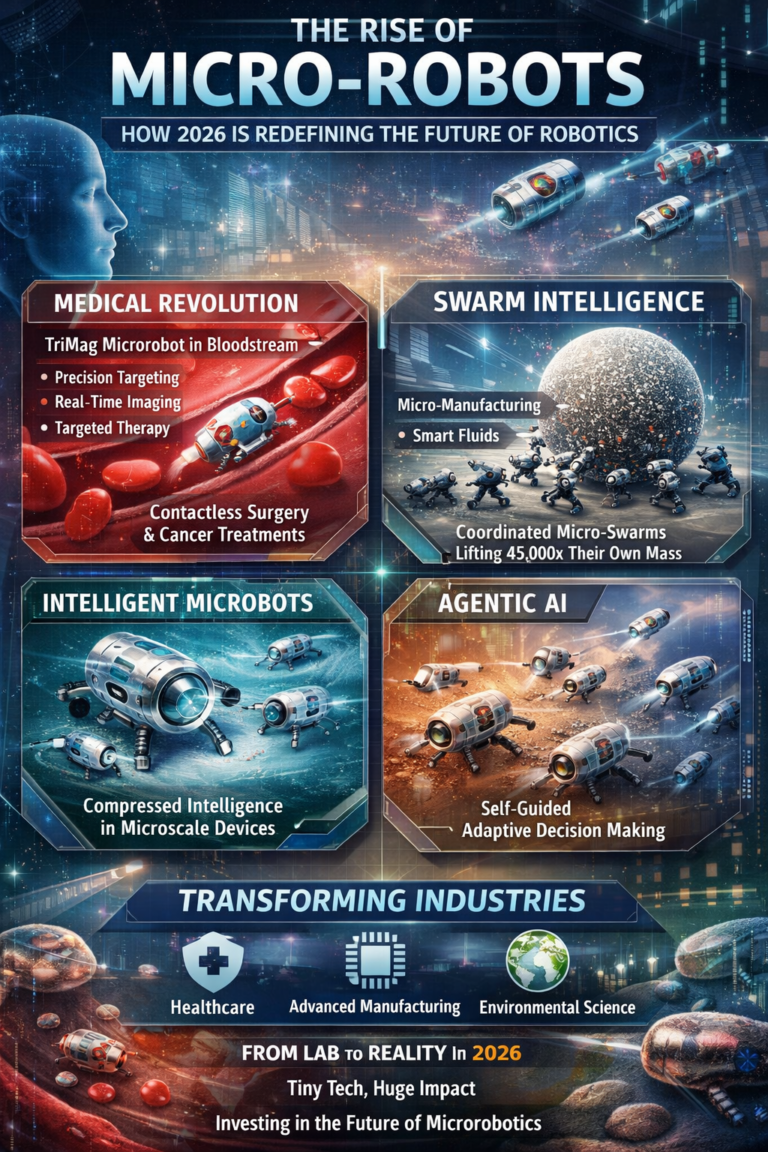
The Dawn of the Microscale Era
The journey toward microrobotics has not been straightforward. For decades, engineers faced challenges that extended far beyond miniaturization. At the microscale, gravity becomes almost irrelevant, while friction and viscosity dominate movement. A micro-robot navigating through fluid experiences resistance akin to a human trying to swim through thick tar.
In 2026, researchers have addressed these constraints by rethinking design principles. Instead of relying on traditional gears, motors, and onboard batteries, modern micro-robots leverage Physical AI and smart materials. Movement is now guided through external stimuli such as magnetic fields, light pulses, and ultrasound waves.
Consequently, these robots no longer depend on internal power sources. They can operate continuously for extended periods without recharging, significantly enhancing efficiency and scalability. This breakthrough “cracks the code” of microscale mobility, paving the way for real-world applications across multiple industries.

Medicine: The “TriMag” Revolution
The healthcare sector is already experiencing the impact of micro-robotics. A standout example in 2026 is the TriMag microrobot, developed at Michigan State University. This innovation represents a leap forward in minimally invasive, highly targeted medical treatments.
TriMag integrates three critical capabilities in a single biodegradable structure:
Precision Steering: Doctors guide robots through the bloodstream using external magnetic fields, reaching precise targets.
Real-Time Tracking: The robots remain visible under standard imaging without the need for harmful radiation.
Targeted Therapy: Once at a tumor or affected area, the robot generates localized heat to destroy diseased cells while leaving healthy tissue intact.
This introduces “contactless surgery,” allowing complex procedures to be performed via simple injections rather than invasive incisions. Clinical trials expected by 2027 could confirm that micro-robots deliver drugs directly to individual cells, potentially replacing traditional chemotherapy and other systemic treatments.
Swarm Intelligence: Strength in Numbers
Beyond individual capabilities, micro-robots achieve their true potential through swarm intelligence. While a single robot is impressive, coordinated swarms can manipulate objects up to 45,000 times their own mass.
Instead of gripping, swarms generate synchronized rotational motion, creating fluidic torque. By controlling surrounding fluid, objects move with precise accuracy.
This unlocks several breakthrough applications:
Micro-Manufacturing: Swarms can assemble components far beyond human capabilities, essential for semiconductors and miniature sensors.
Smart Fluids: Fluids infused with micro-robots can self-pump, regulate flow, or repair micro-leaks in situ.
Thus, swarm behavior transforms micro-robots from isolated tools into collaborative systems capable of executing complex tasks at microscopic scales.
Embedding Intelligence: The Micro-Robot Brain
Simultaneously, researchers are embedding intelligence into micro-robots. Michigan Engineering has integrated sensors, actuators, and processors into devices small enough to be handled with a pipette.
Size constraints demand highly optimized, compact code—essentially “compressed intelligence.” This allows micro-robots to perform sophisticated tasks within minimal memory.
As a result, they now demonstrate capabilities such as:
Cellular Monitoring: Detecting subtle temperature or chemical changes to identify unhealthy cells with high precision.
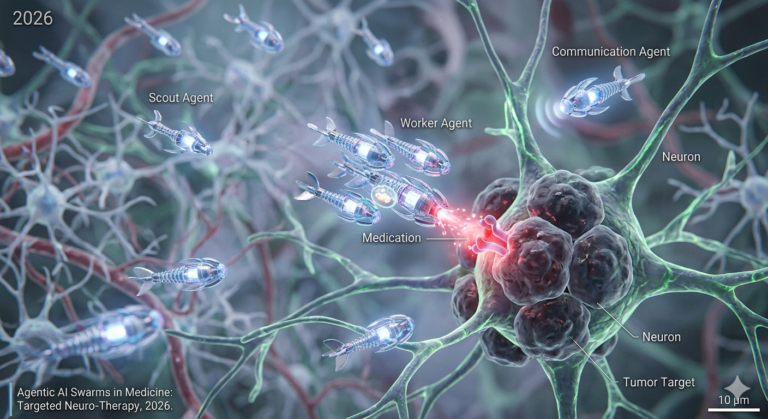
Autonomous Decision-Making: Powered by Agentic AI, micro-robots act on high-level goals, coordinating with one another and minimizing human input.
This shift marks a departure from centralized robotics. Micro-robots are becoming self-organizing entities, adapting in real time to dynamic environments.
The Role of Agentic AI
Agentic AI is the most significant breakthrough of 2026. Micro-robots cannot carry traditional computing hardware, so they rely on lightweight, distributed intelligence.
Unlike remote-controlled devices, these AI agents operate autonomously. High-level objectives—such as locating a chemical leak or clearing an arterial blockage—are assigned, and the robots execute independently. They continuously process real-time data, navigate obstacles, and refine strategies.
In biological contexts, such as the human body, micro-robots face constantly moving environments. Agentic AI enables instant decision-making, allowing the robots to adapt without external input. This evolution shifts AI from reactive systems into proactive agents capable of completing complex tasks in real-world environments.
Challenges and the Road to 2030
Despite rapid advancements, challenges remain. Clinical reliability is a key concern, as precision control inside the human body is still being refined. Safety and ethical considerations also require attention, ensuring micro-robots can be safely removed, neutralized, or biodegraded after completing tasks.
Even with these hurdles, the broader trend is clear. Robotics is transitioning from large mechanical systems to invisible automation, where micro-robots operate seamlessly in previously inaccessible spaces.
The Economic Impact
Micro-robotics is emerging as a high-growth frontier. Companies such as Intel and NVIDIA are driving chip miniaturization, increasing demand for microscale assembly solutions.
Micro-robots can function in environments inaccessible to traditional robots, making them indispensable for producing compact, high-performance hardware. In healthcare, they act as “janitors” of the human body and “engineers” of next-generation devices. The global microrobotics market is projected to expand rapidly over the next decade, opening opportunities across multiple sectors.
Investing in Micro-Robotics: The 2026 Inflection Point
From an investment perspective, micro-robotics resembles the early internet era. Revolutionary, yet many pure-play companies remain private or early in commercialization. The true inflection point occurs when firms move from research into revenue-generating applications.
Key players include:
Microbot Medical (NASDAQ: MBOT) – Focused on surgical micro-robots. Its LIBERTY system is progressing through clinical trials, offering a high-risk, high-reward investment.
NVIDIA (NASDAQ: NVDA) – Provides the AI “brains” for swarms, enabling micro-robots to coordinate at scale.
Teradyne (NASDAQ: TER) – Offers precision testing for next-generation chips, essential for semiconductor manufacturing.
NVE Corporation (NASDAQ: NVEC) – Supplies ultra-efficient sensors that act as the nervous system for micro-robots.
Private innovators like Bionaut Labs (brain-targeting micro-robots) and Nanobotics (DNA-based drug delivery) could become future acquisition targets for companies like Intuitive Surgical or Stryker Corporation.
Final Take
Micro-robots have moved beyond science fiction. In 2026, they are bridging digital intelligence and the physical world. By combining advanced materials, swarm coordination, and embedded AI, these systems are redefining automation.
Whether repairing tissue or assembling microchips, micro-robots represent the next logical step in technological evolution. Their impact will not depend on size—but on the scale of transformation they bring to industries and everyday life.