
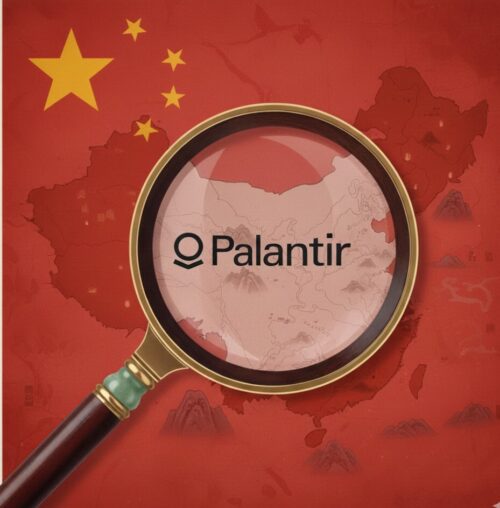
Palantir vs China: Who’s Really Watching Whom?
In the global technology competition, the strategic observation between China and Palantir is profoundly shaped by the specific, cutting-edge software and AI capabilities each side is developing and deploying.
As of January 2026, the global technology competition has evolved from a race for data collection into a high-stakes battle for Agentic AI—systems that don’t just analyze information but autonomously execute complex decisions. While Palantir has solidified its role as the “AI Operating System” for the West through massive 2025 contracts with the U.S. Army and NATO, China has significantly narrowed the gap by commoditizing high-end intelligence with cost-efficient models like DeepSeek. This “two-way street” of observation has transformed into a race for “Decision Intelligence,” where the winner is no longer the side with the most data, but the side that can achieve Autonomous Command first.
The tension is rooted not just in politics, but in the raw power of their respective data platforms.
Palantir’s Arsenal: Foundry and Gotham
Palantir operates primarily through two major platforms: Gotham (for government and intelligence sectors) and Foundry (for commercial use).

The core of their value proposition lies in data fusion—taking massive, disparate silos of data (from satellite imagery and battlefield sensor data to supply chain logistics) and making them interoperable and queryable through a unified interface.
The critical “tech detail” of interest to China is Palantir’s new AI Platform (AIP). AIP integrates large language models (LLMs) and other AI capabilities directly into the operational workflows of government and military users. It acts as an AI “control center,” allowing an Army general, for instance, to use natural language commands to analyze complex battlefield data, recommend actions, and even draft operational orders based on real-time intelligence inputs. This capability offers a massive decision-making advantage that Chinese intelligence seeks to understand and neutralize.
China’s Counter-Surveillance and Tech Ambitions
China, under the guidance of its Military-Civil Fusion (MCF) strategy, leverages a different, but equally powerful, technological ecosystem. Chinese tech giants like Alibaba, Tencent, and Baidu all support state objectives by developing sophisticated AI, cloud computing, and surveillance technologies.
China’s equivalent efforts involve massive state-sponsored data collection and advanced facial recognition, creating a pervasive domestic surveillance state utilizing systems like the Skynet urban video surveillance network. This generates vast quantities of data for the CCP’s AI models.
In the competitive intelligence space, companies like Mininglamp Technology are often cited as China’s answer to Palantir, building platforms to analyze public security and commercial data. China is likely observing Palantir’s software architecture to reverse-engineer its capabilities, understand the vulnerabilities of U.S. data management practices, and refine its own AI algorithms to surpass Western systems.
The “watching” is a two-way street, where each nation scrutinizes the other’s technical approach to data dominance—Palantir offering a “privacy-by-design” data integration approach for democratic institutions, versus China’s top-down, centralized state-control model. The software details are the battle plans of this tech war.
January 2026 Update: The Race for “Agentic” Supremacy
As of early 2026, the tech war has shifted from mere data collection to Agentic AI—autonomous systems that don’t just analyze data but execute actions. Palantir has solidified its role as the backbone of Western defense, while China has proven it can match Western software capabilities with startling speed.
Palantir’s “Warp Speed” and NATO Integration
In late 2025 and January 2026, Palantir moved beyond individual contracts to become an alliance-wide infrastructure provider:
-
The $10 Billion Army “Mega-Deal”: In August 2025, Palantir secured a landmark 10-year enterprise agreement with the U.S. Army, consolidating dozens of disparate systems into one unified AIP-driven layer.
-
NATO’s Maven Smart System: Following its success in Ukraine, NATO officially adopted Palantir’s Maven technology as its primary command-and-control platform in early 2026, marking the first time a single AI software layer has connected all member nations’ battlefield data.
-
Sovereign AI in the UK: A new £1.5 billion partnership signed in late 2025 has established London as Palantir’s European defense headquarters, specifically to develop “Forward Deployed” AI agents for rapid mission planning.
China’s “DeepSeek” Disruption and Data Dominance
China’s response has been to commodify high-end AI. The 2025 release of DeepSeek—a Chinese model that achieved Western-level performance at a fraction of the cost—changed the narrative at Davos 2026.
-
The “Six-Month” Gap: Industry leaders now estimate China is only six months behind the U.S. in model sophistication. Despite Western chip bans, Chinese engineers have optimized their software to run on domestic Huawei Ascend processors, creating massive computing clusters that bypass the need for Nvidia hardware.
-
Mininglamp & The “Civil-Military” Backbone: China has moved past simple surveillance. Its Palantir-equivalent, Mininglamp, is now fully integrated with state-owned energy and transport sectors to predict and neutralize supply-chain vulnerabilities—a direct mirror of Palantir’s Foundry.
-
Data as a Sovereign Resource: While Palantir must navigate the strict EU AI Act (becoming fully applicable in August 2026), Chinese firms continue to benefit from unrestricted access to the data of 1.4 billion citizens, fueling agents that are arguably more “socially aware” in their predictive capabilities.
The 2026 Verdict: Decision Intelligence is the New Arms Race
The competition is no longer about who has more data, but who can make a decision faster. Palantir’s AIP-native development agents have reduced the time to deploy new military solutions from months to days. Simultaneously, China’s ability to “muscle” its way through hardware constraints with massive human capital and state-driven data suggests that the “watching” has become a race to see who can achieve Autonomous Command first. In 2026, the software is no longer just the battle plan—it is the commanding officer.