
🚨 Iran Threatens Tech Companies: Warning Signals for 18 U.S. Giants
The global technology sector is entering uncharted territory. What once seemed like a distant possibility has now become a serious geopolitical risk: Iran Threatens Tech Companies, signaling that nation-states are increasingly targeting private tech firms.
Among the 18 companies cited by the IRGC as potential targets are:
Cisco, HP, Intel, Oracle, Microsoft, Apple, Google, Meta, IBM, Dell, Palantir, Nvidia, JPMorgan Chase, Tesla, General Electric (GE), Spire Solutions, G42, and Boeing.
This list highlights the widening scope of geopolitical and digital conflict, underlining how deeply intertwined global security and technology have become.
As tensions rise, one thing is becoming clear: the battlefield is no longer limited to soldiers and weapons—it now includes algorithms, cloud infrastructure, data centers, and critical undersea cables in strategic chokepoints like the Strait of Hormuz.
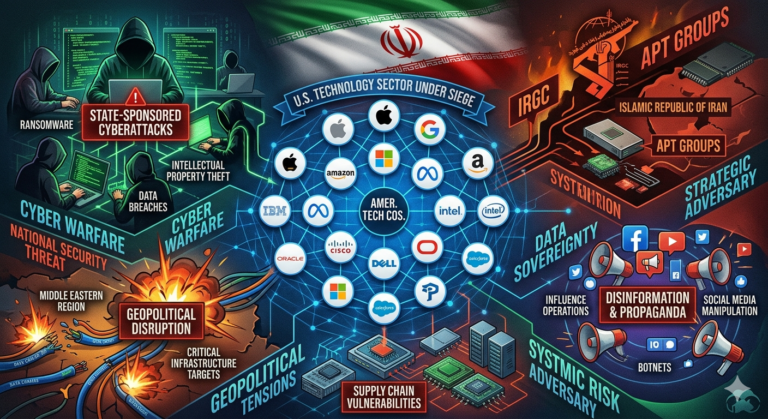
🔥 Why Big Tech Is No Longer “Neutral”
At the core of Iran’s argument is a fundamental shift in how technology is perceived. According to Iranian leadership, today’s tech giants are no longer passive service providers. Instead, they are seen as critical enablers of military and intelligence operations.
Iran Threatens Tech Companies such as Microsoft, Google, Apple, and Nvidia, highlighting their role in providing the infrastructure that powers surveillance, data analysis, and real-time decision-making.
From Iran’s perspective, tools developed in Silicon Valley—particularly in artificial intelligence and cloud computing—play a direct role in modern combat. This belief has fundamentally changed the narrative: tech companies are no longer observers; they are part of the system.
🧠 The Rise of AI-Driven Warfare
This shift is closely tied to the rapid advancement of artificial intelligence. AI is no longer confined to research labs or commercial applications—it is now deeply embedded in defense and intelligence systems.
Machine learning models can process vast amounts of data in real time. They can identify patterns, track movements, and support strategic decisions. Cloud platforms enable this data to flow seamlessly across regions, while high-performance chips power the entire ecosystem.
As a result, the distinction between civilian technology and military capability is rapidly disappearing. What was once considered innovation is now viewed as a strategic asset—and, increasingly, a potential liability.
💻 Cyber Warfare Moves to Center Stage
While the rhetoric is escalating, cyber warfare remains the most immediate and active threat. Iran Threatens Tech Companies and has long been associated with sophisticated cyber operations, with recent developments suggesting a significant increase in activity.
These operations include:
- Distributed denial-of-service (DDoS) attacks
- Data breaches and leaks
- Infrastructure disruption
- Psychological campaigns targeting employees and organizations
Unlike traditional warfare, cyberattacks are fast, cost-effective, and difficult to trace. They allow nations to disrupt systems and send powerful messages without crossing into full-scale military conflict.
Importantly, these attacks are not theoretical—they are already happening. This makes cyber warfare the frontline of today’s geopolitical tensions.
⚠️ From Cyber Threats to Physical Risk
However, the situation may not remain confined to the digital realm. The latest warnings suggest a broader strategy that could extend to physical infrastructure.
Major tech companies maintain a significant presence in the Middle East, including offices, retail stores, and data centers. Cities like Dubai, Abu Dhabi, and Riyadh have become key hubs for global technology operations.
If tensions escalate further, these physical assets could face increased risk. Even the suggestion of such threats has already triggered precautionary measures, including remote work policies and heightened security protocols.
At this stage, large-scale physical attacks remain uncertain. Nevertheless, the possibility alone is enough to reshape how companies operate in high-risk regions.
🌐 Supply Chains and Global Impact
Beyond individual companies, the implications extend to the entire global technology ecosystem. Modern tech infrastructure is deeply interconnected, meaning disruptions in one area can quickly spread across industries.
Semiconductor supply chains, for example, are particularly sensitive. Companies like Intel and Nvidia play a crucial role in powering everything from AI systems to consumer electronics.
Similarly, cloud providers such as Amazon Web Services and Oracle form the backbone of digital operations worldwide.
A disruption to any part of this network—whether physical or cyber—could have ripple effects on latency, data access, and even global chip availability. In an AI-driven economy, these risks are significant.
📉 Market Reactions and Investor Concerns
Unsurprisingly, markets are beginning to react. While major indices have shown resilience, investor behavior tells a more cautious story.
Traders are increasingly hedging positions in tech-heavy portfolios. Companies like Nvidia and Microsoft are seeing increased options activity, reflecting concerns about potential disruptions.
This introduces a new dynamic into the market: geopolitical cyber risk. Investors must now consider not only growth and innovation but also exposure to global conflict.
As a result, volatility in the tech sector could increase, particularly if tensions continue to escalate.
🛡️ Corporate and Government Response
In response to these developments, both corporations and governments are taking action.
Tech companies are:
- Strengthening cybersecurity defenses
- Investing in threat intelligence
- Reviewing regional operations
- Enhancing physical security measures
At the same time, governments are signaling strong support. The United States has indicated that any direct attack on its companies could trigger a significant response, reinforcing the strategic importance of the private tech sector.
This alignment between government and industry highlights a critical reality: technology companies are now part of national security infrastructure.
🚀 A New Era of “Total Tech War”
Taken together, these developments point to a broader transformation. Warfare is no longer confined to traditional battlefields. Instead, it spans digital networks, corporate systems, and global supply chains.
This new phase—often described as “Total Tech War”—blurs the line between civilian and military domains. Companies that build AI models, manage cloud platforms, or manufacture chips are now integral to geopolitical strategy.
For the tech industry, this represents a profound shift. Innovation alone is no longer enough; resilience and security have become equally important.
🛡️ Cybersecurity Stocks in Focus: Where Smart Money Is Looking
As geopolitical threats shift toward cyber and infrastructure warfare, investors are closely watching cybersecurity leaders like CrowdStrike, Palo Alto Networks, and Zscaler. Unlike traditional tech firms that may face downside risk from disruption fears, these companies often benefit directly from rising cyber threats. When nation-state tensions escalate—especially with actors like the Islamic Revolutionary Guard Corps—organizations and governments rapidly increase spending on endpoint protection, zero-trust security, and threat intelligence platforms. This creates a strong tailwind for cybersecurity providers, many of which operate on recurring revenue models and mission-critical infrastructure.
For investors, the key signal is not just the threat itself, but the budget response. If enterprises and governments accelerate cybersecurity spending, stocks like CrowdStrike and Palo Alto Networks can see sustained momentum rather than short-term spikes. In this environment, cybersecurity is no longer a defensive sector—it is becoming a structural growth trade tied directly to global instability.
🎯 The Frontlines Have Changed
Iran’s warning is more than a geopolitical headline—it is a signal of a changing world. Tech companies are no longer just drivers of economic growth; they are now central players in global power dynamics.
For businesses, this means adapting to a new reality where cybersecurity, geopolitical awareness, and operational resilience are essential.
For investors, it introduces a new layer of complexity. The future of technology will not only be shaped by innovation but also by how well companies navigate an increasingly volatile global landscape.
One thing is certain:
In the age of AI, the frontlines of conflict are no longer physical—they are digital, distributed, and deeply embedded in the world’s most powerful companies.