
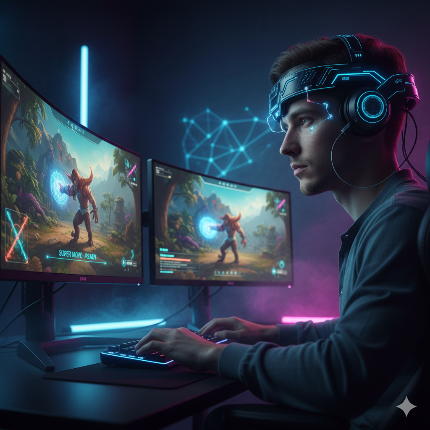
Neurogaming 2025: The Next Frontier for BCI Startups and Global Platforms
While the “AI gold rush” dominates headlines, a quieter but more profound shift is occurring at the intersection of neuroscience and interactive entertainment. Neurogaming—controlled via Brain-Computer Interfaces (BCI)—is no longer a lab experiment; it is a burgeoning industry projected to grow at a CAGR of 20.5% through 2034. For startups, this represents the ultimate “blue ocean” opportunity.
🧠 What is Neurogaming? (The Beginner’s Guide)
For a new user, the simplest way to think about Neurogaming is “The Ultimate Joystick.”
Traditionally, to move a character in a game, your brain has to send a signal to your hand, which presses a button, which sends a code to the computer. Neurogaming cuts out the middleman. It uses sensors to “listen” to the electrical activity of your brain and translates those thoughts directly into game actions.
The “Loop” Simplified
The Ear (Hardware): You wear a headset (like Neurable) or a small chip (like Neuralink). It picks up the tiny electrical sparks your brain makes when you think.
The Translator (AI): A computer program uses Artificial Intelligence to figure out what those sparks mean. “Ah, this specific spark means the user wants to jump!”
The Action (Software): The game character jumps instantly.
How Global Giants are Entering the Mind-Space
The most significant validation for neurogaming in 2025 comes from the world’s largest gaming ecosystems. No longer restricted to niche medical labs, BCI is being integrated into the hardware strategies of major players:
-
Nintendo and the Neuralink Connection: In a landmark demonstration in mid-2025, Neuralink showcased “Mind-Controlled Mario Kart.” By using their “Telepathy” implant, a player was able to steer, accelerate, and use items in Mario Kart 8 Deluxe using only thought, achieving accuracy levels comparable to a physical controller.
-
Valve’s “Starfish” Initiative: Gabe Newell’s neurotech company, Starfish Neuroscience, is set to release its first minimally invasive BCI chips by the end of 2025. Unlike competitors, Starfish chips are battery-free and wireless, designed to sense emotional states like boredom or excitement to dynamically adjust game difficulty.
-
Sony and PlayStation: Sony has filed multiple patents for BCI-integrated headsets. Their research focuses on “Affective Gaming,” where the PS5’s environment could shift—for example, a horror game becoming darker and quieter when it senses a player’s heart rate and brain activity indicating “calm.”
-
Apple Vision Pro: In 2025, Synchron became the first BCI company to achieve native integration with Apple’s visionOS. This allows users to navigate the Vision Pro’s spatial interface entirely hands-free, a major leap for both accessibility and high-end gaming.
The Mechanism: How Your Brain Drives the Game
The core of neurogaming is the Brain-Computer Interface (BCI). Think of a BCI as a “universal translator” that turns your biological thoughts into digital code. These systems use EEG sensors (like those from Emotiv or NeuroSky) to listen to the “electrical chatter” of your brain.
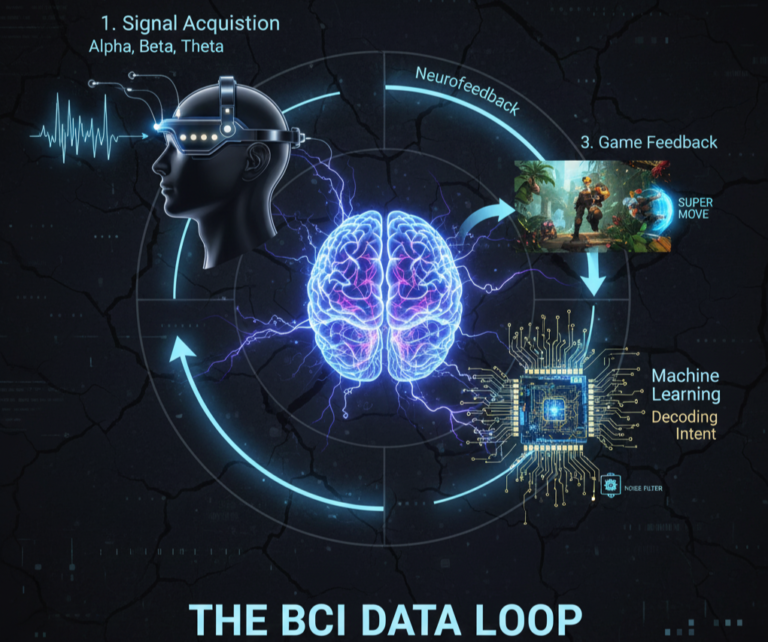
The BCI Data Loop: A 3-Step Cycle
For a startup founder, this loop is the most important concept to master. It happens hundreds of times per second to create a seamless experience.
Signal Acquisition (The Input) Sensors placed on your scalp pick up tiny electrical pulses produced by your neurons. These pulses form patterns known as Brainwaves:
-
Alpha Waves (8–12 Hz): These appear when you are relaxed and calm.
-
Beta Waves (12–30 Hz): These spike when you are alert, solving a puzzle, or intensely focused.
-
Theta Waves (4–8 Hz): These are linked to creativity, “flow states,” or deep relaxation.
AI Processing (The Translator) The raw data from your brain is “noisy”—it includes distractions like eye blinks or muscle twitches.
-
The AI’s Job: Startups use advanced Machine Learning algorithms to filter out the noise and “decode” your intent.
-
The Intent: The AI interprets the difference between you thinking about moving left and you actually moving left. This is where the most valuable “Intellectual Property” (IP) for a startup lives.
Game Feedback (The Action) Once the AI understands your intent, it sends a command to the game.
-
The Result: Your character jumps, a car turns, or—in “Affective Gaming”—the game environment changes.
-
Example: If the BCI detects your Beta waves (focus) are high, your character might unlock a “Super Move.” If it detects high Theta waves, the game music might become more soothing to keep you in a “Flow State.”
The Startup Opportunity: Data and Moats
For venture capital, the value of a neurogaming startup isn’t just in the game; it’s in the biometric data loop.
-
Accessibility: Startups like The Able Gaming Lab are opening a massive market for the 429 million gamers globally with disabilities.
-
The Software Layer: The next “Unicorn” won’t be a hardware maker, but the company that builds the universal BCI driver—the software that allows any headset to work with any game engine (Unity or Unreal).
The 2025 Shift: Neurogaming AI Goes “Agentic”
Recent 2025 industry reports highlight a critical pivot in “Neurogaming AI” from experimental laboratory demos to functional, real-world consumer technologies. We are seeing the rise of AI-driven gaming personalities—NPCs (Non-Player Characters) that don’t just follow a script but use BCI data to sense a player’s actual mood and react contextually.
Breakthroughs in thought-based controllers have finally reached the fidelity required for high-intensity games, moving beyond simple “on/off” commands to nuanced, multi-layered inputs. As we enter 2026, neurogaming is the Trojan horse bringing BCI into every household. The message for founders is clear: The most valuable real estate in the digital age isn’t the metaverse—it’s the human mind.